
الاستدامة والحوكمة
Lake Como Flood Risk: Designing for the Hazard
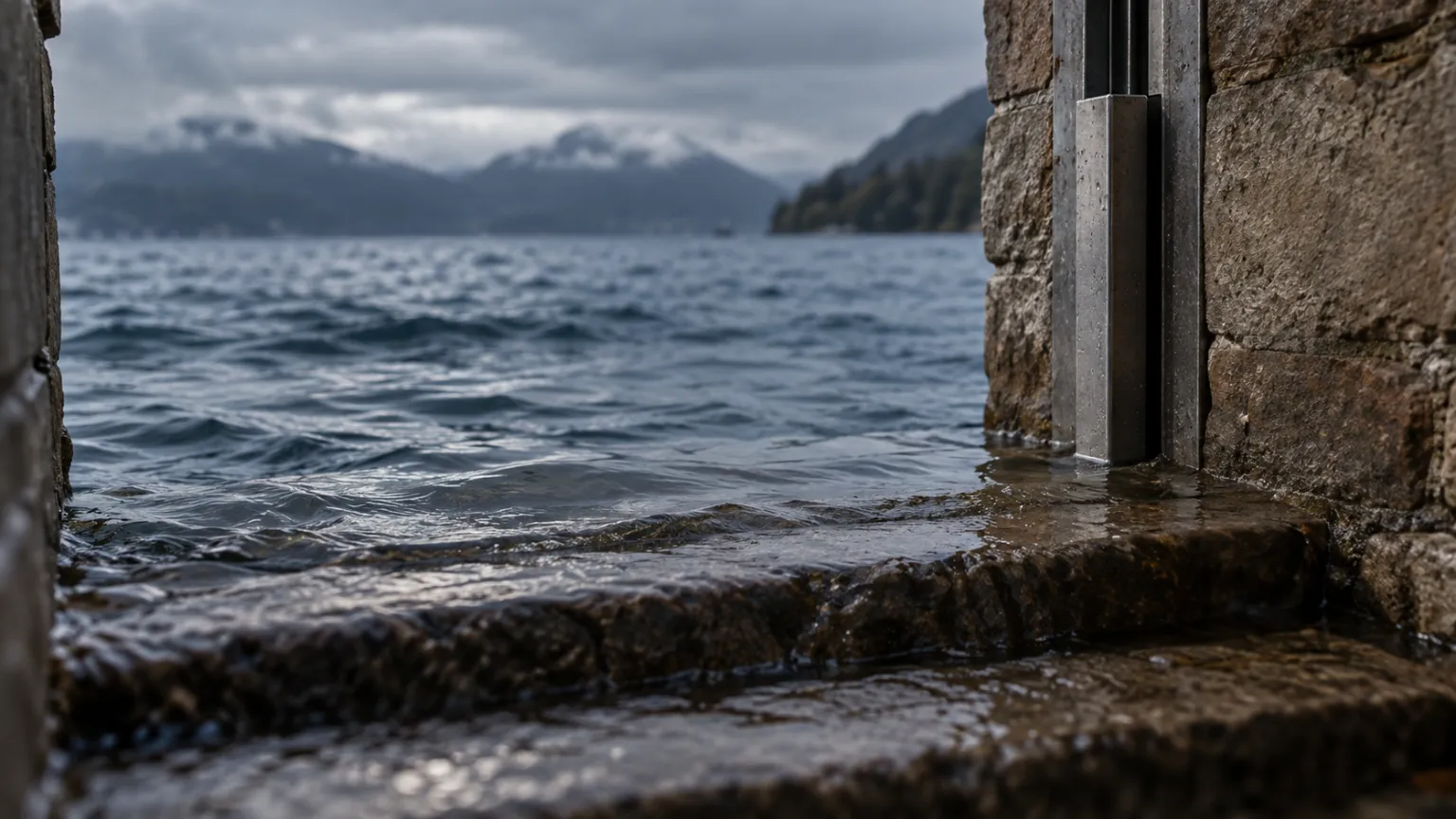
Lake Como floods its own shoreline, and the record is public. The lake reached 138.5 cm at the Malgrate gauge on 31 October 2023 against a 120 cm flood threshold at Como. This note argues that for a lakefront principal, the finished floor level, the drainage and the materials are the first underwriting step. Insurance is the second, and it prices what the design has already fixed.
 رسم توضيحي
أبرز النقاط
- - Lake Como flood risk is documented: 70% of floods in 1980 to 2020 followed clustered rainfall, and clustering drove the seven most severe (Communications Earth & Environment, 2022; measured).
- - The highest Malgrate level since the Olginate dam came into operation is 264 cm (1987 and 1993) above a hydrometric zero of 197.37 m; the Como flood threshold is reported at 120 cm (2010 Consiglio di Rumo study; ComoZero; measured, secondary).
- - On 31 October 2023 the lake reached 138.5 cm at 18:30, 18.5 cm over the threshold, after more than 114 cm at 07:00 (ComoZero; measured, press-reported).
- - Como's defence works are an 810 m line with two tanks of 10,000 m³ combined at €16,176,032, about €20,000 per metre by Victaura arithmetic (ARIA S.p.A.; measured, derived figure directional).
- - Barriers and pumps depend on staff and testing, as the October 2023 response and a June 2025 comment on untested pumps showed (ComoZero; La Provincia di Lecco; press-reported).
- - Cost evidence is American and dated: two-foot retrofit elevation was $17 to $47 per sq ft of footprint at 1998 averages, and new-build freeboard about 0.25 to 1.5% of construction cost per foot (FEMA P-312; FEMA freeboard fact sheet; directional).
- - In the US, Risk Rating 2.0 prices foundation type (1.30 basement to 1.00 other) and CRS discounts run 5% to 45%; no Italian equivalent was sourced (FEMA; measured for the US).
- - Italian companies must insure against natural catastrophes under Law 213/2023 and Decree 18/2025, from 31 March 2025 for large companies, 1 October 2025 for medium and 31 December 2025 for small and micro companies (BibLus; Assimpredil Ance; trade summaries).
في هذه الصفحة (11)
Can Lake Como flood a lakefront property, and how often?
Yes, Lake Como floods its own shoreline, and the hazard is documented in a peer-reviewed series rather than in anecdote. The lake drains through one regulated outlet at Olginate into the Adda. Its flood threshold at the city of Como is read against the Malgrate hydrometer. A study of the period 1980 to 2020 identified seven modes of lake flood and found that in 70% of cases the flood followed a temporal clustering of rainfall (Communications Earth & Environment, 2022). That is a measured finding. It does not give a return period for any single plot.
The first question for the principal is the plot's elevation against the lake, not the lake's headline level. Piazza Cavour in Como begins to flood at 120 cm above the hydrometric zero, as reported on 31 October 2023; the 2022 paper gives a current Como threshold of 1.10 m, so the two sources differ by 10 cm. A site on another shore of the inverted-Y lake sits at a different height relative to that gauge, and the gauge is the common language. Ask for the survey that ties the finished floor level to the Malgrate zero. If it does not exist, the design has no anchor and the insurer will not have one either.
This note argues that design comes first and cover second. Insurance prices a hazard after the building has fixed its own exposure. Design changes the exposure itself. The two compound, but only in that order. The companion piece on the insurance layer deals with cover, and the official price data for the lake says nothing about flood exposure. This one deals with the building.
What is a design flood level on Lake Como?
*A design flood level is the water elevation a building is engineered to stay above or to tolerate, and it is fixed before the drawings are finished. On a regulated lake it is the sum of a recorded peak, a margin for the next cluster of storms, and a margin for wind and wave setup. FEMA calls the margin freeboard*, a factor of safety expressed above the one-percent-annual-chance flood. Italian practice may use different vocabulary. The principal should ask the designer to state the figure in centimetres above the Malgrate zero.
The gauge reference matters because the lake level is a regulated variable with a fixed datum. The Malgrate hydrometric zero is set at 197.37 m above sea level, per a 2010 flood-level study for the Comune di Consiglio di Rumo based on Consorzio dell'Adda data. A design level in metres above sea level and a threshold in centimetres above the zero are the same information in two coordinates. On that datum the 120 cm threshold converts to 198.57 m and the 264 cm post-regulation maximum to 200.01 m. Those conversions are Victaura Research arithmetic, graded derived. Convert once, in writing, and keep both versions in the file.
The design level should be set against the record, not against the threshold. The highest level since the Olginate dam came into operation is +2.64 m, or 264 cm, recorded in 1987 and 1993 per the same 2010 study. The 2023 peak reached 138.5 cm, well below it. The 120 cm threshold describes where Piazza Cavour starts to flood, which is a municipal low point and not a rule for a private plot. Freeboard added to the 264 cm maximum is a defensible starting point. Whether it is sufficient is a question for a hydrologist, not for this note. Wind setup, boat wake and floating debris sit on top of the still-water level and the gauge does not capture them, so that margin is engineering judgement, graded directional.
How high did Lake Como get in the recent floods?
The best-documented recent peak is 138.5 cm on 31 October 2023. ComoZero logged a reading above 114 cm at 07:00, 128 cm at midday and 138.5 cm at 18:30, against the 120 cm threshold. That is a rise of about 24.5 cm in about eleven and a half hours, and a peak 18.5 cm over the threshold (the last figure is derived). The readings are press-reported from the official gauge, graded measured, secondary source.
A second episode reached 131.5 cm, and the outflow arithmetic explains why recovery is slow. La Provincia di Lecco reported 131.5 cm at Malgrate, an outflow at Olginate of 524.3 m³/s against an inflow near 440 m³/s, and an expected fall of about 5 cm a day. The surplus outflow is therefore about 84 m³/s. The same article cites a concession maximum of 130 cm and puts a 10 to 13 cm drawdown at two to three days. The article is dated 7 June 2025 and gives the 131.5 cm reading for the previous day.
September 2025 is documented in rainfall, not in lake levels. On 23 and 24 September 2025 an overnight cloudburst of more than 60 mm followed nearly 170 mm that had fallen in the preceding days (Como Lake Today). Press reports describe floodwaters in Como's historic centre on 22 September 2025 (GeoEngineer); a report of a second lake flood on 23 September could not be opened, so we do not rely on it. We could not retrieve an official Malgrate reading for those days. One aggregator text carried a figure of 162 cm that we could not trace to the gauge, and we did not use it. Days of heavy rain followed by a new cloudburst is the clustering pattern the 2022 paper describes, and it means the building can face a repeat wetting before the lake has drawn down.
Insurance prices the hazard after the building has fixed its exposure. Design is the only step that changes the exposure itself.
Victaura Research
Why does Lake Como flood in clusters, and what does that mean for a building?
Lake Como floods when storms stack, and the stacking is the design problem. The 2022 study in Communications Earth & Environment analysed floods between 1980 and 2020. In 70% of cases the flood was preceded by clustered rainfall, and clustering was the predominant trigger of the seven most severe floods. The authors describe cases where, after a flood, the level had no time to fall before new rain triggered a second one. This is a peer-reviewed result and is graded measured.
A second, smaller mode is a single storm on a lake already raised. The same study found that isolated rainfall events caused floods mainly in spring, when the water had already been lifted by earlier rain or by melting. The principal should read this as a seasonal warning. A building that is dry in autumn can be wet in April with a smaller storm, because the starting level is higher.
Clustering changes what the building must tolerate. A structure designed for one clean event can fail at the second. Materials that cannot dry between events, services placed low, and finishes that trap moisture turn a two-day flood into a months-long repair. Design for repeated wetting inside a short window, and do not assume a recovery period.
What did Como's flood barriers teach about hardware?
Como built a system, and the system has numbers. ARIA S.p.A., the contracting authority, describes mobile barriers along an 810 m defence line from the Sant'Agostino pier to the western gardens, and two lamination tanks with a combined capacity of 10,000 m³. The project covers 8,000 m² and carries a cost of €16,176,032. The contract was signed on 13 May 2020. These are published project figures, graded measured.
Dividing cost by length gives a scale, not a price. €16,176,032 over 810 m is about €20,000 per linear metre. The figure includes the tanks and the promenade works, so it overstates the cost of a barrier alone. It is Victaura Research arithmetic, graded directional. Its use is to show that municipal-scale defence is expensive per metre, which is the reason a private plot is better served by passive design than by bought-in hardware.
On 31 October 2023 the hardware needed people and pumps. The lakeside road was closed to traffic around 9 AM. Once the lake passed 120 cm, reaching 128 cm by midday, maxi pumps were deployed in Piazza Cavour. The combination of the blue barriers and maxi pumps cleared one traffic lane by 4:31 PM, and the lakeside boulevard was closed again at 7:15 PM. During a later high-water episode, La Provincia di Lecco on 7 June 2025 quoted the Adda consortium president saying the Como defence worked only partially because the pumps lacked technical testing.
The lesson for a private owner is the difference between passive and active protection. A raised floor, a closed wall and a sealed penetration work at 3 AM with nobody present. A barrier that must be installed, a pump that must be tested and a valve that must be turned depend on a person and a power supply during the storm. On 24 October 2023 Il Giorno reported that Como was preparing for the flood with temporary barriers, not with the permanent defences that had already cost €35 million, a reminder that cost and function are different columns. That figure differs from ARIA's €16,176,032 project amount, and we did not reconcile the two.
What does it cost to build above the hazard instead of insuring it?
We found no published Lake Como cost series for flood-resilient construction, and the note will not invent one. The only transparent cost structure we could source comes from FEMA in the United States. It shows the shape of the trade-off. It does not give euro magnitudes for Italy, and the principal should treat every number below as a structural illustration.
Retrofit elevation is expensive and the price depends on the foundation. FEMA's Homeowner's Guide to Retrofitting puts a two-foot elevation at $17 per square foot of footprint for a frame house on a basement or crawlspace and $47 for one on slab-on-grade, with masonry houses at $35 to $47. Each extra foot up to eight feet adds $0.75 per square foot. FEMA states that these costs are based on 1998 national averages, so they are dated and graded directional.
The same height is cheap when it is drawn in from the start. A FEMA fact sheet on freeboard, hosted by Carteret County (NC), puts the up-front cost at about 0.25 to 1.5 percent of total construction cost for each foot of freeboard in new construction. This is a US agency estimate, not a Lake Como figure. The ratio is the point. Height bought at the drawing stage costs a fraction of height bought by lifting a finished house.
Public benefit ratios exist, and they are not a private return. The National Institute of Building Sciences reported in 2019 that federal mitigation grants save about $6 per $1 invested across hazards. That is a United States public-sector ratio. We cite it for the direction of the evidence and make no claim about any project's economics.
| Lever | What it addresses | Cost evidence found | Grade |
|---|---|---|---|
| Finished floor above the 264 cm post-regulation maximum plus freeboard | Still-water flooding of habitable space | US new-build freeboard about 0.25 to 1.5% of construction cost per foot; retrofit elevation $17 to $47 per sq ft of footprint for two feet (1998 USD) | US agency estimate; dated; not Italian |
| Services, plant and electrics above design level | Repair duration after repeat wetting | No sourced figure | Judgement; no cost data |
| Flood-resistant materials below design level | Drying between clustered events | FEMA wet floodproofing guidance; no euro figure | Directional |
| Drainage with non-return protection or pumping | Local runoff meeting a high lake | Municipal scale: about €20,000 per metre of Como defence line, including tanks | Derived; overstates a private plot |
| Mobile barriers and pumps | Temporary water exclusion | Como: €16,176,032 for 810 m plus tanks; function needs staff and tested pumps | Measured, project figure |
A premium is a price on the drawing. Change the drawing and the price changes before the first claim.
Victaura Research
Is flood cover mandatory for companies owning property on Lake Como?
Italian companies must insure against natural catastrophes, including floods, on a timetable that began on 31 March 2025. Law No. 213 of 30 December 2023 and Ministerial Decree No. 18 of 30 January 2025 require companies with a legal entity or a permanent establishment in Italy, excluding the agricultural sector, to insure land, buildings, plant, machinery and equipment against events such as earthquakes, floods, landslides and inundations (BibLus, ACCA; Norton Rose Fulbright). Decree-Law 39/2025, converted by Law 78/2025, kept 31 March 2025 for large companies with a 90-day transition to 30 June 2025, and set 1 October 2025 for medium companies and 31 December 2025 for small and micro companies (Assimpredil Ance, June 2025).
The obligation runs both ways. Insurers operating in the Italian market must offer the cover, and businesses must buy it. Norton Rose Fulbright describes the regime as ambitious and ambiguous. The sanction for non-compliance is exclusion from public contributions, subsidies and financial facilities, including those that follow a catastrophe. The sources describe an obligation on companies and do not extend it to private individuals. How a holding vehicle for a lakefront property is classed is a question for the principal's Italian counsel.
Mandatory offer makes the design file valuable. An insurer that must offer cover will ask for elevation, foundation and drainage data to price it. A principal who holds a surveyed floor level tied to the Malgrate zero and a drainage design arrives with the evidence. A principal who does not arrives with a blank page. That is our reading of the incentive and is graded directional.
We found no published guidance on how Italian insurers credit design measures. The decree sets who must insure and what must be covered. It does not tell the principal that a raised floor will lower the price. Do not assume a credit. Ask for it in writing, and treat any figure offered without a stated basis as broker-reported until the policy schedule confirms it.
Which materials, drainage and shoreline works matter on a Lake Como plot?
The elevation of habitable space is the first lever, and everything else supports it. Place the finished floor above the design flood level. Keep bedrooms, kitchens and plant above it. Use the area below it for uses that tolerate water, such as a boathouse, a garage or storage. This is engineering judgement from the principle of freeboard, graded directional. The hydrologist's figure sets the number.
Below the design level, materials must survive and dry. FEMA's retrofitting guidance treats wet floodproofing as letting water enter and leave enclosed areas below the flood level while the structure and finishes withstand it. Masonry, stone and ceramic tolerate wetting better than gypsum board, wood-fibre insulation and chipboard; that ranking is engineering judgement, graded directional. With clustered floods the drying window is short, so the choice of finish is a cost decision.
Drainage is the quiet failure point. The 2022 study ties floods to heavy rain, so local runoff from the slope arrives while the lake is already high. An outfall that discharges to the lake loses its gradient exactly then. The design should show non-return protection on outfalls and a pumped path with a power source above the design level. Ask where the water goes when the lake is at 264 cm and it is raining. That single question exposes weak drainage designs.
Shoreline works bring their own approvals. Quay walls, revetments and landing stages on a public lake normally need authorisation, and they can move water onto a neighbour. We did not source the Italian permitting rules for this note, so we do not state them. The principal should treat any shoreline work as a regulated act, confirm the competent authority through counsel, and read the EU framework in the Floods Directive 2007/60/EC, which requires flood hazard and risk maps and risk management plans from Member States.
What does the evidence on Lake Como flood design not show?
This section is the honestly disclosed weak points, and there are many. We did not retrieve an official Malgrate series for September 2025, and we did not use an untraced 162 cm figure. The 264 cm maximum comes from a 2010 municipal planning study of Consorzio dell'Adda data, and the 120 cm threshold from press reports; neither comes from the regulator's own document, and the 2022 paper gives a current threshold of 1.10 m.
The cost evidence is American and old. The FEMA retrofit figures are 1998 national averages in dollars. The freeboard cost share and premium example come from a FEMA fact sheet on the legacy NFIP rating. The Risk Rating 2.0 factors are a current US methodology. None of these is an Italian price. They show structure, and they do not give a euro budget for Lake Como.
The premium effect for a Lake Como plot is unquantified. We found no Italian rate table, no insurer statement and no decree text that links design measures to price. The mandatory regime is documented through law-firm and trade summaries and not through the decree itself. The claim that design lowers the premium rests on mechanism and on the US evidence, and is graded directional.
The hazard study stops at 2020 and does not forecast. It analyses 1981 to 2020, mentions much earlier events such as an earthquake-triggered flood reported in 1255, and does not project future frequency. We have not surveyed any specific plot, so nothing here is a site assessment. The note is written by an organisation with positions on Lake Como, as the disclosure below states, and the reader should weigh it accordingly.
What should an allocator ask of a Lake Como lakefront design?
Ask for the survey first. Request the finished floor level in metres above sea level and in centimetres above the Malgrate zero, with the survey date and the surveyor. Compare it with 120 cm, 138.5 cm and 264 cm, which convert to 198.57 m, 198.755 m and 200.01 m on the 197.37 m datum. If the habitable floor is below 200.01 m, ask what protects it and who operates the protection.
Ask whether the protection is passive or active. A raised floor and a sealed envelope protect without a person. Barriers, pumps and valves protect only if someone is present and the equipment has been tested. Como's own experience in October 2023 and the pump testing gap the Adda consortium president described in June 2025 are the reference case. The principal may read Victaura's public Nesso lakefront project page and apply the same questions to it. This note makes no statement about that site's exposure.
Ask for two quotations. One quotation should be for the building as designed, with the elevation data attached. The other should be for the same building as if the data were absent. The gap is the market's price of the design. If there is no gap, the design is either not credited or not communicated, and the principal should find out which before spending on hardware.
Skin in the game disclosure. Victaura, through its parent Greystone B.V. (Netherlands), develops projects on Lake Como (Italy), in Nungwi, Zanzibar (Tanzania), on Gili Air and in Uluwatu, Bali (Indonesia), and holds an off-plan capital position on Al Marjan Island, Ras Al Khaimah (UAE). Readers should assume commentary may be influenced by, or benefit, these positions. This document is classified as marketing material under MiFID II Article 24(3). It is not investment advice.
المصادر
- Communications Earth & Environment, Compound flood hazard at Lake Como, Italy, is driven by temporal clustering of rainfall events, 2022
- ARIA S.p.A., Opere di difesa dalle esondazioni del Lago di Como
- ComoZero, Lago di Como esondato, chiude di nuovo il lungolago, 31 ottobre 2023
- La Provincia di Lecco, Lago di Como ai massimi storici: allagamenti e paratie inefficaci
- Como Lake Today, Key Questions about Flooding in Lake Como, 2025
- GeoEngineer, Floods and Landslides Sweep Across Northern Italy, 22 September 2025
- Comune di Consiglio di Rumo, Determinazione dei livelli di piena del Lago di Como (C. Anselmini), October 2010
- Il Giorno, Como si prepara all'esondazione del lago con le paratie
- FEMA, Homeowner's Guide to Retrofitting, Chapter 3: An Overview of the Retrofitting Methods (1998 costs)
- FEMA, Risk Rating 2.0 Methodology and Data Appendix, 2022
- FEMA, National Flood Insurance Program Community Rating System: Local Guide, 2018
- FEMA, Building Higher in Flood Zones: Freeboard (fact sheet hosted by Carteret County, NC)
- National Institute of Building Sciences, Federal Grants Provide a $6 Benefit for Each $1 Invested
- FEMA, Technical Bulletin 3: Requirements for the Design and Certification of Dry Floodproofed Buildings, 2021
- BibLus (ACCA), Polizza catastrofale: per chi e' obbligatoria e quali beni copre
- Assimpredil Ance, Obbligo polizze catastrofali: le novita' del Decreto legge n. 39/2025, June 2025
- Norton Rose Fulbright, Between ambition and ambiguity: Italy's new mandatory NatCat insurance
- European Union, Directive 2007/60/EC on the assessment and management of flood risks
المعلومات الواردة في هذا الموقع لأغراض إعلامية فقط ولا تشكّل عرضاً أو دعوةً للاستثمار أو استشارةً مالية. العوائد المذكورة تقديرية وغير مضمونة؛ والأداء السابق لا يضمن النتائج المستقبلية. ورأس المال المستثمر معرّض للمخاطر.
هل تفكّرون في تخصيص جزء من محفظتكم للعقارات الفاخرة في المواقع التي نعمل فيها؟ تحدّثوا إلينا عن مشاريعنا الحالية والمقبلة.
تواصلوا مع Victaura →رؤى ذات صلة
رؤى السوق
Lake Como Prices: What the Official Data Shows
Lake Como OMI quotations from the Agenzia delle Entrate cover seven shore comuni at 670 to 3,060 euro per square metre for apartments (directional), while Knight Frank prices four- or five-bedroom villas at US$14 million to US$18 million (broker-reported). The two sources describe different objects. This note shows why the official band stops short of the lakefront villa, and what would join the two.
 ملف بحثي
رؤى السوق
عقارات بحيرة كومو الفاخرة 2026: ندرة مزدوجة و+6.5% PIRI
يُقرأ العقار الفاخر في إيطاليا عادةً بوصفه فئة أصول واحدة تسير في دورة متزامنة. وقد سجّل مؤشر PIRI 100 الصادر عن Knight Frank لبحيرة كومو نسبة +6.5% في 2025 وبترتيب 19، مقابل +0.4% لميلانو و-4.7% للندن، وبحسب قراءة Victaura Research فقد خرجت كومو من تلك الدورة. ثلاثة قيود مُلزِمة (قانون المناظر الطبيعية D.Lgs. 42/2004، ونمط من عدم البيع عبر الأجيال داخل العائلات وهو افتراض من Victaura Research، والمادة 24-bis بمبلغ 300 ألف يورو للمقيمين الجدد اعتباراً من 2026) تجعل العرض غير مرن بحكم القانون لا معدوماً، وتُبقي معدل التداول منخفضاً، وتنتقي مشترين يتمتعون بحرية التنقل دولياً على أفق مدته 15 عاماً. وتقرأ الدراسة هذه النتيجة بوصفها ريعاً متراكماً على ما لا يمكن تعويضه، لا عقاراً فاخراً دورياً، وتقترح Mayfair Grosvenor وPark Avenue prewar وSt Moritz Suvretta وCologny سلةً للمقارنة بدلاً من Forte dei Marmi أو Cap Ferrat.

منهجية القيمة المضافة
تقويم التراخيص في بحيرة كومو: يومًا بيوم
الملف الزمني الموثّق لتصاريح البناء هو أرخص دليل على القدرة على التنفيذ، ولا يكاد أحد ينشر مثله. تعيد هذه الورقة بناء الجدول الزمني لبحيرة كومو انطلاقًا من النصوص القانونية. فهي تسمّي كل جهة، واليوم الذي يبدأ فيه سريان مهلتها، والأيام التي يمنحها لها القانون، والأحداث التي توقف احتساب المهلة، ثم تقابل الحساب النظري بما يفيد به الممارسون. والفجوة بين الاثنين هي المعطى الحاسم في التقييم الاستثماري.