
الوجهات
Nungwi: Why the North Coast
Nungwi, at the northern tip of Zanzibar's Unguja island, is chosen for land because the sea stays usable there when it retreats from other beaches. This note tests that claim for the principal. It reads the tide, the 30 m buffer rule, the anchor capital already present and the erosion record, and it grades every number it uses.
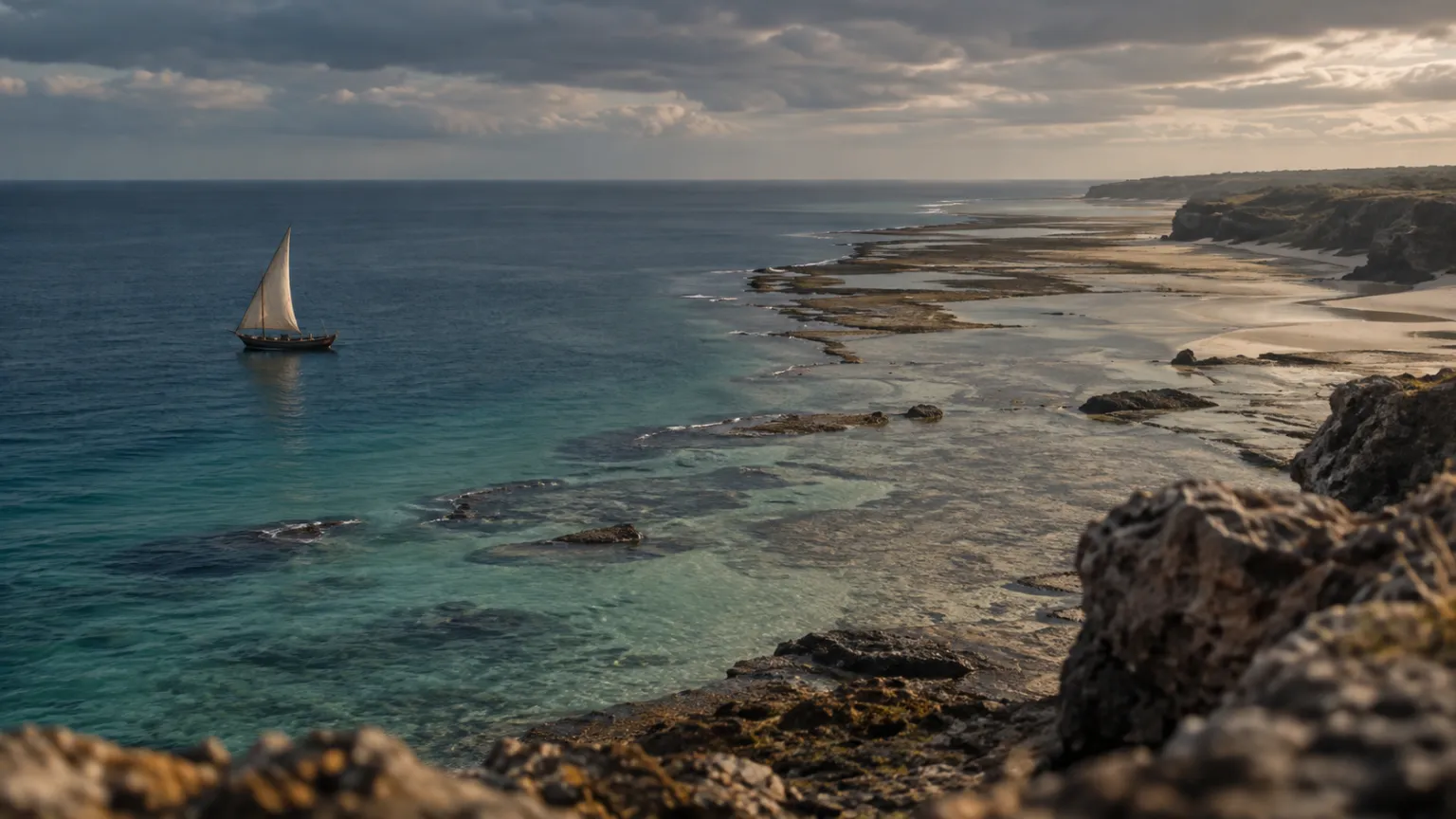 رسم توضيحي
أبرز النقاط
- - Nungwi, at the northern tip of Unguja, is chosen for land because an operator guide reports comparatively tide-flexible swimming there, a directional claim with no survey behind it (Jayne Vy Tours, operator guide).
- - The tide at Nungwi is large, with a predicted 3.68 m range on 10 and 11 October 2026 (TidesAtlas, read 6 October 2026, datum not stated), so the shore profile and not a weak tide carries the result.
- - East-coast reef-flat beaches are described as losing the sea by hundreds of metres at low tide (Jayne Vy Tours, operator guide, directional), which is the contrast the north coast is chosen against.
- - Zanzibar recorded 917,167 international arrivals in 2025 against 736,755 in 2024, about +24.5% (OCGS and ZCT Tourism Statistical Release December 2025, via The Citizen, 18 January 2026), measured at island level only.
- - A 30 m beach buffer is reported for Zanzibar (News24, 23 October 2006, press-reported), and a 100 m deep plot loses 30% of its depth to it, an illustrative calculation and not a real lot.
- - The Zanzibar Commission for Tourism inspected Kendwa and Nungwi in October 2023 and said no activity is allowed in the coastal buffer zone (The Citizen, 22 October 2023).
- - A 2014 field study reported significant erosion at both Nungwi and Paje (Pitman, SIT Study Abroad 2014, directional), and no verified erosion rate in metres per year exists in this note.
- - Branded capital is announced on the northern coast, with 181 keys targeted for 2027 (Minor Hotels, 2024, operator-announced, schedule not re-verified as of 6 October 2026).
في هذه الصفحة (11)
Why Nungwi? The question a land buyer asks first
Nungwi, at the northern tip of Unguja island in Zanzibar (Tanzania), is chosen for land because its water stays usable when the sea retreats from other beaches. That is the whole thesis. The rest of this note tests it. The principal asks four questions of any coastal plot. Can guests swim in every season. How far does the sea move. Who has already committed capital next door. What is left to build once the rules are applied.
Two terms carry the analysis. Tidal range is the vertical difference between high and low water, and on a shallow reef flat it converts into horizontal distance. A metre of vertical change can empty hundreds of metres of lagoon. The coastal buffer zone is the strip behind the high-water line where, according to the Zanzibar Commission for Tourism, no business or activity is allowed. Both terms decide what a plot is worth to an operator, and both can be measured.
This note is a satellite of the destination page, and it does not replace it. It explains the site logic only. It does not quote prices, yields or returns for any Victaura asset, and it does not rank Nungwi against other coasts on a single score. The public description of the site sits on Victaura's Nungwi project page. Where a number appears here, it carries its grade, measured, industry estimate, broker-reported or directional. A figure known only from a press report is directional, and the text labels it press-reported. Where no verifiable source exists, the number is absent.
The sources are public and dated. Arrivals come from the Office of the Chief Government Statistician, as reported in January 2026. Tide predictions come from a public tide table read on 6 October 2026. The buffer rule comes from a 2006 press report and a 2023 regulator statement. None of them is a planning permit for a specific plot, and none replaces a survey.
Can a beach on Zanzibar's north coast be swum at every tide?
On the north-western tip of Zanzibar, around Nungwi and Kendwa, swimming is reported to be less disrupted by the tide than on the east coast. One operator guide calls Nungwi's swimming 'comparatively tide-flexible' and Kendwa the beach with the 'least tide-disrupted swimming', and it describes the broad reef-flat beaches of the east and south-east as the opposite case. Those are descriptive claims from tour operators, and the grade is directional. No official bathymetric survey was found that quantifies them.
The mechanism looks like the shape of the shore, and not a weaker tide. Tides at Zanzibar are semidiurnal, with two high waters and two low waters in each tidal day, according to a University of Cape Town thesis on Zanzibar sea level (Ngwali, 2007). The same water moves everywhere around the island. What differs is the width of the shallow reef flat that the falling water exposes. Along much of the east coast that flat is wide, so the sea walks out. Operator descriptions of Nungwi point to deeper water closer to the sand. The principal should treat that mechanism as a working hypothesis until a survey confirms it.
The principal should not read 'every tide' as 'every metre of the beach'. Even on the north coast, the operator guide speaks of comparatively tide-flexible swimming, not of swimming unaffected by the tide, and it gives no depth for any frontage. A beach that swims at reduced depth is a different product from a lagoon at high water. Swimmable water at the frontage of one plot is a site-level fact, and it needs a measured transect at spring low water.
Seasonality matters on top of the tide. The Cape Town thesis notes that the tidal range may vary with the season of the year, and that the month contains two springs and two neaps with different ranges. A plot assessed in one month has been assessed in one month. The allocator should ask for observations across more than one season, and at both spring and neap low water, before treating the claim as underwritten.
A beach that still swims at a 3.7 m spring range is carried by its slope, and slope can be surveyed.
Victaura Research
How big is the tide at Nungwi, in metres?
The tide at Nungwi is large in vertical terms, and the sources that call it minimal are describing the beach, not the water column. A public tide table read on 6 October 2026 predicts high waters of 2.96 m and 3.36 m and low waters of 1.82 m and 1.51 m for that day, a maximum swing of 1.85 m. For 10 and 11 October 2026 the same table predicts a high of 4.36 m and a low of 0.68 m, a swing of 3.68 m.
The grade on these numbers is directional. They are predictions from a commercial tide-table site, not gauge readings, and the page does not state its datum. Differences between predicted levels are usable. Absolute heights are not. A principal who needs a design water level for a jetty, a pool deck or a drainage outfall needs the official Tanzanian datum and a local gauge record, and should not design from a website.
The physics is not in dispute. A hydrodynamic model of the Zanzibar Channel, published in the Journal of Geophysical Research Oceans, finds that tidal dynamics hold 92% of the total kinetic energy in the channel, against 5% for remotely forced flow and 3% for wind-forced flow. Tide is the dominant driver of water movement on this coast. A site that stays attractive despite a 3.68 m spring swing is attractive because of its shore profile.
This is why the claim is worth testing and not worth repeating. If the water column moves by almost four metres and the beach still swims, then the slope of the foreshore carries the result. Slope is surveyable. A transect taken at spring low and at neap low, by the principal's own surveyor, converts a travel-guide sentence into an underwriting input. Until then the claim stays at directional.
What does a retreating tide do to a beachfront plot on Zanzibar's east coast?
On the reef-flat beaches of Zanzibar's east coast, an operator guide describes the sea retreating by hundreds of metres at low tide, with an exposed zone that at some intertidal locations can extend toward 3 kilometres. The same guide cites representative spring tidal ranges of roughly 3.2 metres and neap ranges around 0.9 metres, and notes that high and low water shift later from one day to the next, by about fifty minutes. These are tour-operator descriptions, graded directional, and they match the physics in the previous section.
For an operator the retreat is a loss of guest-hours. A guest who cannot swim for several hours a day looks for a pool, a boat transfer or a different activity. Each substitute carries a cost. A pool is capital. A boat transfer to deep water is a recurring operating line. Neither appears in a brochure, and both appear in an underwriting model.
The reverse also holds, and it should be stated with restraint. The east coast has its own draw, with wide flats, wind sports and a different guest profile. This note does not rank coasts. It asks a narrower question, which is whether the water reaches the frontage during the hours when a guest expects it. For Nungwi the sources say yes more often than they do for the east. For the east they describe the sea retreating hundreds of metres at low tide.
Demand data cannot settle the point. Zanzibar recorded 917,167 international arrivals in 2025, but the release counts the island and not the beach. No public series was found that splits arrivals or guest-nights by coast. The tide argument is therefore an operating argument about a product, and the principal should not read it as proof of higher demand at any one address. It is one input into how many hours of the day a frontage earns.
Which anchor hotels have settled on Zanzibar's north coast near Nungwi?
Anchor capital is already visible on the north coast, and the clearest public example is the Anantara Zanzibar Resort. Minor Hotels announced the signing of a 181-key resort on the northern coast of Zanzibar Island, owned by the Dubai-based Infinity Group, with a target opening in 2027. The announced mix is 37 suites, one presidential villa, 73 sea-view pool villas and 70 apartments and penthouses, plus six food and beverage outlets.
This is an operator-announced pipeline, and it carries that grade. As of 6 October 2026, this note has not re-verified construction progress or the 2027 date against a primary source. The resort is developed by a third party and has no connection to any Victaura project. It appears here only as evidence of where branded capital has chosen to go.
Older evidence points the same direction, with an age caveat. A secondary reference reports that hotel capacity at Nungwi rose by 129% between 2008 and 2013, to roughly 1,000 rooms, and that the beach was named in a CNN list of the world's best beaches in 2014. Both facts are more than a decade old, were compiled from guidebooks and press, and are graded directional. They show when the village turned from dhow-building and fishing toward hospitality. They do not show how much supply exists now.
An anchor is a signal and a risk at the same time. A branded resort draws infrastructure, staff, flights and guest attention toward its stretch of coast. It also adds supply, competes for the same beach frontage and sets a service benchmark that independent product must meet. The allocator should read an announcement as information about land scarcity and about competition.
The principal can test an anchor with three requests. Ask for the current licence, ask for the stated construction stage, and ask for the room count actually registered with the Zanzibar Commission for Tourism. An announcement that survives those three requests is a fact. One that does not is a press release.
What is the 30-metre rule on Zanzibar, and what does it leave buildable?
Zanzibar's reported rule bars construction within 30 metres of beaches. A 2006 press report quotes officials saying that regulations bar construction within 30 metres of beaches, and that the rule was routinely ignored and needed enforcing. The figure is press-reported and twenty years old. This note did not read it from the statute text, so the principal's counsel should confirm the current figure and the line it is measured from.
Enforcement has moved from rhetoric to closures on the beaches around Nungwi. In October 2023 the Zanzibar Commission for Tourism inspected Kendwa and Nungwi and closed businesses that did not meet its standards. Its director for the management of tourism activities was quoted saying that no business or activity is allowed in the coastal buffer zone. Zanzibar's Environmental Management Act of 2015 replaced the earlier framework law and is the island's current framework environmental statute.
The arithmetic of the buffer is simple and unforgiving. Take an illustrative plot with 100 m of depth from the high-water line to the rear boundary. A 30 m buffer removes 30% of its depth. A plot 60 m deep loses half. These figures are arithmetic and not data about any real lot. They show why the depth of a frontage lot matters as much as its width, and why a long thin lot behaves differently from a square one under the same rule.
The reference line is the hard part. If the high-water line is the reference, then a spring range near four metres moves it horizontally by a distance that depends on the slope. On a gentle foreshore that difference can be many metres. The only safe reading is a line fixed by the competent authority on a dated survey and plotted on the title drawing. For the wider method, see the setback line and the buildable envelope.
If a 30 m buffer holds, it takes the same depth off every beachfront plot, so depth matters as much as width.
Victaura Research
Is the shoreline at Nungwi stable enough for beachfront lots?
A 2014 field study found significant erosion at Nungwi and at Paje, and it is the most direct public evidence this note found. The study was an independent project in the SIT Study Abroad programme and combined beach transects, sediment grain-size analysis and community interviews. It concluded that both beaches were undergoing significant erosion from natural and anthropogenic forces. It is a student study, now twelve years old, and it is graded directional.
No erosion rate in metres per year was verified for this note. Searches surfaced other work on shoreline change in Tanzania and Kenya and on coastal resources at Nungwi, but the quantified figures could not be read and confirmed. The principal should therefore treat the direction of change as reported and the speed of change as unknown.
Coastal protection can move the problem and not remove it. Documentation from Zanzibar shows erosion downdrift of a seawall, which is a general property of hard structures on a drifting shoreline. A hotel that armours its frontage may protect itself and expose its neighbour. A lot that sits downdrift of an armoured neighbour inherits the effect.
Scarcity and risk sit on the same piece of sand. Beachfront lots are scarce because the buffer rule removes land near the water and because the frontage already built is hard to replace. The same position is the one exposed to shoreline change. The allocator should ask for a shoreline history, a coastal engineer's view of sediment drift and the status of any protection works along the adjacent frontage before pricing the lot's scarcity. For the cost side of building on exposed frontage, see what it costs to build on an island.
How much demand sits behind Nungwi, and what does the data not show?
Zanzibar recorded 917,167 international arrivals in 2025, against 736,755 in 2024, a rise of about 24.5%. The totals come from the Tourism Statistical Release for December 2025 of the Office of the Chief Government Statistician and the Zanzibar Commission for Tourism, as reported by The Citizen on 18 January 2026. The percentage is Victaura Research arithmetic on those two published totals. The grade is measured, at island level.
The data stops at the island. The coverage read for this note gives no split by district, village or coast, so it cannot say what share of 2025 arrivals slept in Nungwi. Arrivals are also not room-nights. A guest who stays three nights counts once, and so does one who stays three weeks. Supply, occupancy and average length of stay are the numbers that convert arrivals into revenue, and none of them was verified at village level.
Local population and infrastructure give scale and do not give demand. Kaskazini A district, in the north of Unguja, had 157,369 residents at the 2022 census, as compiled from National Bureau of Statistics data. A secondary reference puts Nungwi itself at 30,762 and calls it the second largest settlement on the island. The labour pool matters for an operator. It does not tell the principal how many guests want a given plot.
Arrivals growth of this size also raises a question about capacity. A rise of about 24.5% in one year is a measured fact. Whether airport throughput, road access to the north, water and power supply and licensed bed supply grew at the same pace is not shown here. A demand tailwind that outruns infrastructure can show up as guest friction before it shows up in revenue. The allocator should ask for the transfer time from the airport to the plot and for the power and water arrangements on site.
How does Nungwi compare with the east coast on the evidence found?
The comparison below uses only evidence that this note could trace, and it leaves a cell marked where the trace failed. The north column draws on a public tide table, a field study, a regulator statement and an operator announcement. The east column draws on tour-operator descriptions and the same field study at Paje. Where the table says 'not collected', the data was not found, and the principal should not read an absence as a zero.
The table is a screen and not a ranking. A row that favours the north coast on swimming does not offset a row that shows erosion at both beaches. The principal weighs the rows according to the product intended. A hotel that sells sea time carries different exposures from a residence that sells privacy, and the same row can be a strength for one and a cost for the other.
One row matters more than the rest for a land buyer, and it is the buffer. The rule applies island-wide according to the sources found, so it does not separate north from east. It does separate lots of different depth within the same coast. The comparison between two plots on the same stretch is often more informative than the comparison between two coasts.
Nungwi's disadvantages are the mirror of its advantage. A beach that is usable is a beach that is used. Nungwi's main beach is described in secondary sources as the most visited tourist beach on the island, a claim graded directional. Crowding, beach vendors and boat traffic are the cost of the same swimmability that draws the guest. The position of a plot relative to the busiest frontage is both a price variable and a product variable.
| Criterion | Nungwi (north-west tip) | East coast reef-flat beaches | Grade |
|---|---|---|---|
| Swimming at low water | Reported comparatively tide-flexible for swimming | Reported sea retreat of hundreds of metres at low tide | Directional, operator descriptions |
| Tidal range, 10 and 11 October 2026 | 3.68 m predicted (high 4.36 m, low 0.68 m) | Not collected for this note | Directional, prediction, datum not stated |
| Shoreline erosion | Significant erosion reported at Nungwi beach in 2014 | Significant erosion reported at Paje beach in 2014 | Directional, single field study |
| Buffer rule | 30 m reported; Kendwa and Nungwi inspected October 2023 | Same island-wide rule reported | Press-reported |
| Branded anchor capital | Anantara Zanzibar Resort, 181 keys announced for 2027, northern coast | Not surveyed for this note | Operator-announced |
What does the Nungwi thesis not prove? Weaknesses honestly disclosed
The central claim rests on operator descriptions and not on a survey. Every statement that Nungwi swims with little disruption from the tide comes from tour operators and travel guides. None cites a bathymetric survey. Directional is the correct grade, and the principal should price it as such.
The tide at Nungwi is not small. A predicted range of 3.68 m on 10 and 11 October 2026 argues against any story of a calm, tideless coast. The honest version is that the shore profile carries the result, and that the profile needs measurement at the plot.
Demand is island-wide, and supply at village level is unverified. The 24.5% arrivals rise is measured, but it says nothing about Nungwi in particular. The hotel-capacity figure for Nungwi is for 2008 to 2013 and is stale. No current registered room count was found.
The regulatory facts are press-reported. The 30 m figure comes from a 2006 article and the enforcement statement from a 2023 article. On tenure, one investment guide states that under the Land Tenure Act of 1992 all land in Zanzibar is public land, that no foreigner can be granted a Right of Occupancy, and that a foreign investor holds land under a registered lease of up to 99 years after obtaining an investment certificate from the Zanzibar Investment Promotion Authority. That is a secondary summary and was not verified against the statute. Counsel should read the primary text.
The anchor pipeline is announced, not delivered. The Anantara Zanzibar Resort opening is a 2027 target, announced in March 2024. Slippage is common in resort pipelines everywhere, and this note found no evidence either way for this one.
Nothing here forecasts a return. This note makes no claim about price, income or yield for any asset on the north coast, and none should be inferred from it. It describes why a site is chosen, and it does not describe what the site will earn.
An anchor is information about scarcity and about competition, and the allocator reads both.
Victaura Research
What should the principal verify before committing capital at Nungwi?
Start with the title and the line. Confirm the form of land right in Zanzibar, which one investment guide describes for a foreign investor as a registered lease of up to 99 years, subject to an investment certificate, and have counsel read the lease, its term and its conditions. Confirm the current buffer distance and the reference line in writing, on a dated survey plan.
Then measure the water. Commission a foreshore transect at spring low and neap low water, across more than one season, and record swimmable depth at the frontage. Obtain the official datum and a gauge record before setting any level for structures.
Then read the neighbours. Check the licence and construction stage of any announced anchor, the state of coastal protection on the adjacent frontage and the shoreline history of the cell. Ask what the buffer has done to the buildable footprint of comparable lots nearby.
Then price the access. Measure the real transfer time from the airport, and ask how power, water and waste are provided on the stretch. A frontage that swims but cannot be reached or serviced reliably is a weaker position than its tide table suggests.
Skin in the game disclosure. Victaura, through its parent Greystone B.V. (Netherlands), develops projects on Lake Como (Italy), in Nungwi, Zanzibar (Tanzania), on Gili Air and in Uluwatu, Bali (Indonesia), and holds an off-plan capital position on Al Marjan Island, Ras Al Khaimah (UAE). Readers should assume commentary may be influenced by, or benefit, these positions. This document is classified as marketing material under MiFID II Article 24(3). It is not investment advice.
المصادر
- Office of the Chief Government Statistician Zanzibar and ZCT, Tourism Statistical Release December 2025, via The Citizen, 18 January 2026
- TidesAtlas, Nungwi tide table, read 6 October 2026
- Ngwali M.K., Sea level and climate variability at Zanzibar, University of Cape Town 2007
- Zavala-Garay J. et al., On the dynamics of the Zanzibar Channel, Journal of Geophysical Research Oceans
- Jayne Vy Tours, Zanzibar tides explained and best beaches for swimming
- News24, Zanzibar beaches threatened, 23 October 2006
- The Citizen, ZCT moves to protect beaches in Zanzibar, 22 October 2023
- University of Dar es Salaam, New Horizons in Protecting Zanzibar's Environment, an Examination of the Environmental Management Act 2015
- Pitman E., Beach erosion at Paje and Nungwi, SIT Study Abroad 2014
- World Register of Introduced Marine Species, Seawall downdrift erosion, Zanzibar
- Minor Hotels, Announcement of the signing of Anantara Zanzibar Resort 2024, via Luxury Travel Advisor
- Wikipedia, Nungwi (secondary reference citing guidebooks and the 2022 census)
- Citypopulation.de, Kaskazini Unguja, 2022 census figures from the National Bureau of Statistics
- National Bureau of Statistics Tanzania, Kaskazini Unguja Region Socio-Economic Profile
- TanzaniaInvest, Guide to Buying Land and Real Estate Property in Zanzibar
- ATTA, Zanzibar introduces new regulations for private tourist accommodations, July 2024
- Minor Hotels, Announcement of the signing of Anantara Zanzibar Resort, 5 March 2024, via Hospitality Net
المعلومات الواردة في هذا الموقع لأغراض إعلامية فقط ولا تشكّل عرضاً أو دعوةً للاستثمار أو استشارةً مالية. العوائد المذكورة تقديرية وغير مضمونة؛ والأداء السابق لا يضمن النتائج المستقبلية. ورأس المال المستثمر معرّض للمخاطر.
هل تفكّرون في تخصيص جزء من محفظتكم للعقارات الفاخرة في المواقع التي نعمل فيها؟ تحدّثوا إلينا عن مشاريعنا الحالية والمقبلة.
تواصلوا مع Victaura →رؤى ذات صلة
الوجهات
زنجبار تقترب من المليون: سوقٌ ينضج
سجّلت زنجبار 917,167 وافدًا دوليًا في عام 2025 وفق السلسلة الرسمية لمكتب كبير الإحصائيين في الحكومة (OCGS) للأرخبيل، وفي عام 2026 حطّمت أرقامًا شهرية قياسية متتالية: 107,801 في يوليو، ثم 124,481 في أغسطس، وهو أعلى رقم شهري مسجّل حتى 10 سبتمبر 2026. وعتبة المليون زائر التي توقّعتها أطروحة الأسواق الحدودية أصبحت في المتناول، واقترابها يغيّر أسس التقييم. ثلاثة أمور يُعاد تسعيرها حين يكون الحجم حقيقيًا: يتقلّص خصم الأسواق الحدودية، وتصبح البنية التحتية مدخلًا في التقييم لا هامشًا في الحاشية، وتنفصل الفئة الفاخرة عن منتج الشواطئ الجماهيري الذي كانت تُصنَّف معه سابقًا. هذه قراءة نضج في طور التكوّن، لا شهادة بلوغ النضج، وهذا الفارق هو جوهر مسألة التخصيص كلها.
الوجهات
زنجبار: وجهة فاخرة صاعدة
تنتقل زنجبار من وجهة ساحلية متوسطة المستوى إلى سوق فاخرة وفائقة الفخامة، بحكم القانون وبحكم الطلب، لكن ضمن نظام حيازة بالإيجار (leasehold) بسقف مدته 99 عامًا ومع تعرّض مناخي معلَن. بيانات الوافدين لعامي 2024 و2025، وإطار قانون حيازة الأراضي لعام 1992 (Land Tenure Act 1992) وقانون الاستثمار في زنجبار لعام 2023 (Zanzibar Investment Act 2023)، وسلسلة المشغّلين في نونغوي، جميعها تروي قصة متسقة: الظروف آخذة في التشكل، والقيود حقيقية، ومتطلبات التحليل الائتماني صريحة.

الوجهات
تنزانيا: السياحة وسقف حيازة الأراضي 99 عامًا
تنزانيا سوق مؤسسية ناشئة تخضع لسقف حيازة أراضٍ مدته تسع وتسعون عامًا، وقانون استثمار لعام 2022 يضمن رأس المال ضد التأميم، وقطاع سياحة ينمو من قاعدة منخفضة. البنية الاقتصادية الكلية والبنية القانونية معًا تفسران سبب تحول البلاد الآن إلى وجهة لرأس المال الأجنبي طويل الأمد، والشروط المحددة التي يشارك بها ذلك الرأس المال.