
الوجهات
Direct Water Access: What It Means on Lake Como
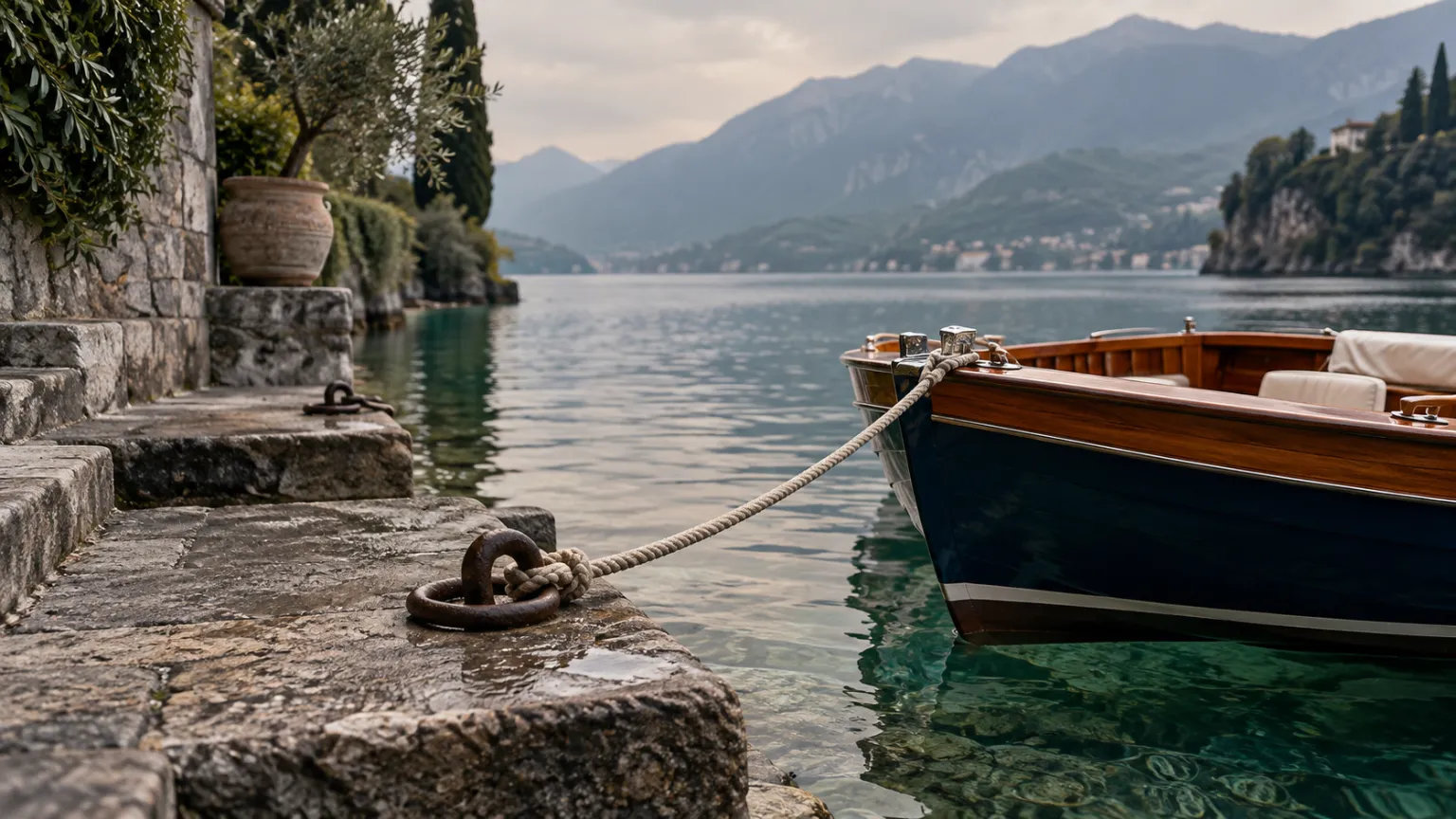
Direct water access on Lake Como is a bundle of rights over State public domain, and the bundle differs from parcel to parcel. Frontage, a servitude and a concession of 4 to 40 years carry different terms, transfer routes and risks. This article sets out what the principal should verify, in the order that decides value.
 رسم توضيحي
أبرز النقاط
- - Lakes belong to the State public domain under Article 822 of the Civil Code, so a villa can touch Lake Como but cannot as a rule own the water (Codice civile art. 822, measured).
- - Lake-domain concessions in Lombardy run for 4 to 40 years, with a 6-year minimum for tourist-recreational use (Regione Lombardia, R.R. 9/2015 art. 18, measured).
- - The authority may adjust the tabulated concession fee by up to 30 percent through a coefficient, and fees are indexed annually to ISTAT (R.R. 9/2015 art. 37, measured).
- - A servitude under Articles 1027 and 1058 of the Civil Code gives a path to the water, and a pontoon or boathouse on the lake domain needs a concession held by someone (Codice civile; R.R. 9/2015 art. 17, measured).
- - Substitution in a concession needs an application and the authority's authorisation, and a new public procedure applies unless the successor meets the initial selection criteria after a sale, transfer or restructuring, or is an heir, so a villa sale does not move the licence by itself (R.R. 9/2015 art. 28, reading to be confirmed by counsel).
- - A 300 m landscape band from the waterline is protected by law, with exemptions for areas zoned A and B on 6 September 1985 (D.Lgs. 42/2004 art. 142, measured).
- - Lake level ran from minus 40 cm at Malgrate in July 2022 to 166 cm on 3 November 2023; an encyclopaedia entry places the Piazza Cavour threshold at 120 cm, while La Regione called 180 cm the overflow threshold (La Provincia di Como, 12 July 2022; La Regione, 3 November 2023, press-reported; Wikipedia IT, compendium).
- - Knight Frank quotes €8,000 to €25,000 per m² for property directly overlooking the lake on 12 April 2024, with no breakdown by water-access type (Knight Frank, Our guide to Lake Como, broker-reported).
في هذه الصفحة (10)
What does direct water access mean on Lake Como?
Direct water access on Lake Como means that a private parcel reaches the lake without crossing land owned or controlled by a third party, and that its owner holds, or can lawfully obtain, the right to use the public shore in front of it. The second half of that sentence carries the value. The lake is not private. Under Article 822 of the Italian Civil Code, lakes and the other waters defined as public by law belong to the State and form part of the public domain (demanio pubblico). A villa can touch the lake. It cannot, as a rule, own it.
The phrase therefore bundles three separate things that a listing will rarely separate. The first is physical contiguity, meaning the parcel boundary meets the shoreline strip. The second is a legal right of use over the strip or the water, normally a concession for a landing, a pontoon, a slipway or a boat basin. The third is practical privacy, meaning that no public path, no neighbour's concession and no road interposes. A property can have the first without the second. It can have the second without the third. Only the combination earns the label an allocator should pay for.
For the principal, the working definition is a test with three questions. Does the parcel meet the water, or is there a strip in between? What document authorises the structures that make the water usable, and when does it expire? Who else can lawfully stand on the shore in front of the house? Each question has a documentary answer. None of them is answered by the word lakefront in an advertisement. That is the reason the modifier needs a definition before it can be priced, and it is also the reason hillside inventory with a lake view sits in a different category altogether, because view is an attribute of the land and access is an attribute of a right.
A villa can touch the lake. It cannot, as a rule, own it.
Victaura Research
Who owns the shore of Lake Como, and who grants rights over it?
The lake belongs to the State, and Lombardy has delegated the management of its shore to municipalities acting through lake basin authorities. Article 822 of the Civil Code places lakes in the public domain. Regional Law 6 of 4 April 2012 and the implementing Regional Regulation 9 of 27 October 2015 organise the management of the demanio lacuale, the lake domain, and set the concession fees. Regione Lombardia states that the municipalities, through the lake basin authorities, issue the concessions. The State owns. The municipality, through its authority, licenses use.
On Lake Como the relevant body is often the Autorità di Bacino del Lario e dei Laghi Minori. Its information sheet, published by the Province of Como and reporting figures up to 2013, describes a non-economic public body formed under Regional Law 6/2012 by riparian municipalities and provinces. Its first function is the issue of concessions for the use of the lake domain and its inland ports, including assessment and collection of fees, surveillance and removal of abusive occupations. The Municipality of Como publishes its own regulation as the demanial authority for its territory. The competent office therefore has to be identified municipality by municipality. The sheet is more than a decade old, so its wording should be checked against the current statute.
The shore strip is a public asset first and a private amenity second. The 2013 sector plan for the Lario lake domain, commissioned by the basin authority, records a regional directive of 30 September 2002. Its logic is that demanial zones serve collective needs such as navigation, fishing, leisure and bathing, normally through undiscriminating public use, and that exclusive private use may be granted only where the area is unsuited to any public use. The plan is a synthesis document, so I read it as a statement of policy orientation and not as the current text of a binding rule. It still explains how a concession office thinks.
Is a servitude to the lake the same as frontage on Lake Como?
*A servitude (servitù prediale) is a burden on one parcel for the benefit of another parcel owned by a different person.* That is the content of Article 1027 of the Civil Code. The burdened parcel is the servient tenement and the benefited one is the dominant tenement. Article 1058 provides that servitudes can be created by contract or by will. A right of way across a neighbour's garden to a landing is the standard case. It is a right in land, so it travels with the dominant parcel to the next owner.
A servitude gives the principal a path to the water, not the water. The distinction is easy to miss in a brochure. If the dominant villa sits behind another parcel and reaches the shore only across it, the servient owner remains the party with the physical frontage. The servitude is limited to its deed, and its width, permitted uses and any right to keep a boat or build a structure depend entirely on the text. A servitude of passage does not by itself authorise a pontoon on the lake domain, because that needs a concession under the regional regulation, and the concession belongs to whoever holds it.
Direct frontage changes who controls the interface, and servitude-based access adds a third party. The owner of a parcel that meets the shoreline strip controls the land side, and the authority controls the water side. I could not verify a general rule that gives a riparian owner priority in the grant of a concession, so the principal should not assume one. With a servitude, the deed may be old, the servient owner may change, a boundary may have been redrawn, and a shared jetty may sit under a single concession in one neighbour's name. A notary and a surveyor resolve most of this before signing, and after signing it becomes the buyer's problem.
| Position | Legal basis | What the owner controls | What to verify |
|---|---|---|---|
| Frontage on the shoreline strip, with a concession | Private parcel next to the lake domain (Civil Code art. 822) plus a concession (R.R. 9/2015, arts. 17 and 18) | The land side of the interface and the use of the conceded structures for the term | Concession text, term, fee, match between structures and record, transfer route (art. 28) |
| Access across a neighbour's land by servitude | Servitù prediale (Civil Code arts. 1027 and 1058) | A path, within the terms of the deed | Scope of the deed, identity of the servient owner, who holds any concession for structures |
| Shared or communal landing | A concession held by one party or a body, with shared use agreed between the parties | A share of use, as agreed | Who holds the concession, the written sharing rules, what happens if the holder lapses |
| Public landing or public path only | Public use of the lake domain | Nothing exclusive | Distance, quality and permanence of the public access |
| Hillside with a lake view | Ordinary freehold, with the landscape band of D.Lgs. 42/2004 art. 142 if within 300 m of the waterline | The view | Landscape consent; there is no right over the water edge |
What is a darsena, and how is it conceded on Lake Como?
Darsena is the Italian word for a boat basin, a sheltered water area, usually cut into or enclosed against the shore, where boats are moored or stored.* On the lakes it is often a boathouse with a water slip at its base. I did not find a definition of the term in the Lombardy regulation text I reviewed. The 2013 Lario sector plan maps it as its own category, distinct from jetties (pontili), landings (approdi*), launch slips and private stairs to the lake. Each is a separate structure on the lake domain, and each is conceded.
A concession is granted by the demanial authority and can be exclusive. Article 17 of Regional Regulation 9/2015 lets the authority grant occupation and even exclusive use of lake-domain assets, subject to public use and, above all, to the regulation of lake basins for hydraulic safety and water reserves. Article 18 sets the duration between 4 and 40 years, with a 6-year minimum for tourist-recreational purposes. The basin authority's online service page adds that it weighs the concessionaire's investment programme and amortisation period, and that concessions follow public-evidence procedures.
The fee is tabulated and adjustable. From 1 January 2016 the annual fee follows unit values in Tables A, B and C attached to the regulation, indexed annually to ISTAT, and Article 37 lets the authority raise or lower it by up to 30 percent through a coefficient. I did not extract the table values, so no fee figure appears here.
The point that decides value is succession. Article 28 says that a concessionaire who wants someone else to take over the concession must apply to the authority. Substitution counts as a substantial modification and calls for a new public procedure, with two exceptions: a successor that takes over, in whole or in part, after a sale, a transfer of rights or a corporate restructuring and meets the initial qualitative selection criteria, with no other substantial change to the concession; and an heir, who must ask the authority for confirmation within six months of the death. In both cases the succession is perfected through the authority's authorisation. On the text I reviewed, the sale of a villa does not move the boathouse licence by itself. How a sale of the land and the licence are coordinated in local practice is a matter for counsel and for the office concerned, and this article does not claim to know it.
Shore rights on Lake Como and the public edge
A concession does not privatise the waterline. The directive summarised in the 2013 Lario plan says that the concessionaire can never prevent public access to the battigia, the strip where water meets land, and that between two concessioned areas a zone must remain that allows full free access to the waters, compatibly with the terrain. The plan also acknowledges an exception. In the past, it says, wide stretches of shore were absorbed into private property with embankments (terrapieni) built flush with the water, and these are kept as part of the historic landscape, while further development in that direction is to be excluded. My reading is that existing lakefront parcels with long-standing private frontage form a closed set. I could not confirm whether the 2002 directive was restated in later texts.
The landscape regime sits on top of the property regime. Article 142(1)(b) of Legislative Decree 42/2004, the Code of Cultural Heritage and Landscape, protects by law the territories adjoining lakes within a band 300 metres deep from the waterline, including land rising above the lakes. Paragraph 2 exempts areas that on 6 September 1985 were zoned as homogeneous zones A and B under the 1968 ministerial decree, and certain other zones only where implementation plans were actually carried out. Works inside the band are therefore subject to landscape control unless an exemption applies, and the exemption is parcel-specific. For how a setback line shapes what can be built, see the setback line and the buildable envelope.
Shore rights come with priorities that rank ahead of the holder. Article 17 subordinates exclusive private use to public use and to the hydraulic management of the lake. The allocator should model the concession as a right with a term and conditions, with the lake's regulation ranking above private convenience.
Lake level and waterfront exposure on Lake Como
Lake Como is a regulated lake, and a regulated lake moves. The Olginate dam, run by the Consorzio dell'Adda, controls the outflow, and levels are read at the Malgrate hydrometer. A reference compilation gives an overflow threshold of 120 cm above the hydrometric zero, the level at which water reaches Piazza Cavour in Como, lowered over time from 186 cm in 1955. On 3 November 2023 La Regione reported the lake at 163.5 cm at 9 am and 166 cm at 4 pm above the Malgrate hydrometric zero and said it overtopped the mobile barriers at several points in the city. The same article cited a forecast of 180 cm, which it called the overflow threshold of the lake, and judged in its afternoon update that the forecast was unlikely to be confirmed. The two sources therefore use different thresholds. Press figures of this kind are a snapshot at a date, not a design standard.
The low end was visible in July 2022. La Provincia di Como reported on 12 July 2022 that the lake had fallen below minus 40 cm at Malgrate, the level beyond which navigation should in theory be suspended, while services continued. In that drought a boat basin sized for a normal summer is a different asset. A boathouse that floods in November and strands its boats in July has two failure modes.
Level exposure is a diligence item. The principal asks for the finished-floor level of every habitable room against the 120 cm threshold, the depth of any basin at the 2022 low-water mark, and the insurer's position on flood and on lake-edge structures. I found no published dataset that links individual parcels to flood exposure, so these questions go to the seller, the surveyor and the insurer. Article 17 itself ranks hydraulic safety and water reserves among the primary needs against which any concession is granted, which is the legal expression of the same physical fact.
Why two villas a hundred metres apart can value differently on Lake Como
Two villas a hundred metres apart on the same shore can sit in different asset classes, because the right attached to each is different. Picture a pair. The first holds frontage on the shoreline strip, a concession for a basin and landing with years remaining, and no public path in front. The second has the same view, reaches the water over a servitude, and keeps its boat at a jetty held under a neighbour's concession. The buildings may be identical. The land is different, and so is the licence.
Market evidence shows a wide band, and the band is made of attributes. Knight Frank's guide to Lake Como, dated 12 April 2024, quotes a local expert placing property directly overlooking the lake at €8,000 to €25,000 per square metre and apartments with city or lake views at €5,000 to €10,000. That is broker-reported, from one voice, and it is a range and not a set of transactions. The guide text I reviewed does not break the range down by type of water access and does not mention docks or boathouses. This article publishes no premium for direct access, because no source I could verify does.
The factors that move value inside that band can be listed, and none of them is a number I can source. They are the years remaining on the concession, the transfer route on sale, whether the structures match the concession and the landscape consent, the depth and orientation of the basin, whether a public path or a neighbour's mooring sits in front, and exposure to the lake level. The principal prices each as a discount or premium to a base case. The hillside comparison follows from the same logic, because an elevated villa with a lake view keeps the view and lacks the right of use over the water edge. It is a valid asset and a different one. Victaura's public project card for Two Villas on Lake Como sets out what that project is, and readers should rely on the card for it and not on this article.
The servitude gives the principal a path to the water. The concession gives the right to use it. They are different documents.
Victaura Research
Seezugang am Comer See, what the German query asks of Italian law
*German-language buyers search for the same thing under a different noun, and Seezugang am Comer See is a question about rights more than about scenery. Seezugang joins See (lake) and Zugang (access), and the word does not say which situation applies. It can describe a private landing, a garden that touches the water, a share in a communal jetty or a public path to the shore. A short glossary prevents most misreadings. Seezugang in the strict sense corresponds to a private right of use over the shore, which in Italy is a concessione demaniale or, behind another parcel, a servitù. Bootshaus corresponds to a darsena, a structure on or over the lake domain. Steg corresponds to a pontile or approdo*. A private beach has no clean equivalent, because it is a concession over public property, and a listing that says the shore belongs to the villa should be read against Article 822.
The legal gate for foreign buyers differs by nationality. Under Article 16 of the preliminary provisions to the Civil Code, foreigners enjoy the civil rights of citizens on condition of reciprocity. The commentary published with the article on Brocardi states that the condition has no effect within EU law, that a non-EU foreigner regularly resident in Italy can buy property without a reciprocity check, and that one not regularly resident can buy only where a treaty or reciprocity allows it. That is a general rule from secondary sources, and the principal's notary confirms the position for the specific buyer and for any corporate vehicle.
The concession adds a second gate. The basin authority's concession page requires that the applicant is not subject to measures prohibiting contracts with the public administration, and for legal entities the test extends to the legal representative and every administrator with power of representation. A holding company that wants to hold a darsena concession therefore faces a screening that a buyer of bare land does not. That is a documentary burden to plan for, and I found no barrier aimed at foreign nationals as such.
Diligence on a Lake Como waterfront, the documents that define the right
The first document is the concession itself, and the principal reads it before the price. It states the holder, the structures covered, the surface, the term, the fee and the conditions. If the seller cannot produce it, or produces one that has expired, the sale is of land with a lapsed licence, whatever the listing says.
The second set is the map evidence. The 2013 sector plan built a coastline chart from panoramic aerial photographs taken by the consortium in 2006, with a database that attaches a concession record to each mapped structure, and says a second photo series of May 2012 allowed a first update. The authority therefore holds a structure-by-structure record, so asking it to compare the structures on the ground with the structures on the record is reasonable. A structure that appears on the ground and not in the record is a question to answer before signing.
The third set is the land side. Cadastral and title documents show where the parcel ends and the demanial strip begins, which servitudes burden or benefit it, and whether the building and any waterside works are covered by permits and, inside the 300-metre band, by landscape consent unless an exemption applies. Counsel and a surveyor verify these. They are not matters for a marketing pack.
The fourth set is the operating side and the exit. Ask for the last three years of fee notices, the indexation applied, the insurance schedule and the maintenance duties, together with the lake-level exposure from the previous section. Then price the exit. Because Article 28 does not make the concession move automatically with the villa, a future buyer faces the same succession question, and a concession with a long remaining term and a clear transfer route is easier to sell than one near expiry.
The price of the villa is the price of the land plus the price of a licence with a term.
Victaura Research
Weaknesses honestly disclosed
This article rests on public legal texts and press reports, and it contains no transaction data. It publishes no premium for direct water access because I found no verifiable source for one. The only price evidence is a single broker-reported range from April 2024, from one voice.
Several legal points are summaries and not certainties. The regulation was read through an official consolidated database and a secondary compilation, and the Article 28 reading in particular should be checked against the current text and local practice. The 2002 directive is known to me only as summarised in the 2013 sector plan. The basin authority sheet carries no date and reports figures up to 2013. Which municipalities delegate to the authority and which act as their own demanial authority is a point to verify parcel by parcel.
Physical and level figures are compendium and press figures. The 145 km², 170 km and 412 m values and the history of the overflow threshold come from an encyclopaedia entry and not from a survey, and level readings are press-reported at a date and will move. The author is not independent of the subject, as the disclosure below states, so the article limits itself to legal structure, cited sources and verification steps.
Skin in the game disclosure. Victaura, through its parent Greystone B.V. (Netherlands), develops projects on Lake Como (Italy), in Nungwi, Zanzibar (Tanzania), on Gili Air and in Uluwatu, Bali (Indonesia), and holds an off-plan capital position on Al Marjan Island, Ras Al Khaimah (UAE). Readers should assume commentary may be influenced by, or benefit, these positions. This document is classified as marketing material under MiFID II Article 24(3). It is not investment advice.
المصادر
- Codice civile, art. 822, Demanio pubblico
- Codice civile, art. 1027, Contenuto del diritto (servitù prediali)
- Codice civile, art. 1058, Modi di costituzione delle servitù
- Disposizioni preliminari al codice civile, art. 16, Trattamento dello straniero
- Regione Lombardia, Regolamento regionale 27 ottobre 2015 n. 9, Disciplina della gestione del demanio lacuale e idroviario
- R.R. 27 ottobre 2015 n. 9, testo consolidato (edizionieuropee.it)
- Regione Lombardia, Legge regionale 4 aprile 2012 n. 6, Disciplina del settore dei trasporti
- Regione Lombardia, Gestione del demanio lacuale e idroviario e dei relativi canoni di concessione
- Autorità di Bacino del Lario e dei Laghi Minori, Scheda informativa (undated, figures to 2013)
- Autorità di Bacino del Lario e dei Laghi Minori, Chiedere la concessione per l'utilizzo di aree del demanio lacuale
- Comune di Como, Regolamento per la valorizzazione e promozione del demanio lacuale, autorità demaniale di Como
- Autorità di Bacino del Lario e dei Laghi Minori, Piano di Settore del Demanio Lacuale del Lario, Documento di Sintesi, 2013
- D.Lgs. 22 gennaio 2004 n. 42, art. 142, Aree tutelate per legge
- Knight Frank, Our guide to Lake Como, 12 April 2024
- Wikipedia IT, Lago di Como
- La Regione, Lago di Como sempre più alto, 3 novembre 2023
- La Provincia di Como, Il lago scende sotto -40, 12 luglio 2022
المعلومات الواردة في هذا الموقع لأغراض إعلامية فقط ولا تشكّل عرضاً أو دعوةً للاستثمار أو استشارةً مالية. العوائد المذكورة تقديرية وغير مضمونة؛ والأداء السابق لا يضمن النتائج المستقبلية. ورأس المال المستثمر معرّض للمخاطر.
هل تفكّرون في تخصيص جزء من محفظتكم للعقارات الفاخرة في المواقع التي نعمل فيها؟ تحدّثوا إلينا عن مشاريعنا الحالية والمقبلة.
تواصلوا مع Victaura →رؤى ذات صلة

الوجهات
Lake Como Shores: Carate Urio, Pognana, Nesso
Carate Urio, Pognana Lario and Nesso sit on two different shores of the Como branch of Lake Como, and the shore sets the road, the ferry, the direction of the light and how steeply the land meets the water. This note compares the three on published facts, labels what is only geometry, and lists what no desk study can settle.

الوجهات
Lake Como Purchase: The Foreign Buyer's Sequence
A foreign principal can buy on Lake Como, Italy, but the order of the steps decides the outcome. Nationality check, tax code, proposal, preliminary contract with deposit, planning and cadastral verification, notarial deed. This note sets each step against who performs it, what the law charges and where the weak points sit, using public sources only.
الاستدامة والحوكمة
Lake Como Flood Risk: Designing for the Hazard
Lake Como floods its own shoreline, and the record is public. The lake reached 138.5 cm at the Malgrate gauge on 31 October 2023 against a 120 cm flood threshold at Como. This note argues that for a lakefront principal, the finished floor level, the drainage and the materials are the first underwriting step. Insurance is the second, and it prices what the design has already fixed.