
Market Views
Lake Como Developers: Who Builds New
On Lake Como, the rules on new building point to very few entities delivering genuinely new residential product, and consent, not capital, is what thins the field. This note maps the legal filters on new building, the actor types that clear them, and what separates a developer from an agency that resells. Every figure carries its grade.
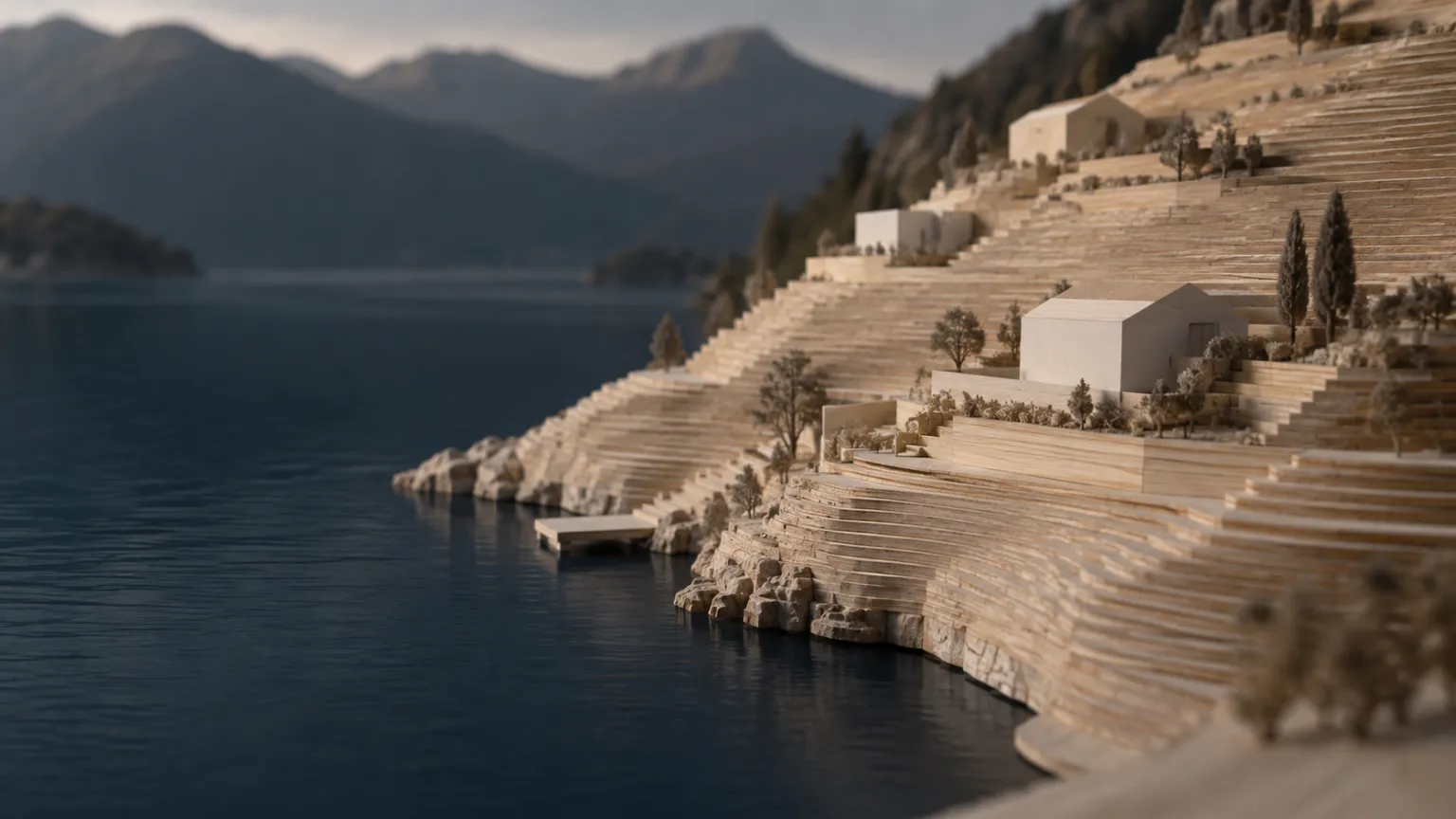 Illustration
Key takeaways
- - Article 142(1)(b) of Legislative Decree 42/2004 protects a 300 m band from the waterline of lakes by law, including elevated terrain, with an exception for zones A and B as delimited on 6 September 1985 (Brocardi reproduction of D.Lgs. 42/2004).
- - Landscape authorisation under Article 146 precedes the building permit, the heritage authority has 45 days from receipt of the file to give its opinion, and after 60 days from receipt without one the administration issuing the authorisation can decide (D.Lgs. 42/2004 Art. 146 and Consiglio di Stato ruling n. 2487/2023, measured as statutory text, not an observed duration).
- - The building permit procedure under Article 20 of D.P.R. 380/2001 allows 60 days for the review and 30 for the decision, 90 days in all, or 100 where grounds for refusal are notified, and silent assent does not form on landscape-protected land without prior landscape consent (measured, statutory text, with TAR Lombardia 518/2024 as reported by trade press).
- - Lombardy Regional Law 31/2014, in force since 2 December 2014, aims at zero net land take by 2050 and works through an ecological soil balance (Regione Lombardia, LR 31/2014, measured statutory).
- - Lombardy recorded 834 hectares of new land consumption in 2024, second in Italy after Emilia-Romagna at about 1,000 hectares (ISPRA press release of 24 October 2025 on the SNPA 2025 report, report tables not read).
- - Broker data give 5,000 to 7,000 EUR per sqm for new and renovated prime Lake Como property in 2026, with around 60% of purchases international and about 50% second homes (Engel & Völkers, broker-reported, undated, no methodology).
- - National quarterly permits for dwellings in new residential buildings were 11,958 in Q1 2025 and 14,322 in Q4 2025, seasonally adjusted, and the national series does not show the Lake Como share (ISTAT quarterly releases, measured national estimate).
- - Announced hospitality-led supply, such as the 58-key Corinthia resort planned in Menaggio with a late-2028 target, was at announcement stage as of 9 October 2026 (press-reported, January 2026 releases).
On this page (10)
Who builds new on Lake Como, and why are there so few?
On Lake Como, the rules on new building point to a handful of entities delivering new residential product, and the constraint that thins the field is consent, not capital. The lake is a narrow, steep, heavily protected basin. Most of its shoreline was built out long before modern planning law. What reaches the market as new is therefore, on this note's reading, mostly redevelopment, conversion or infill, rarely greenfield. The allocator who wants to understand supply should count permits, not listings. Each municipality must give public notice of the building permits it issues on its official notice board, the albo pretorio, under Article 20 of the Consolidated Building Act, Presidential Decree 380/2001.
A developer, for the purposes of this map, is the entity that carries consent risk and construction risk and then sells the finished unit. That differs from an agency, which carries neither. It differs from a private owner who renovates a villa and lists it. It also differs from a hospitality owner who builds hotel rooms, or keys, for operation and sells a few branded residences alongside. Four different risk profiles hide behind the single word new.
The public record on Lake Como new-build is thin, and this note does not pretend otherwise. No public dataset reviewed here isolates lakeshore completions by municipality. Italy's statistics institute publishes national permit estimates. Its seasonally adjusted quarterly figure for dwellings in new residential buildings was 11,958 in the first quarter of 2025 and 14,322 in the fourth quarter of 2025 (measured, national, ISTAT estimate). The national figure does not show how much of that flow, if any, falls on Lake Como.
What follows is a map of constraints and actor types, not a league table of named firms. Naming builders from marketing material would turn a map into a brochure. The only named third-party example below comes from an announcement with a press source, and it is labelled by its status at a stated date.
What does the 300-metre lakeshore rule do on Lake Como?
The 300-metre band is the first filter on any Lake Como site. Article 142(1)(b) of Legislative Decree 42/2004, the Code of Cultural Heritage and Landscape, protects by law the territories bordering lakes within a band 300 metres deep, measured from the waterline. The text adds that this holds also for terrain elevated above the lake. Slope does not take a plot out of the band. Height does not either.
The exception is historical and narrow. Article 142(2) excludes areas that, on 6 September 1985, were delimited in municipal planning instruments as homogeneous zones A or B under Ministerial Decree 1444 of 2 April 1968. In plain terms, historic centres and the already built fabric of that date sit outside the automatic band. The test is how the planning instrument in force on that date zoned the area, not what stood on the plot. Article 142(2) adds two narrower cases, for parts of other zones included in multi-year implementation plans whose provisions had actually been carried out, and for built-up centres in municipalities that had no such instrument. Being outside the band removes one layer of protection, not every layer.
A second filter sits on top, because the regional landscape plan treats the great Insubric lakes as a protected scenic system. Lombardy's landscape plan forms part of its Regional Territorial Plan. As summarised from the plan's norms, it defines a safeguard area for the scenery of the large lakes, Como and Lecco among them, and a stricter tier that coincides with the Article 142 band, including built-up centres and the water surface. The municipality-level detail sits in the plan's commune index and its maps, which this note has not reproduced.
The practical consequence is that site selection is a legal exercise before it is a design one. The allocator looking at a lake plot should ask which tier the plot sits in, whether the 1985 exception applies, and what existing volume is documented. Volume that can be proven is an asset. Volume that cannot be proven is a hope, and a hope is not underwritten.
On Lake Como, the scarce asset is not land. It is a consent chain that can be proven.
Victaura Research
How long does consent take for new building on Lake Como?
Landscape authorisation is the gating instrument, and it comes before the building permit. Autorizzazione paesaggistica is the authorisation required under Article 146 of the Code before works on landscape-protected land can start. Article 146(4) of the Code describes it as an autonomous act and a precondition of the building permit, and practice guidance requires both titles for works on protected land. The same paragraph bars issuing it after the works have been carried out, even in part.
The statute gives the heritage authority a clock, and no dataset reviewed shows how often it is met. Under Article 146(5) and (8), the Soprintendenza, the heritage authority, must give its opinion within 45 days of receiving the file, and under Article 146(9) the administration competent for the authorisation can decide on the application once 60 days from receipt have passed without one. In ruling 2487/2023 the Council of State held that a late opinion remains valid but is no longer binding. That is the statutory design (measured, statutory). A project with a contested design, a listed object or a litigating neighbour may not run to it.
The building permit has its own statutory clock, 90 days in the base case. Under Article 20 of the Consolidated Building Act, Presidential Decree 380/2001, the procedure officer completes the review and proposes a decision within 60 days of the application. The final decision follows within 30 days of the proposal, 90 days in all, or within 40 days, 100 in all, where the municipality has notified grounds for refusal, and a 2024 Lombardy administrative court ruling reported by trade press applied the 100-day term. Article 20(7) allows the review period to be doubled for particularly complex projects. Silent assent can form if the municipality does not refuse in time, but Article 20(8) excludes it on landscape-protected land unless the landscape consent has already been obtained, so on a lakeshore site it is not a basis for underwriting.
Underwriting should therefore carry consent as a calendar risk, not a footnote. Statutory clocks describe a best-case sequence. Add pre-application dialogue, design revisions after the heritage opinion, and the risk of appeal. The allocator who is shown a delivery date on a Lake Como new-build should ask which steps are already complete and ask for the document that proves each one. No dataset of actual Lake Como consent durations was found, so any duration beyond the statutory clocks is directional at best.
How does Lombardy's soil-consumption law limit new building near Lake Como?
Lombardy has a dedicated regional soil-consumption law, and the law points at zero. Regional Law 31/2014 entered into force on 2 December 2014. It frames soil as a non-renewable common good and aims to bring into Lombardy the European objective of zero net land take by 2050 (measured, statutory).
The mechanism is the ecological soil balance. Net consumption is the difference between agricultural land transformed for the first time and urbanised or urbanisable land returned to agricultural use in the same planning instrument. Where the balance is zero, land take is zero. Regional Law 16/2017 revised the transition rules, and under that revision municipalities could still approve plan variants with an ecological balance of zero or less. Later amendments to the transition article were not reviewed here.
For a lake basin the law bites on greenfield, and it pushes the market toward replacing what already stands. Redevelopment of land that is already built is not new land take. That is the legal logic behind the conversion and reconstruction projects that, on this note's reading, make up most of the lake's new supply. The law does not forbid new building. It is designed to stop the greenfield alternative from scaling, which is a supply constraint written into regional policy.
The regional record shows the law has not stopped land take, which is itself a data point. According to the ISPRA press release of 24 October 2025 on the 2025 national soil report, Lombardy recorded 834 hectares of new land consumption in 2024, second in Italy after Emilia-Romagna at about 1,000 hectares (measured, national monitoring system). The same release puts the consumed share of Lombardy's territory at 12.22%, the highest of any region. The regional tables of the full report were not read here.
What does new-build cost on Lake Como, and is it scarcity pricing?
Broker data put new and renovated prime property on Lake Como at 5,000 to 7,000 EUR per square metre, in figures the broker labels 2026. Engel & Völkers' market insight page gives that range, with a top price of around 7,500 EUR per square metre and prime budgets typically between 800,000 and 1.2 million EUR (broker-reported). The page carries no publication date and no methodology. It is a signal, not a measurement.
Broker data is a ceiling-biased instrument. It describes what agents market, not what settles at deed. It reflects one firm's view of its own pipeline. And it merges new and renovated stock into a single band, which hides precisely the distinction this note is about. An allocator who wants a new-build price needs the prices declared in deeds, not a range on a web page. The revenue agency's online service for declared property values, launched in December 2020, shows them by area for sales of the last five years, with each unit's cadastral category and size. Access requires Italian online credentials, and results appear only where at least five sales took place in the area and period selected.
The same source reports that around 60% of purchases are international, around 50% are second homes and about 30% are investment purchases. These shares describe demand composition, and they are broker-reported. They matter here because second-home buyers are the natural customer for a finished unit, which is the same demand logic examined in the second home that pays rental yield in prime resort markets. Whether that demand reaches new product or resales is not shown by the data.
Scarcity is a hypothesis that the data supports only indirectly. The supply constraint is documented in statute, as set out above. A price premium for new product over renovated product is not documented in any source reviewed here. Honest framing therefore says the constraint is measured, the price effect is directional at best, and the link between the two is an inference by the author. The allocator is free to disagree with the inference, and should test it against deeds.
Can a foreign allocator buy new-build on Lake Como?
A foreign buyer can purchase on Lake Como subject to reciprocity, which the notary checks at the deed. Article 16 of the preliminary provisions to the Civil Code admits a foreigner to the civil rights of a citizen on condition of reciprocity and subject to special laws. In practice, a foreign national can buy Italian real estate where an Italian could do the same in the buyer's country. The rule applies to legal persons as well. According to the Foreign Ministry page, citizens of EU and EEA states, and some categories of non-EU residents in Italy, are exempt from the check.
Reciprocity is a documentary step, and it belongs before the preliminary contract. The notarial guide reviewed ties the check to the buyer's status, not to the type of sale, and advises completing it before signing even a preliminary contract. The Ministry of Foreign Affairs maintains a page on reciprocity conditions, and treats reciprocity as existing for matters covered by a bilateral investment treaty. This is not a reason to avoid the market. It is a reason to place the step in the closing checklist on day one rather than the week before signing.
Structure matters more than nationality for the new-build buyer. A purchase from a developer is a sequence, usually a preliminary contract, staged payments and a deed. The allocator carries counterparty risk between the first signature and the last. Italian law has a dedicated regime for buyers of buildings still to be built, Legislative Decree 122/2005. A June 2021 guide by ANCE, the national builders' association, reads it as requiring the builder to deliver a guarantee covering sums paid before the deed, callable if the builder falls into crisis. The same guide notes that the regime protects only natural persons, so a purchase through a company falls outside it. It also notes that the law is silent on renovation, which the national notarial council reads as covered at least where the works are radical. The allocator should ask counsel which protections apply to the specific contract.
Tax treatment differs between a developer's sale and a private resale, and the rule should be confirmed by a notary. According to the revenue agency's buyer guide, as reproduced by a third-party site, a sale by the building company within five years of completion bears VAT. The rate is 10% for a non-first home and 22% for luxury cadastral categories A/1, A/8 and A/9, with fixed registration, mortgage and cadastral taxes of 200 EUR each. A purchase from a private seller bears registration tax of 9% instead, with a minimum of 1,000 EUR, and mortgage and cadastral taxes of 50 EUR each. A buyer who is a natural person can ask the notary to apply the 9% to the cadastral value, a tax value set by formula, rather than to the price. The guide dates from November 2021, and current amounts should be confirmed with the notary (directional, to be verified).
| Actor type | What it carries | Main constraint exposure | What the allocator can verify |
|---|---|---|---|
| Redevelopment developer | Land, consent and construction risk, then sells units | Landscape authorisation, building permit, provable existing volume | Permit chain in the developer's own name |
| Hospitality owner with branded residences | Operating hotel plus a small residential component | Same consents, plus scale of site and operator approval | Planning status, operator agreement, completion schedule |
| Private owner-renovator | Own reconstruction for personal use | Works within existing volume, heritage review | Title history and works certification |
| Agency reselling | A sales mandate, no construction or consent risk | None directly, depends on the seller's documents | Seller's permits, not the agency's claims |
What distinguishes a Lake Como developer from an agency that resells?
The first difference is what sits on the balance sheet. A developer carries land, consent and construction exposure. An agency carries a mandate. When a unit fails to sell, one loses capital and the other loses a commission. That asymmetry shapes what each is willing to say about a project, and what each is able to prove.
The second difference is what can be verified. A developer's claim is checkable against documents the allocator can request. The landscape authorisation, the building permit, the cadastral record and the construction schedule are all documents. An agency's claim about a new villa is a claim about someone else's work. The first question is always whose permit it is.
The third difference is accountability after the sale. Defects, delays and snagging run back to the builder. In a resale they run back to a seller who may be a private individual or an overseas entity with no remaining capacity to remedy. The contract and its guarantees decide this, not the brand on the brochure. The allocator should read the guarantees before the renders.
The fourth difference is the horizon each party works to. A developer plans in permit cycles and build programmes measured in years. An agency plans in listing cycles measured in months. On a lake where consent clocks dominate, the party that lives on the longer horizon is usually the one that can answer a question about sequence. The party on the shorter horizon is usually the one that can answer a question about comparable asking prices.
None of this makes developers better by default. A developer has a motive to sell its own units, and an agency's resale can be the cleaner asset. The point is narrower. The two are different instruments, and the allocator should know which one the listing is. A simple disclosure test applies. Can the seller produce the permit chain, in the seller's own name, for the volume being sold?
A developer carries consent risk and construction risk. An agency carries a mandate.
Victaura Research
Which operators deliver new product on Lake Como?
Three actor types build what the market calls new on Lake Como, and a fourth sells it. The first is the redevelopment developer, who buys an existing building or villa, obtains consent to rebuild or convert within the existing volume, and sells units. The small local builder delivering a few units on infill plots carries the same risks at a smaller scale. The second is the hospitality owner, who builds keys for operation and carves out branded residences. The third is the private owner-renovator, who rebuilds for use and may later sell. The fourth is the agency, which resells what the others produce and carries neither consent nor construction risk.
Hospitality-led supply is the most visible and the most announced. In January 2026, press releases reported that Corinthia Hotels, with RoundShield and Kervis SGR, an Italian real estate investment manager, plan a 58-key resort in Menaggio on a 40-hectare site, with three branded residences and a late-2028 target opening. Construction is described as expected to begin after final planning approvals (press-reported, announcement stage). As of 9 October 2026, the sources reviewed show an announcement and a target date, not a delivered building.
An announcement does not tell the allocator what the allocator needs to know. It does not show the consent state, the sale terms of the residences or a completion. A target opening is a developer's schedule. On a lake whose permits run on the clocks described above, schedules are the first thing to move. The allocator should treat announced supply as a pipeline hypothesis, not as inventory.
Victaura participates in this market, and this note should be read with that in mind. One of its public listings for the lake is Two Villas on Lake Como. Nothing in this map is an argument for any operator, including Victaura, over another. The map describes constraints that apply to every actor, and the disclosure at the end of the note describes the interest of the author.
What are the weak points in this reading of Lake Como supply?
The first weakness is the absence of a supply dataset. No source reviewed isolates new-build completions on Lake Como. The ISTAT figures are national. The soil figures are regional. The broker figures are asking prices. The claim that few entities deliver new product rests on the structure of the constraints, not on a count. A count would be better, and it does not exist in the material reviewed.
The second weakness is reliance on secondary reporting for some figures. The Lombardy land-take numbers come from the ISPRA press release on a national report, not from a reading of the report tables. The VAT rates come from a third-party reproduction of an agency guide that dates from 2021. Both are labelled as such and both should be verified against the primary document before any decision rests on them.
The third weakness is the depth of the landscape-plan reading. The commune-level classification and the full text of the lake norms were not read in full here. The description of the safeguard area and the stricter tier is a summary of the plan's structure. A site-specific view needs the plan's maps and the municipal planning instrument, read by a qualified professional.
The fourth weakness is timing. The permit clocks are statutory best cases, and no data on actual durations was found. The Menaggio project is at announcement stage. Planning law and regional rules change, and a status written on 9 October 2026 can be out of date within months. The same applies to the broker range, which is undated.
The fifth weakness is the choice of lens. A map built from constraints will tend to find scarcity, because constraints are what it measures. It does not measure demand elasticity, resale liquidity or exit cost. An allocator should read the map as one input to a decision that also needs those three, and none of them is covered here. The last weakness is the author's interest, set out in the disclosure below.
Volume that can be documented is an asset. Volume that cannot is a hope.
Victaura Research
What should the allocator ask a Lake Como developer?
Ask for the consent chain first, in the developer's own name. The landscape authorisation, the building permit and the proof of existing volume are the three documents on which a lakeshore project stands. If the developer cannot produce them, or produces them in another entity's name, the sale is a promise about someone else's work.
Ask which clock the delivery date assumes. A date that already includes the heritage opinion and the permit is a different statement from a date that assumes both will arrive on time. The statutory clocks of 45, 60 and 90 days are best cases. A developer who shows the sequence with dates, rather than a single completion month, is giving the allocator something to underwrite.
Ask what protects the money between signature and deed. Staged payments on a building not yet built create counterparty exposure. Counsel should confirm whether the builder's guarantee under Legislative Decree 122/2005 applies to the contract and has been delivered, and what stands in its place where it does not. Ask also whether the buyer's reciprocity documentation is needed, and when. Both are items for the closing checklist, not for the week of closing.
Ask for the answer in the plainest form. What is the existing volume. What is the status of every consent. What is the worst realistic delay. A developer who answers with documents is a developer. A seller who answers with adjectives is a marketer.
Skin in the game disclosure. Victaura, through its parent Greystone B.V. (Netherlands), develops projects on Lake Como (Italy), in Nungwi, Zanzibar (Tanzania), on Gili Air and in Uluwatu, Bali (Indonesia), and holds an off-plan capital position on Al Marjan Island, Ras Al Khaimah (UAE). Readers should assume commentary may be influenced by, or benefit, these positions. This document is classified as marketing material under MiFID II Article 24(3). It is not investment advice.
References
- Italian Republic, Legislative Decree 42/2004 (Code of Cultural Heritage and Landscape), Article 142
- Consiglio di Stato, ruling of 9 March 2023 n. 2487 (Article 146 Soprintendenza opinion deadlines)
- Bollettino di Legislazione Tecnica, Interventi edilizi e vincolo paesaggistico
- Italian Republic, D.P.R. 380/2001 (Testo Unico Edilizia), Article 20
- LavoriPubblici.it, Permesso di costruire e silenzio assenso, il TAR sulle tempistiche
- Regione Lombardia, Legge Regionale 28 novembre 2014 n. 31
- Assolombarda, Modifiche alla legge sul consumo di suolo in Lombardia
- SNPA, Consumo di suolo, dinamiche territoriali e servizi ecosistemici, edizione 2025
- ISPRA, Rapporto SNPA Consumo di suolo 2025, nota di precisazione
- Regione Lombardia, Piano Paesaggistico Regionale, Indirizzi di tutela (2014)
- Regione Lombardia, Piano Paesaggistico Regionale, Abaco dei comuni vol. 1
- Engel & Völkers, Lake Como market insight 2026
- ISTAT, Permessi di costruire, I trimestre 2025
- ISTAT, Permessi di costruire, IV trimestre 2025
- Hospitality Design, Corinthia To Develop Luxury Resort on Lake Como (January 2026)
- Hotel Online, Corinthia Hotels Partners With RoundShield and Kervis for Luxury Development in Lake Como
- Italian Republic, Preleggi al Codice civile, Article 16 (reciprocity)
- Ministero degli Affari Esteri, Condizione di reciprocità
- Consiglio Nazionale del Notariato (NotaiOnline), Acquisto casa da parte di stranieri non residenti
- Agenzia delle Entrate, Guida all'acquisto della casa, novembre 2021, cap. 2 (third-party copy)
- ISPRA, Comunicato stampa, Consumo di suolo: ogni ora sparisce un tassello del mosaico naturale (24 October 2025)
- Harrison Street, Kervis SGR to Develop Corinthia-Branded Luxury Hotel in Lake Como on Behalf of a Fund Fully Invested by RoundShield (26 January 2026)
- Regione Lombardia, Beni paesaggistici e aree tutelate dal Piano Paesaggistico Regionale, Art. 19 Normativa (laghi insubrici)
- Italian Republic, Legislative Decree 42/2004, Article 146 (as reproduced by Brocardi)
- Agenzia delle Entrate, Consultazione online dei valori immobiliari, press release (7 December 2020)
- ANCE, Compravendita immobili in costruzione, Guida alle regole (June 2021)
- Agenzia delle Entrate, Consultazione valori immobiliari dichiarati, Guida al servizio (June 2026)
The information on this website is provided for informational purposes only and does not constitute an offer, solicitation, or financial advice. Indicated returns are estimates and are not guaranteed; past performance is not indicative of future results. Capital invested is at risk.
Considering an allocation to luxury real estate in the locations we operate? Speak to us about our current and upcoming projects.
Speak to Victaura →Related insights

Market Views
Swiss Capital and Lake Como: The Franc Read
Swiss capital moving toward Lake Como is being priced against a EUR/CHF rate that stood at 0.9445 on 25 September 2026, above its 9 March low of 0.9008 and about 15% below its 2019 average of 1.1124. This note reads that move against UBS's own bubble-risk scores for Zurich and Geneva, Knight Frank's separate Como data, and the reciprocity rule that lets a Swiss national buy there at all, without forecasting where the franc goes next.

Market Views
Lake Como Buyers: Reading the Shares
Engel & Völkers cites about 40% and 60% foreign buyers on Lake Como. Gate-away logs enquiries, not deals, and German requests fell 13.6% in 2025. Transactions, enquiries and listings are three instruments. The allocator should read each for what it counts, and should not average them into one share.

Market Views
Lake Como vs Lugano: One Border, Two Regimes
Which gate a foreign principal passes depends on which side of the border the parcel sits. In Switzerland, a buyer domiciled abroad needs an authorisation under the Lex Koller or the deed is void, and a separate rule caps second homes at 20 percent per commune. In Italy, EU citizens buy freely and non-EU citizens pass a reciprocity test. This note maps the gates and does not rank the lakes.