
ESG & Stewardship
Zanzibar Seaweed: The Shoreline Two Economies Share
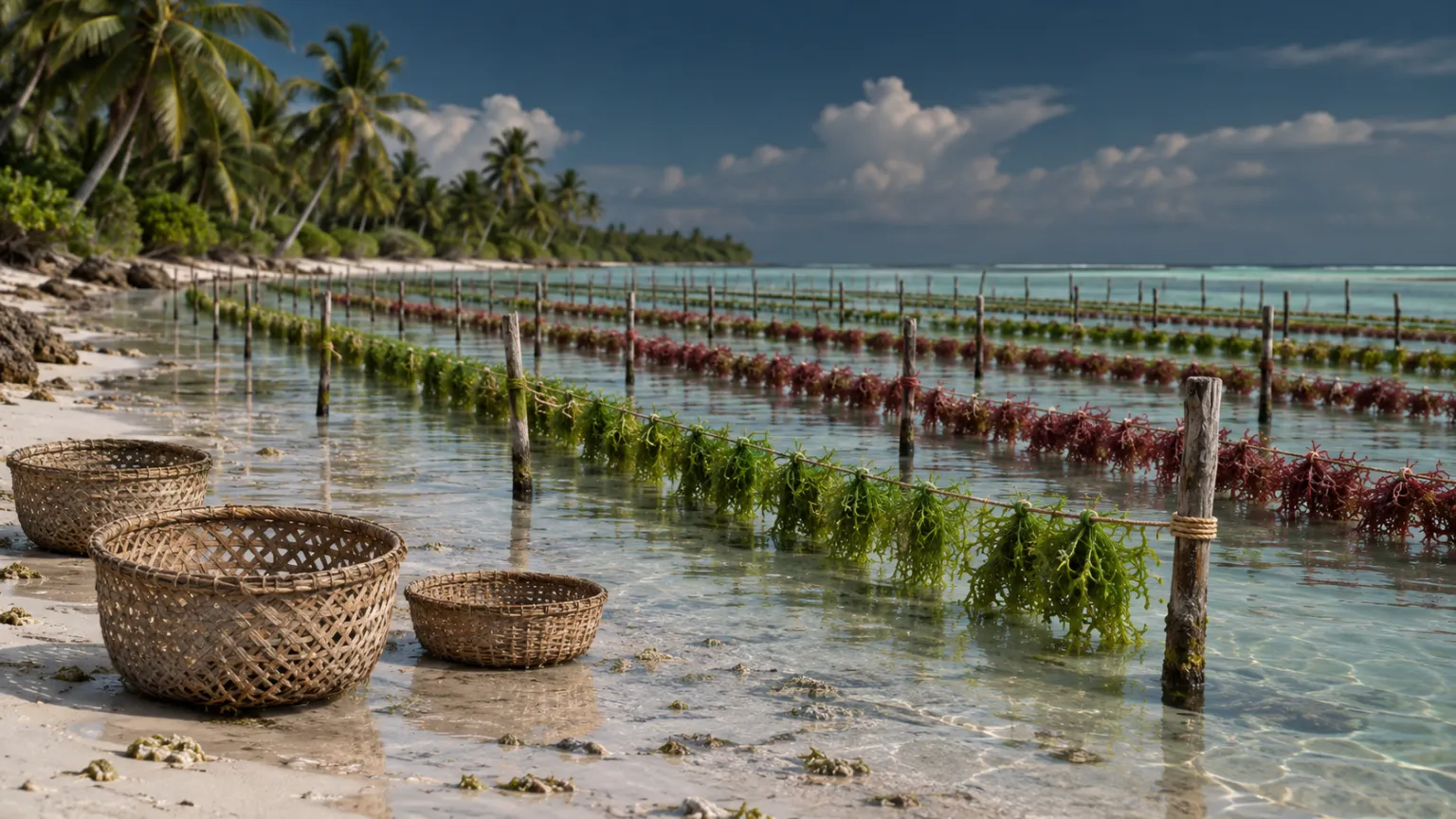
Seaweed farming occupies the intertidal flats of Zanzibar's east coast, the same shore that hotels and villas in Paje and Jambiani treat as frontage. The World Bank counts about 20,000 Zanzibar farmers in 2024, over 80 percent of them women, and lists blocked pathways and chemical discharges among tourism's effects on farms. The farmers hold no registered title. The allocator should price that second layer of use before pricing the view.
 Illustration
Key takeaways
- - Zanzibar had about 20,000 seaweed farmers in 2024, out of about 30,000 in Tanzania, over 80 percent of them women (directional, World Bank, Seaweed Power, 2025).
- - The World Bank puts Zanzibar's farmer count at 23,000 in 2011 and 16,000 in 2020, while recent sources give 23,000 to 35,000 with no stated method (directional, World Bank, UN Tanzania, Daily News).
- - Tanzania's seaweed production reached 25,426 metric tons in 2023, about 70 percent of it Zanzibar's (measured, ministry data compiled by the World Bank, 2025).
- - Zanzibar's 2023 output appears as 11,737 tons and as 16,653 tons in two press accounts (directional, press-reported, The Citizen 2025 and Daily News 2026).
- - About 80 percent of Zanzibar's seaweed comes from Pemba; more than 83 villages farm it, about 50 on Unguja and 33 on Pemba, so the east coast of Unguja is a minority producer (directional, World Bank, 2025).
- - The World Bank lists blocked pathways, chemical discharges, and damage from kite surfing and water scooters among tourism's effects on seaweed farms (directional, World Bank, 2025).
- - Entry to seaweed farming needs no licence and no land purchase and rests on informal “rural modesty”, while the 30-metre sand-beach building setback regulates structures, not foreshore users (directional, World Bank, 2025; Zanzibar DCU, 2018; Victaura Research reading).
- - Implied unit value fell from about TZS 991 to about TZS 802 per kilogram between 2023 and 2025 (directional, Victaura Research arithmetic on press-reported Daily News figures).
On this page (10)
Who works the shoreline on Zanzibar's east coast?
Seaweed farmers work the intertidal flats and lagoon of Zanzibar's east coast, the same shore that hotels and villas in Paje and Jambiani treat as frontage. Most of those farmers are women. The World Bank puts the Zanzibar count at about 20,000 in 2024 and the share of women above 80 percent (directional, World Bank, Seaweed Power, 2025). The shore is a workplace before it is a view.
Seaweed farming, as practised here, is the off-bottom cultivation of red algae on lines tied between stakes in shallow water. Two species dominate. Spinosum (Eucheuma denticulatum) is about 70 percent of Tanzanian production and cottonii (Kappaphycus alvarezii) about 10 percent, according to key-informant interviews cited by the World Bank (directional). Farmers dry the harvest and sell it raw. Processors abroad turn it into carrageenan, a thickener used in food and cosmetics. The tide sets the working day, because the lines are reached at low water.
The farmer holds no registered title to the plot. The World Bank describes entry as open to villagers living on the coast, with no licence and no land purchase. Once a person starts farming a space, it becomes that person's farm under an informal arrangement called “rural modesty”, and villagers allocate space among themselves. The right is customary. Local government authorities monitor farming areas, in the report's account.
A principal reading a coastal listing therefore meets two layers. Above the high-water mark sits a registered, surveyable plot. Below it sits an unregistered livelihood, with its own paths, drying places and seasons. This article maps the second layer, because a sales pack rarely draws it, and says plainly where the evidence for it is thin.
How big is seaweed in Zanzibar's economy?
Seaweed is Zanzibar's second-largest export crop after cloves, on the account of the United Nations. UN Tanzania, in a post of 13 July 2026, counts more than 23,000 farmers and about 80 percent women (directional, UN Tanzania). The World Bank puts seaweed at 17.8 percent of Zanzibar's export value in 2020 and, in another section, at around 16,000 jobs with no year given (directional).
Production is the number on which the sources disagree most. For Tanzania as a whole, the World Bank reports 25,426 metric tons in 2023, after a fall to 11,223 tons in 2020 (measured, ministry data compiled by the World Bank). It gives the 2015 peak as 17,000 tons in one place and 17,900 in another. Zanzibar accounts for about 70 percent of the national total in the same report. For Zanzibar alone, 2023 appears as 11,737 tons in a Citizen article citing the Zanzibar Statistical Abstract 2023, and as 16,653 tons in remarks by the UNDP Resident Representative reported by the Daily News (directional, press-reported). The Citizen printed the 16,653 figure in January 2024 without naming a source (directional, press-reported).
Export value is thinner than production, and it is also contested. The World Bank says the sector earns over USD 6 million a year in exports. The Chanzo, citing the Bank of Tanzania, reports USD 2.96 million for the year to September 2025 (directional, press-reported). The two cover different periods and the sources do not reconcile them.
Set against tourism, the crop is small in value and large in people. The Chanzo reports tourism earnings of about USD 1.19 billion in 2025 and 917,167 visitors (directional, press-reported). A few million dollars at the border sits beside a billion at the resort. Yet the farmers number in the tens of thousands, and on Unguja, Zanzibar's main island, the east-coast shore they use is the same one.
The shore is a workplace before it is a view, and only one of the two has a title.
Victaura Research
Is the east coast of Unguja where Zanzibar's seaweed is grown?
Most of Zanzibar's seaweed is not grown on the east coast of Unguja. The World Bank states that 80 percent of Zanzibar's seaweed comes from Pemba, and that more than 83 villages farm it, about 50 on Unguja and 33 on Pemba (directional, World Bank, 2025). Paje and Jambiani belong to the Unguja share, not to the centre of the crop. That matters for any claim that seaweed alone decides the future of the coast.
The east-coast farms are real and long-lived. The Daily News reported from Paje in June 2026 on farmers describing a sudden decline in their crop and ice-ice disease, a whitening of the seaweed that the World Bank links to warmer water (directional, press-reported). UN Women, in February 2023, quoted a Jambiani farmer who had worked seaweed for more than 20 years and who said storage facilities and tools were very hard to find.
The farmer count itself has moved a great deal. The World Bank reports Zanzibar's farmers falling from 23,000 in 2011 to 16,000 in 2020, which it attributes to fluctuating prices, low profitability, labour intensity and disease, and then 20,000 in 2024. UN Tanzania gives more than 23,000 in 2026, and the Daily News quotes officials at more than 32,000 and about 35,000, the latter with a share of women above 90 percent. None of these figures states a method.
The policy money points toward the north. The UN joint programme launched in August 2025 targets 15,000 farming households in northern Unguja and Pemba, with USD 1.965 million for its first phase and a target of a 40 percent average rise in income by 2028 (directional, programme page, UN Tanzania). The page does not name the south-east coast.
A census may settle the count. The Zanzibar Ministry of Blue Economy and Fisheries began training for a fisheries census in June 2026 that explicitly covers seaweed farmers, according to The Citizen of 17 June 2026. As of 20 November 2026, this desk found no published results.
What does tourism do to seaweed farms on the shore?
The World Bank names conflict with tourism as a constraint on Tanzania's seaweed farmers. Its list of challenges says competition for space and resources with tourism has resulted in “blocked pathways and chemical discharges affecting seaweed farms”, and that kite surfing and water scooters damage ropes and farms. Its threats table lists potential conflicts with the tourism industry over land and marine resource use, “especially in Zanzibar” (directional, World Bank, 2025).
The Daily News describes how farmers answer the pressure. Reporting from Paje in June 2026, it says some plots are pushed further offshore, others shrink, and farmers shift positions by season to stay out of tourism zones. It writes that access to traditional farming areas changes as hotels expand along the coastline, and it calls the shoreline “a shared space of competing survival” (directional, press-reported).
Access is physical before it is legal. Farmers carry lines, bundles and dried crop across the beach. The World Bank notes there are no designated drying areas or sanitation facilities at landing sites, so seaweed is dried against house walls, hung on trees or spread on cliffs along the beach. A gated frontage that closes a path closes a working route, even if the plots are far offshore. That sentence is a Victaura Research inference, not a finding of the report.
On the sources read, there is no tenure for a farmer to defend. The World Bank describes rural modesty as informal mutual protection among farmers against outside intrusion. No source read gives it force against a hotel or a landowner. This desk found no Zanzibar statute or case that registers a seaweed plot, and no reported dispute that reached a court. That is an absence in the sources reviewed, not proof that none exists.
Tourism pressure is rising, which is why the question is live. The Chanzo reports visitor arrivals of 736,755 in 2024 and 917,167 in 2025 (directional, press-reported). An earlier piece on Zanzibar's seasons and monthly arrivals looks at when arrivals peak, and the farmers work to a different calendar.
Does the coastal setback protect a seaweed farm?
No, because a setback regulates where a building may stand, not who may use the foreshore. Zanzibar's 2018 building-permit guidelines, issued by the Development Control Unit, set a minimum of 30 metres from the highest high-water mark where the sea-side boundary is a sand beach, and 10 metres where it is a cliff (measured, as written in the guideline, Zanzibar DCU, 2018). The rule is covered in full in the earlier piece on the setback line.
The farm sits seaward of the line, and the path to it crosses the line. Seaweed lines are tended in the intertidal flat and lagoon. The setback is measured from the highest high-water mark, and the guideline applies it to “any development / structures to be constructed on the coastal plots”. A building line leaves the strip of sand in front of the building unbuilt. It does not say that the strip stays open to farmers. That reading is a Victaura Research assumption.
Where the line is drawn decides how much working beach remains. The guideline measures from the highest high-water mark and asks drawings to show the first vegetation line, without saying how the mark is fixed. On an eroding or accreting shore the mark moves, and the strip moves with it. For a farmer the difference is the width of sand available for paths and drying.
The rule is an administrative guideline and may have changed. A principal underwriting a plot should confirm the current figures with the Development Control Unit at the time of application, as the earlier piece also notes. This desk found no provision in the 2018 guideline that reserves passage for foreshore users.
A building line leaves sand unbuilt. It does not say the sand stays open.
Victaura Research
What does Zanzibar's blue economy policy say about the shore?
On its FAOLEX summary, the Zanzibar Blue Economy Policy of 1 October 2020, a ten-year framework for a sea-based economy, is silent on access to the shore. Its record in the FAOLEX database lists fisheries and aquaculture, maritime trade and infrastructure, energy, tourism, and marine and maritime governance as its sectors, and states the goal of making Zanzibar the leading blue economy hub in the Western Indian Ocean. It also addresses community empowerment, especially for women and youth, and proposes a blue economy institution to coordinate implementation and manage a Blue Fund.
Seaweed appears in the policy as a commodity to be industrialised. The FAOLEX summary records commitments to improved maritime transport infrastructure and industrial development aimed at commercialising “the seaweed and fisheries sub-sectors”, and to developing the “industrial potential for refined seaweed”. This desk read the FAOLEX record and its summary, not the full text, and cannot say whether the policy addresses access to the shore.
Marine spatial planning is where a shoreline answer would be given. The World Bank recommends a spatial zonation plan for fisheries, aquaculture, tourism and conservation, to avoid conflict between marine activities. UN Women, in February 2023, said it was supporting Zanzibar's marine spatial planning together with UNDP and UNEP. This desk found no published zoning map for the east coast.
The social side of the policy is being built in parallel. A Blue Economy Gender Strategy and Action Plan was developed in 2022 with Norwegian support, UN Women reports, and the same article gives ocean-based activities as 29 percent of Zanzibar's GDP and 33 percent of its labour force (directional, UN Women, 2023). The strategy concerns women's access to resources and markets, and women are the population that works the shore.
| Measure | Figure | Source and channel | Grade |
|---|---|---|---|
| Tanzania production, 2023 | 25,426 MT, Zanzibar about 70% | World Bank, 2025, from ministry data | Measured, ministry data compiled by the World Bank |
| Zanzibar production, 2023 | 11,737 tons | The Citizen, 2025, citing the Zanzibar Statistical Abstract 2023 | Directional, press-reported |
| Zanzibar production, 2023 | 16,653 tons, TZS 16.5 billion | Daily News, 2026 (UNDP); The Citizen, January 2024 | Directional, press-reported |
| Zanzibar production, 2025 | 20,075 tons, TZS 16.1 billion | Daily News, 2026 (UNDP) | Directional, press-reported |
| Zanzibar farmers, 2020 and 2024 | 16,000 and 20,000 | World Bank, 2025 | Directional, no method stated |
| Farmers, 2024 to 2026 | Nearly 25,000; more than 23,000; 32,000 to 35,000 | The Citizen, August 2024; UN Tanzania, July 2026; Daily News, 2026 (officials) | Directional, no method stated |
| Export revenue | Over USD 6 million a year; USD 2.96 million, year to September 2025 | World Bank, 2025; The Chanzo, October 2026 (Bank of Tanzania) | Directional; directional, press-reported |
What does a seaweed farmer earn, and why does it matter at the beach?
Income is low, so a lost plot is a large loss. The World Bank gives the average farmer income as USD 20–40 per month and the price of spinosum at TZS 700–1,000 per kilogram (USD 0.30–0.40), with cottonii at TZS 1,800–2,500 (directional, World Bank, 2025). The Chanzo, in October 2026, quotes the then deputy minister on a rise to TZS 850–1,000 per kilogram (directional, press-reported).
Volume has risen while value has not. The UNDP Resident Representative, as reported by the Daily News, gave 16,653 tons worth TZS 16.5 billion in 2023 and 20,075 tons worth TZS 16.1 billion in 2025 (directional, press-reported). By Victaura Research arithmetic that is about TZS 991 per kilogram falling to about TZS 802, a fall of roughly a fifth. The representative called it a paradox.
Value moves only if the crop is processed. The World Bank says about 1 percent of Tanzanian seaweed is processed at home and that Tanzanian raw seaweed averages USD 386 per ton, against USD 1,236 in Malaysia and USD 3,000 in Taiwan. A carrageenan plant run by Zanzibar Seaweed Company is expected to create over 300 direct jobs, and the report records it paying TZS 1,000 per kilogram against TZS 600 from traditional exporters.
Displacement from shallow water is expensive for this workforce. The World Bank describes moving to deeper water, 2–6 metres at low tide, as an adaptation to heat, and says it needs boats and swimming training. UN Women reports that most people in the area cannot swim, and quotes a woman farmer who pays men to farm deep water. A shallow plot lost to tourism use therefore pushes a farmer toward a capital cost that the farmer's income cannot carry. That chain is a Victaura Research inference.
A comparison with hospitality wages is not available on these sources. The announced 2027 private-sector minimum wage would set a floor for employees, but the farmer is self-employed, and the two incomes are not the same kind of income.
What should a principal ask before underwriting east-coast frontage?
The first question is who works the foreshore in front of the plot, in every season. The World Bank says production has shifted from year-round to seasonal, with some farmers stopping in the hot season, December to February, and resuming in cooler and rainy months. A visit in the quiet months can show empty lines. A visit across the cycle shows the real use.
The second question is where the paths run. Farmers cross the beach to reach the lines and to carry the crop to drying places. A survey that records the existing paths, formal or not, lets a design keep them or move them by agreement. A frontage plan that ignores them will meet them later, on the day a gate is closed.
The third question is what leaves the property. The World Bank lists chemical discharges among the damage that tourism does to farms. Pool water, laundry and kitchen drainage are a design choice and a diligence item. The operator's water plan is a document the principal can ask to see, and a farmer cannot.
The fourth question is who the neighbours are and what they have been asked. In the World Bank's account, local government authorities monitor farming areas. This desk found no consultation protocol for a coastal project near seaweed plots. Where none exists, the written record of who was consulted, and what was agreed, is the only evidence of good practice. The argument in ESG in Luxury Real Estate applies here.
None of the four questions is a prediction. They are the questions a diligence file would hold, and a promoter has no better excuse than a buyer for skipping them. Answers will differ by village, by beach and by year.
Honestly disclosed
The production and farmer figures disagree and none was opened at its original statistical source. The Zanzibar Statistical Abstract 2023 was not located, so the 11,737-ton figure is known only through The Citizen. The 16,653 and 20,075-ton figures come from remarks reported by the Daily News. The World Bank's national figure is the only production series this desk opened in a primary document, and it is a compilation of ministry data.
The east-coast conflict evidence is thin. It rests on World Bank passages, one naming Paje for kite surfing in farmed zones, and on one press feature from Paje. No source reviewed describes seaweed farms at Bwejuu. No dispute, complaint or court case about beach access was found. Other accounts, including student reports and a university policy brief, surfaced in searching but were not opened and are not used.
One source is read at second hand. The 2020 Blue Economy Policy was read through its FAOLEX record, not the full text. The 2018 building-permit guideline was read in a copy on a Zanzibar government portal, and may have been revised since.
The inferences are labelled and remain inferences. The reading that a setback does not protect foreshore users, the link between displacement and the cost of deeper water, and the per-kilogram arithmetic are Victaura Research's, not the sources'.
This desk writes from the promoter's side of the Zanzibar shoreline. Readers should weigh that, together with the disclosure at the end of this article, and should treat the farmers' own account as the evidence missing from it. No farmer was interviewed for this piece.
The farmer's right is customary. The buyer's right is registered. The dispute sits in between.
Victaura Research
What this means for the allocator
On Zanzibar's east coast the shoreline is a shared workplace, and the allocator should price it as one. The sector is small in export value and large in households. It is led by women, runs on customary right, and sits in the same shallow water that hospitality uses.
The legal protection is thin on both sides. The farmer has an informal right and no registered title. The buyer has a registered plot and a building line that leaves the foreshore question open. A dispute sits in the gap between them, and the cost of closing the gap by agreement is, in this desk's view, lower before construction than after.
The evidence base may improve, on no published timetable. A fisheries census covering seaweed farmers is under way as of 20 November 2026 on the sources read, a seaweed investment programme targets northern Unguja and Pemba, and UN Women reported spatial planning support in 2023. None has produced a map of the east coast. The prudent course is to treat the foreshore as unmapped until one exists.
Skin in the game disclosure. Victaura, through its parent Greystone B.V. (Netherlands), develops projects on Lake Como (Italy), in Nungwi, Zanzibar (Tanzania), on Gili Air and in Uluwatu, Bali (Indonesia), and holds an off-plan capital position on Al Marjan Island, Ras Al Khaimah (UAE). Readers should assume commentary may be influenced by, or benefit, these positions. This document is classified as marketing material under MiFID II Article 24(3). It is not investment advice.
References
- World Bank, Seaweed Power: Unlocking Tanzania's Potential for Sustainable Growth and Climate Action, 2025
- FAOLEX, Zanzibar Blue Economy Policy, 1 October 2020
- UN Tanzania, seaweed farming in Zanzibar, 13 July 2026
- UN Tanzania, Transforming Seaweed Farming through Integrated Financial Solutions for Enhanced Food Systems in Zanzibar
- Joint SDG Fund, Women leading Zanzibar's seaweed transformation, 6 March 2026
- Daily News, Mwinyi pushes seaweed value addition drive, 2026
- Daily News, Rising seas, failing harvests: Zanzibar seaweed farmers battle a changing ocean, 15 June 2026
- The Citizen, Seaweed Farming: Prosperity or peril in the face of climate change, 6 June 2025
- The Citizen, Zanzibar's blue economy surges as fish production doubles, seaweed thrives, tourism booms, 12 January 2024
- The Citizen, Rising ocean temperatures challenge women seaweed farmers in Zanzibar, 14 August 2024
- The Citizen, Zanzibar launches fisheries census to boost data quality and blue economy growth, 17 June 2026
- The Chanzo, Zanzibar's Blue Economy Grows, but Women Still Struggle to Reap the Benefits, 15 October 2026
- UN Women, Putting the needs of women first in the Zanzibar Blue Economy agenda, 20 February 2023
- Zanzibar Development Control Unit, Building Permit for Investors: Drawing Guidelines and Procedures, 2018
The images in this article are computer-generated illustrations, not photographs.
The information on this website is provided for informational purposes only and does not constitute an offer, solicitation, or financial advice. Indicated returns are estimates and are not guaranteed; past performance is not indicative of future results. Capital invested is at risk.
Considering an allocation to luxury real estate in the locations we operate? Speak to us about our current and upcoming projects.
Speak to Victaura →Related insights
Destinations
Buying in Zanzibar: The Purchase, Step by Step
A purchase in Zanzibar follows an order that statute largely, though not wholly, sets. The seller and the scheme are verified, a developer hands over eight documents, value is cleared, 1% stamp duty falls on the buyer, a lease cession is approved, and the transfer is registered. This reading sets out the sequence from the texts, grades each source, and lists what remains unestablished.
Destinations
Zanzibar Residency: What the 2023 Act Says
Zanzibar's Investment Act, 2023 lets a buyer of property worth at least USD 100,000 in an approved real estate project be granted resident permits for the buyer, spouse and four children under twenty. The text is short. It leaves duration, renewal, issuer and the effect of a sale unwritten, and it grants neither work rights nor citizenship.
Destinations
Living in Zanzibar: What an Owner Should Check
Zanzibar's prices, power, connectivity, access and safety advisories can be read from official documents, but the figures are uneven. This article reads them for an owner who stays for months, grades each one, and lists what the desk could not verify. Health and residence status are referred to other articles. The principal gets a checklist, not a view of the destination.