
Destinations
Bali Green Zones: Where Villas Cannot Go
Bali's green zone is not a legal category. The restriction sits in LP2B designations, protected rice-field maps and the zoning codes of each regency's detailed plan. This article traces what the texts prohibit, how a parcel is checked through OSS and GISTARU, and which 2025 cases in Badung and Gianyar show enforcement. The principal's question is which layer covers the parcel.
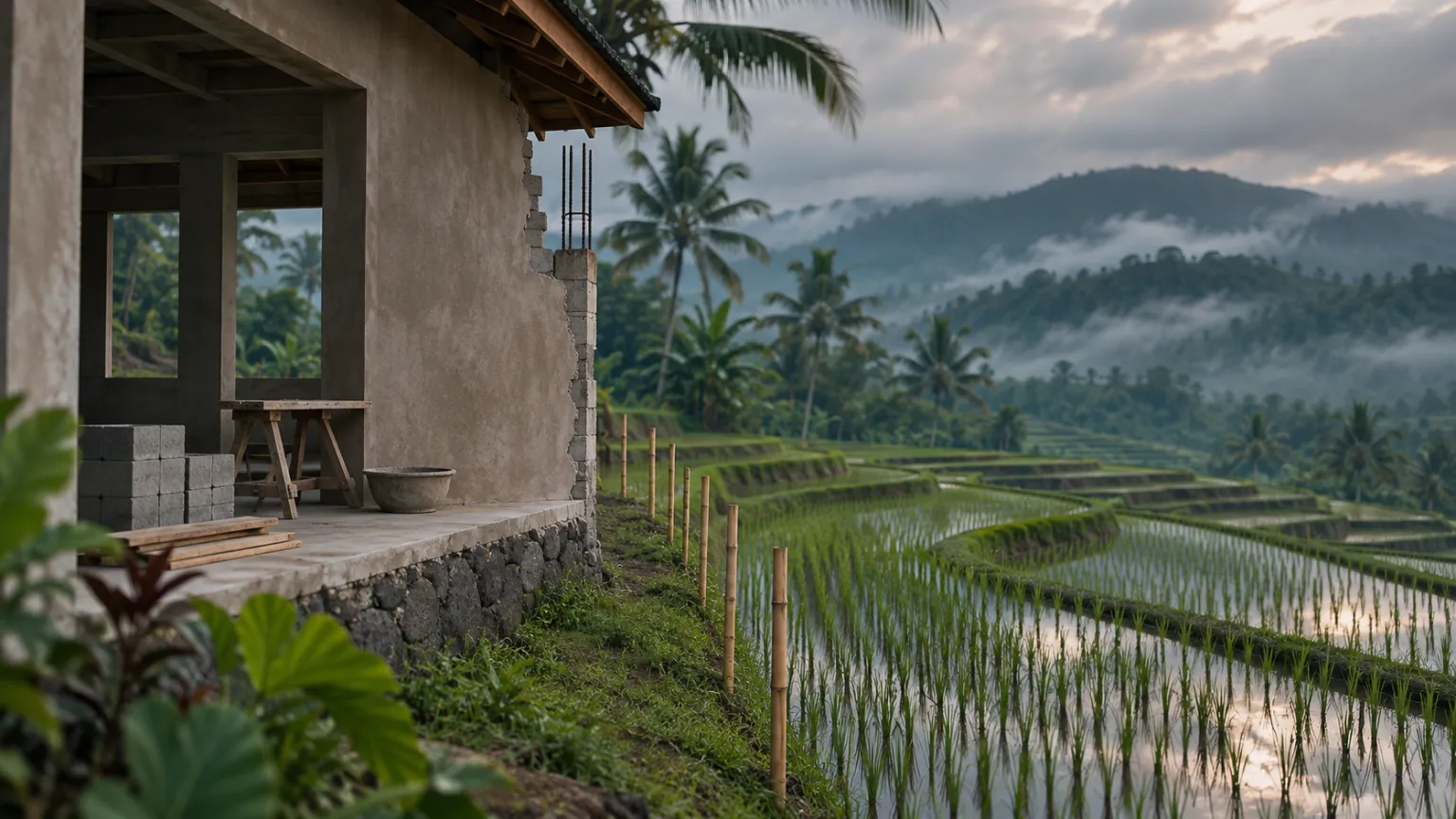 Illustration
Key takeaways
- - Green zone is a market label. The binding layers are LP2B, LSD, RDTR zone codes and setbacks (Law 41/2009; Perpres 59/2019).
- - Law 41/2009 Article 44(1) prohibits converting designated LP2B land, and Article 72(1) sets up to 5 years' imprisonment and a fine of up to Rp 1,000,000,000 (both unchanged by Law 6/2023, which amended Article 44(2) and Article 73).
- - Bali's LP2B is about 62% of baseline rice land, 39,973 ha against 64,474 ha, versus an at-least-87% national target (BPS Bali 2024 via ATR/BPN minister, Antara, 25 November 2025; directional).
- - BPN Bali reported 6,521 ha of rice fields lost over 2019–2024, 9.19%, with Denpasar at 38.83% and Gianyar at 18.85% (detikBali, 17 September 2025; directional).
- - Gianyar's council set 9,232.65 ha as LSD in a draft 2023–2043 plan, and the draft dropped green lanes as no-build zones (Antara Bali, 30 January 2023; directional, draft).
- - KKPR is the first gate in OSS-RBA under PP 28/2025, in two forms, Konfirmasi and Persetujuan, and it speaks to the plan and not to title or setbacks (Hukumonline, 23 July 2025; Prolegal on Article 15, 3 July 2025; directional).
- - Four 2025 cases show the pattern, Ubud sealed 23 June, Bingin demolitions from 21 July, Canggu markers 28 October, Munggu seal recommended 30 December (Bali Discovery, The Bali Sun, detikBali; directional).
- - The desk did not read the provincial Perda 2/2023 articles or any Badung, Gianyar or Tabanan RDTR text, and it ran no live GISTARU query, so the weak points are disclosed in the article.
On this page (10)
What counts as a green zone for villas in Bali?
A villa cannot lawfully be built on land that Bali's spatial plans reserve for food agriculture, and the market calls that land a green zone. In Bali the binding categories are narrower than the label. They are LP2B (sustainable food agricultural land), LSD (protected rice fields), the agricultural and protected zones of each regency's detailed spatial plan, and the statutory setbacks along rivers and coasts. Land is green in law only when one of these layers covers it.
The provincial plan sets the frame and the regency plan draws the line. The provincial spatial plan is Perda Provinsi Bali No. 2 of 2023, covering 2023–2043. The desk located that text but did not read its articles, so it makes no claim about its wording. The lines that decide a parcel sit in the regency plans and in the detailed spatial plan, the RDTR, which carries zoning rules by district. For Badung, Gianyar and Tabanan, the RDTR is the instrument that decides.
'Green zone' is a market term, and the gap between label and layer costs money. In the texts the desk read, no official definition of the phrase appeared. A broker's green zone may mean a protected rice field, an agricultural zone, a river border or a cliff-edge strip. Each carries a different rule, a different map and a different enforcing authority. The principal who accepts the label without the layer has not yet identified the restriction.
This article covers the spatial restriction and nothing else. It does not revisit the moratorium or the permit calendar, which Victaura Research treats separately. It names no price. It reads statutes where the desk could open them and dated press reports where it could not find a primary record.
Land is green in law only when a map layer says so. Everything else is a label.
Victaura Research
Can LP2B farmland in Bali be converted to villas?
No, not for a private villa on the text the desk read. LP2B (Lahan Pertanian Pangan Berkelanjutan) is farmland designated for protection so that it keeps producing staple food. Law No. 41 of 2009, Article 1(3), defines it as a parcel of agricultural land designated to be protected and developed consistently to produce staple food for national self-reliance, security and sovereignty.
Article 44(1) prohibits converting land once it is designated. Article 44(2), as amended by Law No. 6 of 2023, allows conversion only for the public interest or national strategic projects. Article 44(3) then sets four conditions, namely a strategic feasibility study, a conversion plan, release of the owner's rights, and replacement land. The desk found nothing in the text that treats a private villa as a public-interest use.
The criminal penalty is explicit. Article 72(1) provides imprisonment of up to five years and a fine of up to Rp 1,000,000,000 for an individual who converts LP2B land. Article 72(3) adds one third where an official commits the act. On 18 December 2025 the ATR/BPN minister, Nusron Wahid, said that only national strategic projects and public-interest uses may convert LP2B, and that liability reaches the applicant, the permit issuer and officials who allow it.
Replacement land is the practical gate. In the same speech, as reported by CNBC Indonesia on 19 December 2025, the minister gave replacement ratios of three times the area for irrigated land, two times for reclaimed sawah (rice fields) and once for non-irrigated land. Replacement cannot be existing sawah. These ratios come from a press account of a speech and not from a regulation the desk opened, so they are directional.
The Job Creation amendment did not open LP2B to private villas. Law No. 6 of 2023, Article 124, rewrote Article 44(2) to allow conversion for the public interest and/or national strategic projects, and rewrote Article 73 on officials who issue non-conforming approvals. Article 44(1) and Article 72 keep their 2009 wording. The desk read the amendment in a Wikisource transcription of the gazetted text.
How much of Bali's rice land is protected?
Bali's protected farmland is smaller than its rice-land base, and the gap is the pressure point. The ATR/BPN minister said on 25 November 2025 that Bali's LP2B stands at about 62% of its baseline rice land (lahan baku sawah), citing BPS Bali data for 2024 of 64,474 hectares of baseline and 39,973 hectares of LP2B. The national target he cited, from Perpres 12/2025, is at least 87%. The figures are directional, press-reported, because the desk read them through Antara and not through BPS Bali tables.
The unprotected 24,501 hectares sit outside LP2B, which does not make conversion lawful. That is the desk's subtraction of the two figures, not a published number, and it assumes both series are measured on the same basis, which the desk could not confirm. Land outside LP2B may still sit in an agricultural zone of an RDTR or under LSD. It is simply not covered by the 2009 statute.
LSD is a separate layer, set by map. Perpres 59/2019 on controlling rice-field conversion, as described by the Cabinet Secretariat on 12 September 2019, has local governments agree the area to protect, a joint team synchronise it, and the Minister of ATR/BPN set the protected map, which is then integrated into regency spatial plans as LP2B. In Gianyar, the regency council set 9,232.65 hectares as LSD in a draft spatial plan for 2023–2043 on 30 January 2023, down from 10,514 hectares in an earlier ministerial designation after re-verification in October 2022. That is directional, press-reported, and about a draft.
Losses are real but poorly measured. BPN Bali told the Bali regional council in September 2025 that rice fields fell by 6,521 hectares over 2019–2024, or 9.19%. Denpasar fell 38.83% and Gianyar 18.85%. Tabanan fell least, which BPN attributed to its large area including LSD. No Badung figure was given in the report. BPN attributed the losses mainly to changes in spatial plans that reduced protected land, and the method of measurement was not described.
What does the RDTR add in Badung, Gianyar and Tabanan?
The RDTR is where a parcel receives its zone. The RDTR (Rencana Detail Tata Ruang) is the detailed spatial plan with zoning rules for a district. Under Article 15 of PP 28/2025, as summarised by Prolegal, a location inside an RDTR integrated with OSS receives a Konfirmasi KKPR (Kesesuaian Kegiatan Pemanfaatan Ruang, conformity of the activity with the spatial plan), and a location outside it needs a Persetujuan KKPR. A code such as P1, agricultural land in Badung's RDTR, decides which activities the zone allows.
Badung's Mengwi corridor shows the code in practice. detikBali reported on 30 December 2025 that the road to Munggu beach in Mengwi is recorded as zone P1 in Badung's RDTR and designated LP2B. The special committee of the Bali regional council on spatial planning, assets and permits, Pansus TRAP, recommended sealing a padel club there. The case concerns a sports venue and not a villa, and the desk uses it only to show how the zone code is applied.
Gianyar's plan has changed its categories, so the date of the map matters. Antara Bali reported on 30 January 2023 that the draft regency plan for 2023–2043 no longer lists green lanes, jalur hijau, as no-build zones, a change from the previous plan. The same report said the council urged a regent's regulation on the RDTR to follow quickly. A principal holding an older map may be reading a category that the current plan has dropped. This is directional, press-reported, and about a draft.
Gianyar publishes RDTR documents by district, and Tabanan was not tested. The desk found a regency portal hosting RDTR files for individual districts, including Tegallalang, and did not open the document. For Tabanan it found no RDTR text. The only Tabanan evidence in this article is the BPN Bali remark that the regency lost less rice land because much of it is LSD.
Whether an RDTR is in force and integrated into OSS is the first question for any parcel. It decides which KKPR route applies and whether the zone code can be read parcel by parcel. The principal should obtain the regulation number and date of the plan in force for the district, and not a summary from the seller.
How does OSS-RBA test a villa parcel for spatial compliance?
OSS-RBA is the national licensing portal, and KKPR is its first gate. The portal, Online Single Submission with a risk-based approach, runs under Government Regulation No. 28 of 2025. Corry Agustina of ATR/BPN, quoted by Hukumonline on 23 July 2025, said KKPR is the entry point for licensing on land and sea, and that all KKPR for business activities must be applied for and issued through OSS. A villa let to guests would on that wording fall under business activities, though the desk found no text that says so for villas specifically.
KKPR comes in two forms with two routes. Hukumonline names Konfirmasi KKPR and Persetujuan KKPR for business activities and does not explain the difference. Prolegal, a legal consultancy citing Article 15 of PP 28/2025 on 3 July 2025, says the first applies to locations covered by an RDTR integrated with OSS and is issued automatically, and the second to locations outside that coverage, after document review. The desk did not open the regulation text itself.
A KKPR speaks about the plan, not about the parcel's history. It states that a planned activity matches the spatial plan. It does not certify title, a surveyed setback or the lawfulness of earlier construction. The Canggu case shows the point. Satpol PP Badung, the regency's civil service police, cited no land rights, no building approval (PBG) and no functional-worthiness certificate (SLF), and the report does not mention KKPR.
The Munggu owner reportedly held an OSS recommendation only. detikBali reported that the padel club had an OSS recommendation, and that the zone does not permit non-agricultural business use, so the business was treated as unpermitted. The desk cannot say which document the owner held. It can say that a paper issued through OSS and a KKPR matching the zone are different things to ask for.
The principal should ask for the KKPR document itself. The request is for its number, its date and the coordinates it covers, matched to the parcel boundary on the certificate. That is the desk's practical sequencing and not a published procedure.
How can a principal read GISTARU maps before signing in Bali?
GISTARU is the ministry's web viewer for spatial plans. A paper in Undip's journal Geoplanning describes it as a web-based spatial information system developed by ATR/BPN, made of RTR Online and RDTR Interactive. The same paper reports inconsistencies in the data entered in the two modules, and the desk did not verify those data. A viewer result is therefore a first screen and not a certificate.
A workable check runs in five steps. First, take the certificate and the parcel coordinates from the notary. Second, place the coordinates on the district's RDTR layer. Third, check the LP2B and LSD layers against the regency plan. Fourth, check river and coastal setbacks, which the Canggu case shows can remove part of a built plot. Fifth, obtain the KKPR from the seller and compare it with the viewer. The sequence is the desk's own and no authority publishes it in this form.
Disagreement between layers is a finding. If the viewer shows agriculture and the seller says tourism, the question is which regulation, with which date, is in force. The Gianyar change on green lanes shows that plans move. The principal should not average the two answers.
A clean result is not a clearance. It records the absence of a finding on the day the map was read. The desk did not run a live GISTARU query on any parcel for this article, and it names no parcel as cleared or restricted.
A clean map check is the absence of a finding on the day the map was read. It is not a clearance.
Victaura Research
Which Bali buildings were sealed or demolished in 2025?
Gianyar sealed one villa and Badung demolished buildings at Bingin, and only some 2025 cases are green-zone cases. The table sets out four, with the ground each authority gave. Two concern farmland or agricultural zoning, one a river border and one a beach site on alleged state land. The desk found no official enforcement register for Bali, so the list is not complete.
Ubud, 23 June 2025. Bali Discovery reported on 19 August 2025 that Gianyar's Satpol PP sealed Green Flow Villa at Sayan, for use of land reserved exclusively for traditional agriculture. Local administrators had issued written warnings and official recommendations since 2024, the report said. The Bali Police were investigating criminal charges against the owner. An elder of the subak, the traditional irrigation association, said the original agreement covered roadway access only.
Bingin, 21 July 2025. The Badung government began demolishing buildings at Bingin Beach under a warrant from the Regent dated 15 July 2025, issued in response to a letter from the provincial government. The Bali Sun reported on 18 July 2025 that notices covered 45 buildings, citing violations of spatial planning and environmental rules and alleged encroachment on state land. On 23 July 2025 the same outlet reported 48 buildings demolished, and the counts are not reconciled here. Bingin sits on the Uluwatu cliff line, where Victaura publishes a project page for Uluwatu, and this article assesses none of that land.
Canggu, 28 October 2025. detikBali reported that Satpol PP Badung placed stakes, enforcement tape and a stop-activity notice on a villa that BPN and the river basin authority found to stand on a riverbed and river border, occupying about 2.5 are, or 250 square metres. Officials said the building had no land rights, no PBG and no SLF. The operator received a second warning to self-demolish. This is a setback case and not a farmland case.
Munggu, 30 December 2025. The Badung RDTR zone P1 and LP2B designation described above led the Bali council committee to recommend sealing a padel club, with Satpol PP Bali to carry out the seal. It is a use case and not a villa case.
| Date | Place | Action | Stated ground | Grade, channel |
|---|---|---|---|---|
| 23 June 2025 | Sayan, Ubud, Gianyar | Satpol PP Gianyar sealed Green Flow Villa; Bali Police investigating | Use of land reserved for traditional agriculture; subak says agreement covered road access only | Directional, press-reported (Bali Discovery, 19 August 2025) |
| 21 July 2025 | Bingin Beach, Badung | Demolition began under the Regent's warrant of 15 July 2025 | Spatial planning, environmental rules, alleged encroachment on state land; 45 buildings served notices, 48 demolished by 23 July per The Bali Sun | Directional, press-reported (The Bali Sun, 18 and 23 July 2025) |
| 28 October 2025 | Canggu, Kuta Utara, Badung | Satpol PP Badung placed markers and issued a second warning to self-demolish | Villa on riverbed and river border (about 2.5 are); no land rights, PBG or SLF | Directional, press-reported (detikBali, 28 October 2025) |
| 30 December 2025 | Munggu, Mengwi, Badung | Council committee recommended sealing a padel club; Satpol PP Bali to execute | Zone P1 and LP2B in Badung's RDTR; non-agricultural business use not permitted; not a villa | Directional, press-reported (detikBali, 30 December 2025) |
What do the Bali cases show about how enforcement unfolds?
In Ubud and Canggu, enforcement ran through warning, seal, self-demolition and order. In Ubud, written warnings and recommendations had gone out since 2024 before the seal of 23 June 2025. In Canggu, a first warning preceded the second of 28 October 2025, and the next step named by Satpol PP Badung was a joint enforcement hearing and a demolition order requested from the Regent. In Bingin the Regent's warrant of 15 July 2025 answered a letter from the provincial government.
A sealed villa can still be bookable. Bali Discovery reported on 19 August 2025 that the sealed Green Flow Villa was still bookable on several online booking sites. A listing is not evidence of conformity, and a principal should not read operating history into a booking page.
Where the loss falls matters to underwriting. A seal or a demolition order lands on the asset and not on the operator's brand. For a lender or a co-investor, the exposure is a stranded building and a legal process on two tracks, administrative and, in Ubud, a criminal investigation by the Bali Police.
Selective enforcement is not a margin of safety. Critics quoted in the press say the authorities act on some sites and not others. The desk cannot test that claim. A circulating figure of more than 1,000 unpermitted villas on green zone carries no stated method and is not used here. A principal who relies on being overlooked is underwriting the regulator's attention, which the principal does not control.
A listing is not evidence of conformity. Green Flow Villa stayed bookable while sealed.
Victaura Research
Where is this research weakest on Bali's green-zone record?
The provincial text was located and not read. The desk found Perda Provinsi Bali No. 2 of 2023 on the national regulation portal. The server did not respond when the desk tried to open the file, so no article of the plan is quoted or characterised here.
The district layer is thin. No RDTR text for Badung, Gianyar or Tabanan was read in full. The zone code for Mengwi comes from a news report. Whether each regency has an RDTR in force and integrated with OSS is not established here.
Most numbers are press-reported. The 6,521 hectares come from a BPN Bali official speaking to the regional council, and the method was not described. The 62% figure rests on a minister's remarks citing BPS Bali, and the desk did not open the BPS Bali tables. The 24,501 hectare gap is the desk's subtraction and assumes both series share a basis. All are directional.
Counts and scopes conflict. Reports on Bingin give more than 40, 45 and 48 buildings. Walhi Bali, cited by detikBali, estimated about 2,000 hectares of rice fields lost per year, which sits beside BPN's 6,521 hectares over six years on a different basis. The desk does not reconcile them.
The law has moved in part. Law No. 6 of 2023, Article 124, amended Article 44(2) of the 2009 statute and rewrote Article 73, leaving Articles 44(1) and 72 unchanged; the desk read it in a Wikisource transcription of the gazetted text. PP 28/2025 was read through Hukumonline and a Prolegal summary of Article 15, not the regulation text. The minister's remarks of 25 November 2025 on a moratorium for active farmland are a stated position, and Bali's Perda No. 4 of 2026 on controlling productive-land conversion, reported by RRI on 6 March 2026, was not read here. No parcel linked to Victaura is assessed here.
What should the principal ask before signing on a Bali parcel?
The principal should ask which layer covers the parcel, in writing. The answer names LP2B, LSD, an RDTR zone code or a setback, with the regulation number and date. A reply that says only that the land is not green zone does not answer the question.
The principal should ask for the KKPR, the PBG and the SLF as separate papers. The Canggu case shows each can be missing independently, and the Munggu case shows the zone can bar the activity whatever else exists.
The principal should price the enforcement chain and not the single event. In Ubud and Canggu the steps ran in sequence, while Bingin went from the Regent's warrant to demolition in six days. For an individual who converts LP2B land, Article 72(1) sets a ceiling of five years' imprisonment, a provision Law 6/2023 left unchanged.
The cliff line and the farmland belt call for different checks. Uluwatu's coastal strip raises state-land and setback questions, as Bingin showed on 21 July 2025, and the desk's reading of shell and core on the Uluwatu cliff line covers the build stage. Mengwi's and Ubud's paddies raise LP2B and zone-code questions. The 2026 villa licence delisting covers the separate question of licence status.
Skin in the game disclosure. Victaura, through its parent Greystone B.V. (Netherlands), develops projects on Lake Como (Italy), in Nungwi, Zanzibar (Tanzania), on Gili Air and in Uluwatu, Bali (Indonesia), and holds an off-plan capital position on Al Marjan Island, Ras Al Khaimah (UAE). Readers should assume commentary may be influenced by, or benefit, these positions. This document is classified as marketing material under MiFID II Article 24(3). It is not investment advice.
References
- Republic of Indonesia, Undang-Undang No. 41 Tahun 2009 tentang Perlindungan Lahan Pertanian Pangan Berkelanjutan (full text, JDIH Kementerian Keuangan)
- BPK, Undang-Undang No. 41 Tahun 2009, record page
- Sekretariat Kabinet, Perpres Pengendalian Alih Fungsi Sawah Telah Terbit (Perpres No. 59 Tahun 2019), 2019
- Pemerintah Provinsi Bali, Peraturan Daerah Provinsi Bali No. 2 Tahun 2023 tentang RTRW Provinsi Bali 2023-2043
- Republic of Indonesia, Undang-Undang No. 6 Tahun 2023 (Penetapan Perppu Cipta Kerja), Pasal 124 amending Law 41/2009, Wikisource transcription of the gazetted text
- Hukumonline, Penting, Ini yang Perlu Diperhatikan dalam Proses Pengajuan KKPR sesuai PP 28/2025, 23 July 2025
- Prolegal, Ketentuan Baru Mengenai KKPR dalam PP 28/2025, Apa yang Perlu Diketahui Pelaku Usaha?, 3 July 2025
- Universitas Diponegoro, Geoplanning journal paper on GISTARU (RTR Online and RDTR Interactive)
- Pemerintah Kabupaten Gianyar, RDTR Kecamatan Tegallalang (validation portal)
- Antara Bali, DPRD Gianyar tetapkan 9.232,65 ha sawah dilindungi, 30 January 2023
- Antara, Menteri ATR ingatkan Bali soal LP2B di bawah lahan baku sawah, 25 November 2025
- CNBC Indonesia, Tak Boleh Sembarangan, Ubah Fungsi Lahan Sawah Wajib Ganti, 19 December 2025
- detikBali, 6.521 ha sawah di Bali lenyap dalam enam tahun terakhir, 17 September 2025
- Bali Discovery, Village at Odds with Russian Owner of Ubud's Green Flow Villa, 19 August 2025
- The Bali Sun, Demolition of tourist favourite hangouts in Bali's Bingin Beach begins, 18 July 2025
- detikBali, Vila pencaplok sungai di Canggu disegel, diminta bongkar mandiri, 28 October 2025
- detikBali, Lahan pertanian di Badung jadi lapangan padel, Pansus TRAP minta disegel, 30 December 2025
- The Bali Sun, Bali leaders reveal vision for Bingin Beach after demolitions at tourist hotspot, 23 July 2025
- RRI Denpasar, Perda Pengendalian Alih Fungsi Lahan Diharap Bukan Macan Kertas (Perda Provinsi Bali No. 4 Tahun 2026), 6 March 2026
The images in this article are computer-generated illustrations, not photographs.
The information on this website is provided for informational purposes only and does not constitute an offer, solicitation, or financial advice. Indicated returns are estimates and are not guaranteed; past performance is not indicative of future results. Capital invested is at risk.
Considering an allocation to luxury real estate in the locations we operate? Speak to us about our current and upcoming projects.
Speak to Victaura →Related insights

Destinations
Bali and the Indian Ocean Villa Market
The Indian Ocean villa market is six destinations, not one. Each has a different tenure regime, a different climate exposure, and a different cycle stage. The forensic question for the foreign buyer is not where the headline arrivals are highest, it is where the structural constraint protects value and where the legal architecture allows it to be held.

Destinations
Bali Villa Licences: The 2026 Delisting Outcome
Indonesia's Ministry of Tourism told the press that 259 accommodations had been removed from eight of nine booking platforms as of 1 August 2026, from a roster of about 1,367. The count is national, no Bali split exists in the sources found, and 515 listings remain unresolved. This note sets out the licence stack behind a Bali villa listing, the outcome as reported, and what an allocator can and cannot conclude.

Market Views
Bali Luxury Villas: ADR and Occupancy, Measured
BPS star-hotel occupancy in Bali ranged from 46.61% to 69.54% across 2025, and Horwath HTL puts the island's top rate band at USD 796 ADR on 49.4% occupancy. Both are hotel figures. This article sets out what the public record measures for Uluwatu, Canggu, Ubud and Gili Air, and how a hotel number is corrected before anyone applies it to a villa.