
Value-Add Methodology
Escrow and the Payment Plan: Al Marjan Island
An Al Marjan Island payment plan is only as safe as the escrow account behind it. In Ras Al Khaimah (RAK) that account is governed by the emirate's own development law, whose 2023 text was replaced in 2026, not by Dubai's Law 8 of 2007, and the instalment schedule and the release schedule are two different clocks. This note traces the gap between them.
 Illustration
Key takeaways
- - Dubai's Law No. 8 of 2007 governs Dubai only. RAK escrow sat in Law No. 12 of 2023, issued 21 August 2023 and in force from 20 October 2023 (RAK Municipality, official text, Article 63), until Law No. 10 of 2026, issued 21 July 2026, repealed it (Lexis Middle East).
- - RAK's 2023 law required a project escrow account with a RERA-registered trustee, a main account and a sub-account per unit (Trowers & Hamlins, November 2023), and trustees remain registered under the 2026 law (Al Tamimi & Company, October 2026).
- - A RAK developer's financial plan must show a contribution of at least 20% of construction cost, and the build may not rely on off-plan sales alone, although the plan by itself does not show the cash paid in (Trowers & Hamlins, November 2023; statutory floor, kept by the 2026 law according to Al Tamimi & Company, October 2026).
- - Under the 2023 law construction payments out of RAK escrow needed RERA approval of a developer payment voucher and up to 5% of expected profits could be drawn once works passed 60% and deposits covered the remaining cost (Articles 41 and 42); the 2026 law removes the profit draw, limits disbursements to construction and other costs the Municipality Department deems necessary, and keeps the 5% retention of construction cost for one year after the completion certificate (Trowers & Hamlins, November 2023; Al Tamimi & Company, October 2026).
- - Under the 2023 law a RAK developer could mortgage off-plan units only above 50% completion, with the full loan paid into escrow (Article 21), and Article 52 barred attachment of the project and its escrow account, a bar the 2026 law is not confirmed to keep; the 2026 law moves the developer mortgage to the project land, with proceeds paid into escrow (Al Tamimi & Company, October 2026).
- - On 23 September 2026 Khaleej Times reported a Dubai Court of Cassation ruling that a developer mortgage fails if loan proceeds were not deposited in escrow, with one case cut from Dh246m to Dh93m (Khaleej Times, press-reported).
- - Since March 2026 Abu Dhabi's registry has been able to record mortgages on off-plan units for buyers who have paid 50% of the price, and the first registration, by Aldar with Abu Dhabi Commercial Bank, was reported on 4 September 2026 (The National, 13 September 2026; Khaleej Times, 4 September 2026; Abu Dhabi only).
- - Two broker listings on Al Marjan Island show a 20/30/50 plan (booking, construction, handover) and a 60/40 plan with post-handover instalments (broker-reported, accessed October 2026, not representative), so each plan needs mapping to a certified release event.
On this page (10)
What is an Al Marjan Island payment plan, and who holds the money?
An Al Marjan Island payment plan is the schedule through which a buyer funds a building that does not yet exist, and the money it collects must, by law, sit in a project escrow account held by a registered trustee. Al Marjan Island is an artificial island off the coast of Ras Al Khaimah (RAK), the northernmost of the seven emirates, and most new residential product there is sold off-plan. The plan fixes how much the buyer pays, when, and against which event. The escrow account decides what happens to those payments if the event never arrives.
An escrow account is a ring-fenced account, held by a registered trustee, that receives buyer instalments and releases them mainly for construction of that one project. It separates the buyer's cash from the developer's general balance sheet. Without it, an instalment is an unsecured loan to the developer. With it, the instalment is a restricted deposit with a defined purpose. The difference matters most if the site stalls.
Payment plans on the island vary widely, and the variation is itself information. Broker listings accessed in October 2026 show a branded-residence plan at 20% on booking, 30% during construction and 50% on handover. Another listing shows a plan it calls 60/40, with the final 30% paid over 20 months after handover and the rest of the schedule not stated. These are broker-reported marketing terms, not registered contract terms, and they are not a representative sample of the island.
The principal should read every plan as two schedules. The first is what the buyer pays. The second is what the regulator allows the developer to withdraw. Nothing in the RAK summaries reviewed requires them to coincide. The gap between them is buyer cash whose return, if the site stops, depends on the escrow rules, and the rest of this note follows that gap through the RAK statute.
The question is narrower than whether the structure is safe. An escrow account does not insure completion. It limits three of the ways in which money can be lost before completion, which are diversion by the developer, attachment by the developer's creditors, and enforcement by a lender. It does not bring back money already released for work on a site that later stops. Those three failure modes are what the statute addresses, and each is examined below against the text that could be verified.
Which escrow law applies in Ras Al Khaimah, and is it Dubai's Law 8 of 2007?
Ras Al Khaimah escrow sits in the emirate's own Law No. 10 of 2026, which repealed Law No. 12 of 2023 (Lexis Middle East; Al Tamimi & Company), and Dubai's Law No. 8 of 2007 does not apply there. Law No. 8 governs escrow accounts for real estate development in the Emirate of Dubai only. The Dubai Court of Cassation ruling reported on 23 September 2026 interprets that law, so its reach is Dubai courts and Dubai projects. For a RAK purchase it is persuasive context and nothing more. The distinction was the first thing to verify, because the market conversation often treats UAE escrow as one regime.
Until 2026 the RAK regime sat in a 2023 instrument that sources call both a law and a decree. The Ruler issued Law No. 12 of 2023 on regulating real estate development on 21 August 2023. The 2023 summaries by Al Tamimi and Trowers & Hamlins style it Decree No. 12, while Al Tamimi's 2025 note on Mondaq uses Law No. 12. Article 63 of the text published by the RAK Municipality brings it into force 60 days after issuance, which falls on 20 October 2023. The number is identical in every source reviewed. The label is not. The official text is titled Law No. (12) of 2023, and this note uses that form.
RAK had an escrow regime before 2023. The National reported on 13 July 2008 that Emiri Decree No. 22, issued on 3 July 2008, made RAK the second emirate after Dubai to require guarantee accounts for off-plan projects. The Ras Al Khaimah Investment Authority (Rakia) was the licensing body, and fines started at Dh100,000 (UAE dirhams). The 2023 text builds a different set of institutions, so the 2008 rules are not the current test for a new sale. For a project whose sale permit predates the 2023 or the 2026 law, which text governs is a question to put to the RAK regulator in writing, although Al Tamimi & Company reports that the 2026 rules on purchaser default apply to every off-plan contract without a completion certificate.
The regulator sits inside the municipality. The 2023 law set out the responsibilities of the Real Estate Regulatory Administration (RERA) within the RAK Municipality Department, an Escrow Account Trustee Register, and a committee for development projects (Articles 1, 3 and 36 of the official text). According to Al Tamimi & Company, the 2026 law abolishes that committee and moves its functions to the Municipality Department. The practical consequence is that the principal's first document request is the project's RERA registration and its off-plan sale permit.
The 2023 law reached every category of developer and buyer in the emirate. The Al Tamimi summary reports that it covered master developers, sub-developers and purchasers, and Article 2 of the official text applied it to the whole emirate, Ras Al Khaimah Economic Zones included. A buyer on Al Marjan Island therefore sat inside the same statute as a buyer in a mainland compound, whatever the master developer's own marketing structure says.
Dubai's escrow law is the one behind the Dubai court ruling reported in September 2026. It is not the one that governs a purchase on Al Marjan Island.
Victaura Research
How does the Ras Al Khaimah escrow account hold buyer payments?
Under the 2023 law every project required an escrow account in the project's own name. Trowers & Hamlins reports an escrow trustee registered with RERA, a main account for the project and a sub-account for each unit. Purchase-price receipts went into the sub-account of the unit bought. The developer and the trustee signed an escrow agreement, and the form of that agreement required the approval of the RAK Municipality Department. The structure was unit-level, which is more granular than a single pooled account.
Under the 2023 law an off-plan sale needed a permit, and the permit needed the escrow account. A guide published by dubizzle, a UAE property listings site, summarising Articles 26 to 28 and 31 reports that the developer needs an off-plan sale permit from the administration, that the project must be registered with an escrow account open, and that a sale made without the permit is considered void. Articles 26 and 27 of the official text confirm all three. The sequence was the protection. No account, no lawful sale. According to Al Tamimi & Company, the 2026 law still requires registration in the developer and project registers before any off-plan sale, and a sub-developer needs the main developer's approval before selling off-plan.
The developer must also put its own capital in. The financial plan submitted to RERA must show the developer contributing at least 20% of construction cost, and off-plan sales alone cannot fund the build (Trowers & Hamlins). Al Tamimi & Company reports that the 2026 law keeps both rules. The floor is measured against cost, not sales price, and it is a statutory minimum set in a plan. The summary does not say when or where the contribution must be paid in, so the plan alone does not show that the cash is in the escrow account. Administrative Decision No. 43 of 2026 of the RAK Municipality, dated 16 July 2026 and issued under the 2023 law, answers when. It bars the Real Estate Regulatory Administration from completing a project's registration or issuing its Project Registration Certificate until the contribution is settled and its final value approved. The decision does not say into which account the contribution is paid, it was issued five days before the law that repealed the 2023 text, and no text that could be read says whether it still applies. A developer at exactly the floor has the remaining 80% of construction financed by buyers and lenders, which is why the release rules matter.
Under the 2023 law, monthly statements and unit registration completed the control set. The dubizzle summary reports that the developer provides monthly transaction statements and must record each sold unit in the buyer's name in the initial land register, the register of off-plan sales that Trowers & Hamlins calls the Interim Real Estate Register, within five working days of the purchaser signing the contract, the period Article 31 of the official text sets. If the developer fails, the buyer may approach the administration to complete the registration. The register entry is what turns a contract into a recorded interest, and Article 31 makes an off-plan sale not recorded there void.
How are instalments tied to construction progress, and who certifies the stages?
The buyer's instalment schedule is a contract term. The developer's right to withdraw is a regulatory term. The sale and purchase agreement states the payment plan. The statute states when the trustee may pay out, which in RAK was, under the 2023 law, on RERA's written approval of a developer payment voucher (Article 41). Nothing in the summaries reviewed requires the two to match. A plan can collect a large share of the price by a date at which the regulator has approved far less in construction payments. That gap is buyer cash paid ahead of the building, and whether it comes back if the site stops depends on the escrow rules below.
Under the 2023 law, construction payments out of RAK escrow required RERA approval on a payment voucher from the developer. That is the release test reported by Trowers & Hamlins and set in Article 41 of the official text. The certifying event was therefore the regulator's approval of each voucher, not a buyer-facing milestone certificate. The 2023 text required monthly progress reports prepared by the contractor and approved by the consultant, let the regulator commission engineering or accounting reports (Article 20) and had it appoint auditors for projects and escrow accounts (Article 51), but it did not tie the approval of a voucher to an independent engineer's report. Whether the 2026 law does so was not verified, and what the trustee checks before paying a voucher is a question to put to it in writing.
Dubai's text shows what a statute can and cannot say about certification. Law No. 8 of 2007 requires the escrow agent to give regular revenue and expenditure statements to the Department (Article 11), requires the estimated cost and revenue statement to be certified by an accredited chartered auditor (Article 6(6)), and makes it an offence for a consultant to knowingly certify fraudulent project reports (Article 16(6)). It does not set a table that links percentages of completion to percentages of release.
Stage of completion is a pricing concept as much as a cash concept. The companion note on stage-of-completion pricing treats the price side. The cash side is narrower. The principal should ask the developer and the escrow trustee for three items in writing, namely the milestone list in the sale agreement, the name of whoever certifies each milestone, and the escrow release test that corresponds to it. A plan that cannot be mapped to those three items is a date schedule, not a progress schedule.
Under what conditions do funds leave the Ras Al Khaimah escrow account?
Funds leave mainly for construction, on approval, and under the 2026 law other costs leave only if the Municipality Department deems them necessary. The account is dedicated to the project. The law-firm summaries identify two exits, which are payments for construction approved by RERA and the release of the retained sum after completion. The dubizzle guide adds a third, refunds to buyers before a project is cancelled. The official 2023 text allowed two more with the regulator's approval, up to 5% of deposits for marketing (Article 41) and up to 5% of expected profits once works passed 60% and deposits exceeded the cost of the remaining works (Article 42). According to Al Tamimi & Company, the 2026 law removes the profit draw, ends marketing as an entitlement and limits disbursements to construction and other costs the Municipality Department deems necessary. Both laws bar paying for the land from the account before the completion certificate (Article 41; Al Tamimi & Company).
The retention is the buyer's defects reserve. The trustee retains 5% of total construction cost for one year from the construction completion certificate (Trowers & Hamlins), a sum Article 35 of the 2023 text assigns to defects appearing after completion and the 2026 law keeps, according to Al Tamimi & Company. Dubai's law uses the same percentage on a different base and with a different clock. The escrow agent retains 5% of the account's total value once the completion certificate is issued, and the developer receives it one year after units are registered in purchasers' names (Article 14). Article 14 does not state what the sum is for, and the Dubai Land Department's FAQ describes it as a guarantee that the developer or contractor fixes defects visible at completion or appearing within one year of handover. Both are statutory terms rather than market practice.
Lender money is the second inflow, and the statute treats it as the dangerous one. Under the 2023 law a RAK developer could mortgage off-plan units only once construction exceeded 50%, the mortgage had to sit over units still registered to the developer, and the full loan had to be paid directly into the project's escrow account (Article 21, as Mondaq and Trowers & Hamlins also report). The same article required the sale contract of a mortgaged unit to state the mortgage, and the purchaser to be registered subject to the lender's mortgage. A unit could therefore be sold while it secured the developer's loan, and the sale agreement is where that shows. According to Al Tamimi & Company, the 2026 law replaces the unit mortgage with a mortgage of the project land, with the proceeds deposited into escrow. A bank that wires proceeds to the developer instead of the trustee has not met the condition, and what that does to its mortgage in RAK is untested.
Article 52 of the 2023 law closed the loop in the buyer's favour. The official text barred precautionary attachment or distraint on the development project and on the funds in its escrow account, and kept both outside the general guarantee of the developer's creditors. Mondaq reads this as a restriction that may undermine the practical value of the lender's security, and it does not say how far enforcement against the mortgaged units themselves reaches. For the allocator this was the cleanest sentence in the 2023 regime. Al Tamimi & Company's note on the 2026 law does not mention an equivalent, so whether the new law keeps it is unverified.
What did the Dubai Court of Cassation decide on escrow and developer mortgages?
As reported on 23 September 2026, the Dubai Court of Cassation held that a developer's mortgage fails if the lending bank did not pay the loan into the project's escrow account. Khaleej Times quoted a BSA Law senior associate saying that such a mortgage is deemed as if it never existed and that the bank's good faith does not change the outcome. The legal basis is Law No. 8 of 2007, Article 13 of which requires the lender to deposit the loan amount in the escrow account.
The remedy is described differently by different sources. Khaleej Times frames the outcome as invalidity. In the example it gives, a mortgage was reduced from Dh246 million to Dh93 million because only Dh93 million had actually been deposited. Al Tamimi's note on the same line of authority is titled as limiting the security to funds actually deposited in escrow. The two are reconcilable, because the mortgage is worth what reached the account. The judgment itself could not be retrieved.
The ruling is Dubai law, and the link to RAK is structural, not binding. Article 21 of RAK's 2023 law used the same architecture, with full loan proceeds paid to escrow as a condition of the mortgage. No RAK court decision on the point was found in the sources reviewed. The inference that a RAK court would reason the same way is analytical and untested, and it should be read as such.
For a buyer the point is about priority. A lender whose security shrinks to the funds it actually deposited has a smaller claim on the units and the land. Under the 2023 law the buyer's cash in the escrow account was shielded by Article 52. The unit was a different matter. On a unit the developer had mortgaged, the purchaser was registered subject to the lender's mortgage (Article 21; Trowers & Hamlins), so on that unit the lender's claim sat ahead of the buyer's. That is the reason the lender's deposit discipline is a buyer-side risk factor. Under the 2026 law the mortgage sits on the project land, and this note does not establish how it ranks against purchasers of units on that land, a question to put to RERA in writing.
In Dubai, a lender's security is worth the money it actually paid into the account. A buyer's escrow refund is bounded by what is still in the account when a site stops.
Victaura Research
What does Abu Dhabi's construction-stage mortgage change for an Al Marjan Island buyer?
For an Al Marjan Island buyer it changes no rule, because the framework applies in Abu Dhabi and no RAK equivalent was found in the sources reviewed. Abu Dhabi now lets a buyer who has paid 50% of the price finance an off-plan unit with a registered mortgage. The National reported on 13 September 2026 that the Abu Dhabi Real Estate Centre (ADREC) has had its capability to register mortgages against off-plan units operational since March 2026. A buyer can therefore finance the balance during construction rather than waiting for handover. As of 11 October 2026 this is an ADREC framework that applies in Abu Dhabi.
The first registration under the framework was reported on 4 September 2026. Aldar completed it with Abu Dhabi Commercial Bank. Participation is limited to developers and lenders that meet ADREC's requirements, and CBRE's Matthew Green described the 50% payment threshold as a restriction. Gulf News reported Aldar as saying the 50% threshold aligns with UAE Central Bank regulation, but the reporting did not publish the requirements a developer or bank must meet to take part. The registry capability is about seven months old and, in the public reporting reviewed, one registration old.
The market context is directional. The National's article reported that off-plan transactions made up 89% of Dh70.4 billion in residential sales in the first half of 2026, and that mortgages rose by a third to Dh26.7 billion across 8,876 transactions, without stating the comparison period. These are press-reported aggregates, and they describe Abu Dhabi. They are not evidence about Al Marjan Island.
Whether RAK has an equivalent is not established. The sources reviewed describe developer mortgages in RAK under Article 21. They do not describe a purchaser's registered mortgage on an off-plan unit before completion. That absence is a finding about the sources, not about the law. Where a buyer cannot finance during construction, the plan's later instalments must be funded from cash or other borrowing, which changes how the back end of the plan is underwritten.
What does the buyer keep in Ras Al Khaimah if the project stops or the contract ends?
If the project stops, what the buyer recovers is decided by a statutory committee, and if the buyer defaults, what the developer may keep is capped by a statutory table. Al Tamimi's summary reports that the 2023 law gave the Projects Committee authority over stalled projects, provided for termination of sale agreements on purchaser default, and addressed developer liability for construction defects. Article 50 of the official text set four bands of what a defaulting purchaser could lose, from up to 40% of the price above 80% completion to up to 20% of the sums paid where works never started through no fault of the developer. According to Al Tamimi & Company, the 2026 law sets three caps on the unit price, 40% at 60% completion or more, 25% below 60% and 20% in the same no-fault case, drops auction and forced completion as self-help remedies, and requires the refund to be paid to the purchaser, or deposited with the Municipality Department, within six months. The 2023 summary does not report remedies for delay or a general buyer right to cancel, so the sale agreement's termination clause is the first document to read on that point.
The 2023 law had a refund-first rule for project cancellation. The dubizzle summary says the committee can cancel a project, for example where the developer starts late, and that cancellation proceeds only after all buyer payments are refunded and dues to contractors, consultants and trustees are settled, which Article 24 of the official text confirms. According to Al Tamimi & Company, the 2026 law gives stalled and cancelled projects to a Judicial Committee that can cancel a project and set the priority of purchaser refunds and creditor claims, so whether refunds still come first is that committee's decision.
Dubai's text is explicit about the same scenario, which is useful for contrast. Article 15 of Law No. 8 of 2007 requires the escrow agent, after consulting the Department, to act so that the project is completed or depositors are refunded. The closest RAK provision found, Article 24 of the 2023 law, makes the refund a condition of cancellation rather than a duty of the trustee. Dubai's refund mechanics should not be imported into a RAK contract by assumption.
Escrow bounds the recovery at what is in the account. A refund out of escrow can only be paid from what was deposited and not already released for work performed. As an illustration only, if buyers have paid 40% of the total price and an amount equal to 35% of that price has been released and spent on a site that then stops, the refundable pool is the difference, 5% of the price, and not the sum paid. This is arithmetic, not a finding, and in RAK the order of claims now sits with the Judicial Committee that Al Tamimi & Company describes.
| Item | Dubai, Law No. 8 of 2007 | Ras Al Khaimah, Law No. 12 of 2023 (repealed) and, per Al Tamimi, Law No. 10 of 2026 |
|---|---|---|
| Account structure | One account per project, dedicated exclusively to construction (Article 9) | 2023: account in the project's name with a registered trustee, main account plus a sub-account per unit. 2026 (Al Tamimi): trustees still registered, structure not reported |
| Release test | Regular revenue and expenditure statements to the Department (Article 11). No milestone table in the text | 2023: construction payments on RERA's written approval of the developer's voucher (Article 41). 2026 (Al Tamimi): construction and other costs the Department deems necessary |
| Retention | 5% of account value once the completion certificate is issued, released one year after units are registered to purchasers (Article 14) | 5% of total construction cost held for one year from the completion certificate; unchanged in 2026 (Al Tamimi) |
| Developer equity | Not set out in Law No. 8 of 2007. BSA Law attributes a 20% construction-cost deposit to Law No. 9 of 2007 | At least 20% of construction cost, shown in a financial plan submitted to RERA; unchanged in 2026 (Al Tamimi) |
| Lender proceeds | Lender must deposit the loan in the escrow account (Article 13). Court of Cassation reported 23 September 2026 | 2023: more than 50% completion, mortgage over units, full loan paid directly into escrow (Article 21). 2026 (Al Tamimi): mortgage of the project land, proceeds into escrow |
| Project stops | Escrow agent must ensure completion or refund of depositors (Article 15) | 2023: committee authority over stalled projects, cancellation only after buyers are refunded (Article 24). 2026 (Al Tamimi): a Judicial Committee cancels projects and sets the priority of refunds and creditor claims |
How should the principal underwrite an Al Marjan Island payment plan against the escrow?
Underwriting starts with five documents, four of them to be requested from the developer before signing. They are the RERA project registration, the off-plan sale permit, the escrow agreement or a trustee confirmation naming the account, the sale agreement with its milestone and termination clauses, and, after signing, the unit's entry in the buyer's name in the initial land register. If any of the five cannot be produced, the escrow protection described above cannot be shown to cover the unit.
The principal then maps the plan against the release test. For each instalment, the questions are what construction event it corresponds to and who certifies that event. Instalments that fall due on dates rather than on events are the ones that separate the buyer's cash from the build's progress. They are not necessarily wrong. They are the ones that need to be priced, and the price is the buyer's exposure to a stalled site between two release approvals.
Post-handover instalments are a different instrument. Where a plan extends beyond handover, as in the 60/40 listing described above, the later instalments fund no construction. They are credit extended by the developer to the buyer. Whether they sit inside or outside the escrow framework was not established in the sources, and the principal should ask the trustee which account receives them.
The same checklist applies to any off-plan position in Ras Al Khaimah, including the one disclosed on Victaura's own pages. The public Ras Al Khaimah project page describes a capital position in off-plan units built by a local developer, not a Victaura development, and this note does not test those units against the five documents.
An instalment tied to a date is paid ahead of the building. An instalment tied to a certified event is paid alongside it.
Victaura Research
What this analysis cannot establish, honestly disclosed
The law in force could not be read, and the law it replaced could. The text of Law No. 10 of 2026 was not available. On 14 October 2026 Lexis Middle East showed only its heading and preamble, the RAK Municipality's list of real estate regulations did not include it, and the emirate's legislation portal did not respond. Everything said here about what the 2026 law contains comes from Al Tamimi & Company's note of 5 October 2026 and is attributed to it. The RAK article numbers above come from the official bilingual text of the 2023 law published by the RAK Municipality.
The instrument in force has moved. Law No. 12 of 2023 was repealed by Law No. 10 of 2026, issued by the Ruler on 21 July 2026 and in force sixty days later (Lexis Middle East; Al Tamimi & Company, 5 October 2026), and the text of the new law was not read for this note. The principal should ask RERA, in writing, which text governs the specific project, the date of its sale permit, and whether decisions issued under the 2023 law, such as Administrative Decision No. 43 of 2026, still apply.
The Dubai ruling is a Dubai ruling. The facts come from one press report and one law-firm title, not from the judgment. The remedy is described differently across sources, and no RAK court decision on escrow or mortgage priority was found. Everything said above about RAK courts is inference.
Payment plan terms are marketing terms. The listings cited are broker-reported, unregistered and unrepresentative. No dataset of executed RAK payment plans was found, so no average, median or distribution is offered. The statutory percentages quoted are floors and thresholds, not outcomes observed in any project.
Skin in the game disclosure. Victaura, through its parent Greystone B.V. (Netherlands), develops projects on Lake Como (Italy), in Nungwi, Zanzibar (Tanzania), on Gili Air and in Uluwatu, Bali (Indonesia), and holds an off-plan capital position on Al Marjan Island, Ras Al Khaimah (UAE). Readers should assume commentary may be influenced by, or benefit, these positions. This document is classified as marketing material under MiFID II Article 24(3). It is not investment advice.
References
- Dubai Legislation Portal, Law No. (8) of 2007 Concerning Escrow Accounts for Real Estate Development in the Emirate of Dubai
- Khaleej Times, Dubai developer mortgages are void unless funds go into escrow, says court, 23 September 2026
- Al Tamimi & Co, Mortgage enforcement in Dubai real estate projects, court limits security to funds actually deposited in escrow, 2026
- The National, Abu Dhabi's new off-plan mortgage framework to support property market with financing at construction phase, 13 September 2026
- Khaleej Times, Aldar, ADCB complete Abu Dhabi's first off-plan mortgage under new ADREC framework, September 2026
- Gulf News, New mortgage option opens for Abu Dhabi off-plan buyers with Aldar and ADCB deal, September 2026
- WAM, Aldar, ADCB complete Abu Dhabi's first off-plan mortgage under new ADREC framework, September 2026
- Trowers & Hamlins, Updates to real estate development laws in Ras Al Khaimah, 21 November 2023
- Mondaq, Can Developers Mortgage Their Branded Residence Projects in Ras Al Khaimah?, 2025
- Al Tamimi & Co via GCC BDI, New Regulations on the Development of Real Estate Projects in Ras Al Khaimah, September 2023
- Al Tamimi & Co, New Regulations on the Development of Real Estate Projects in Ras Al Khaimah, 2023
- The National, RAK law regulates off-plan property, 13 July 2008
- dubizzle, Off-Plan Property Laws in Ras Al Khaimah (secondary summary of Law No. 12 of 2023)
- EuroEstates Properties, Protecting Off-Plan Investments in RAK, Law No. 12 of 2023
- Metropolitan Real Estate, Wyndham Residences Al Marjan Island (broker listing, payment plan, accessed October 2026)
- dubizzle RAK, Ice Beach Al Marjan Island 2 BR duplex (broker listing, payment plan, 20 August 2026)
- Property Finder, Wyndham Residences, Al Marjan Island (project listing, payment plan, accessed October 2026)
- Ras Al Khaimah Municipality, Law No. (12) of 2023 on Regulating Real Estate Development in Emirate of Ras Al Khaimah, official Arabic and English text
- BSA Law, Navigating Dubai's Off-Plan Real Estate Laws: Compliance Essentials for Developers, 20 June 2025
- Lexis Middle East, Ras Al Khaimah Law No. 10 of 2026 (21 July 2026)
- Al Tamimi & Company, Ras Al Khaimah's new real estate development law: what developers need to know (5 October 2026)
- Ras Al Khaimah Municipality, Administrative Decision No. (43) of 2026 on the developer's contribution when registering a real estate development project, 16 July 2026
- Dubai Land Department, Escrow Account Law FAQ (Article 14, 5 per cent post-completion retention)
The information on this website is provided for informational purposes only and does not constitute an offer, solicitation, or financial advice. Indicated returns are estimates and are not guaranteed; past performance is not indicative of future results. Capital invested is at risk.
Considering an allocation to luxury real estate in the locations we operate? Speak to us about our current and upcoming projects.
Speak to Victaura →Related insights
Market Views
Al Marjan Island Developers: Who Builds What
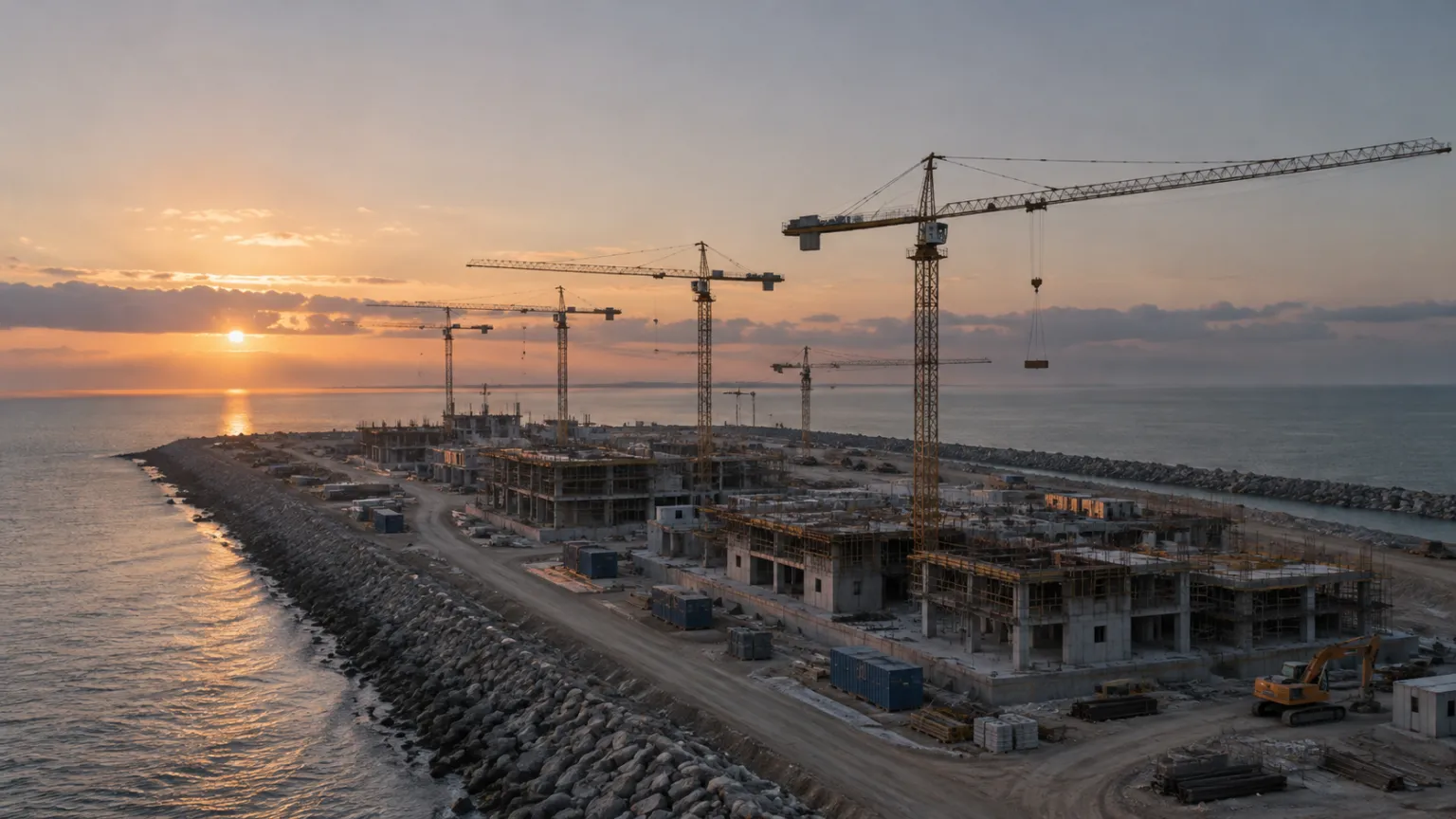
Al Marjan Island has one land authority, one anchor resort joint venture, a handful of listed regional groups and a long tail of private developers. It also has a capital layer that buys units without building anything. This note separates the layers, grades what each is documented to do, and sets out the register and escrow rules an allocator can test a name against. Victaura sits in the last layer, not the first. The note says so, and says what follows from it.
Market Views
Ras Al Khaimah versus Dubai: One UAE Exposure, Not Two
Ras Al Khaimah and Dubai are routinely presented as alternative UAE allocations. On five vectors (oil price, regional security, federal regulation, insurance and reinsurance, currency peg) they are correlated. Diversification across the two emirates is, on the evidence, a single exposure with two postcodes.
 Dossier
Branded Residences
The Resale Test: Branded Residences After Handover
Savills places the average branded residence premium at roughly 33 per cent and publishes no separate figure for resales. Whether that premium survives the secondary market is a different question, and the industry rarely asks it in public. This dossier assembles the resale evidence, Dubai transaction records, two Miami towers with six to eight years of recorded sales, and the brand-removal natural experiments, and tests the premium where it matters: at exit. With branded residences forecast by CBRE at 54 per cent of Ras Al Khaimah's new supply in 2030 and Victaura holding an off-plan capital position there, the question is not academic. The conflicts are declared. The evidence decides, and where it cannot, the dossier says so.