
Value-Add Methodology
Lake Como Villas: The Conformity Test
On Lake Como the villa a principal buys is almost always an existing building, so its legitimate state decides what can be restored and whether the deed passes. This article sets out the order of tests, from titles and condoni to the survey, the cadastral plan, the Salva Casa tolerances and the binding landscape opinion, and ends with the clause for the preliminary contract.
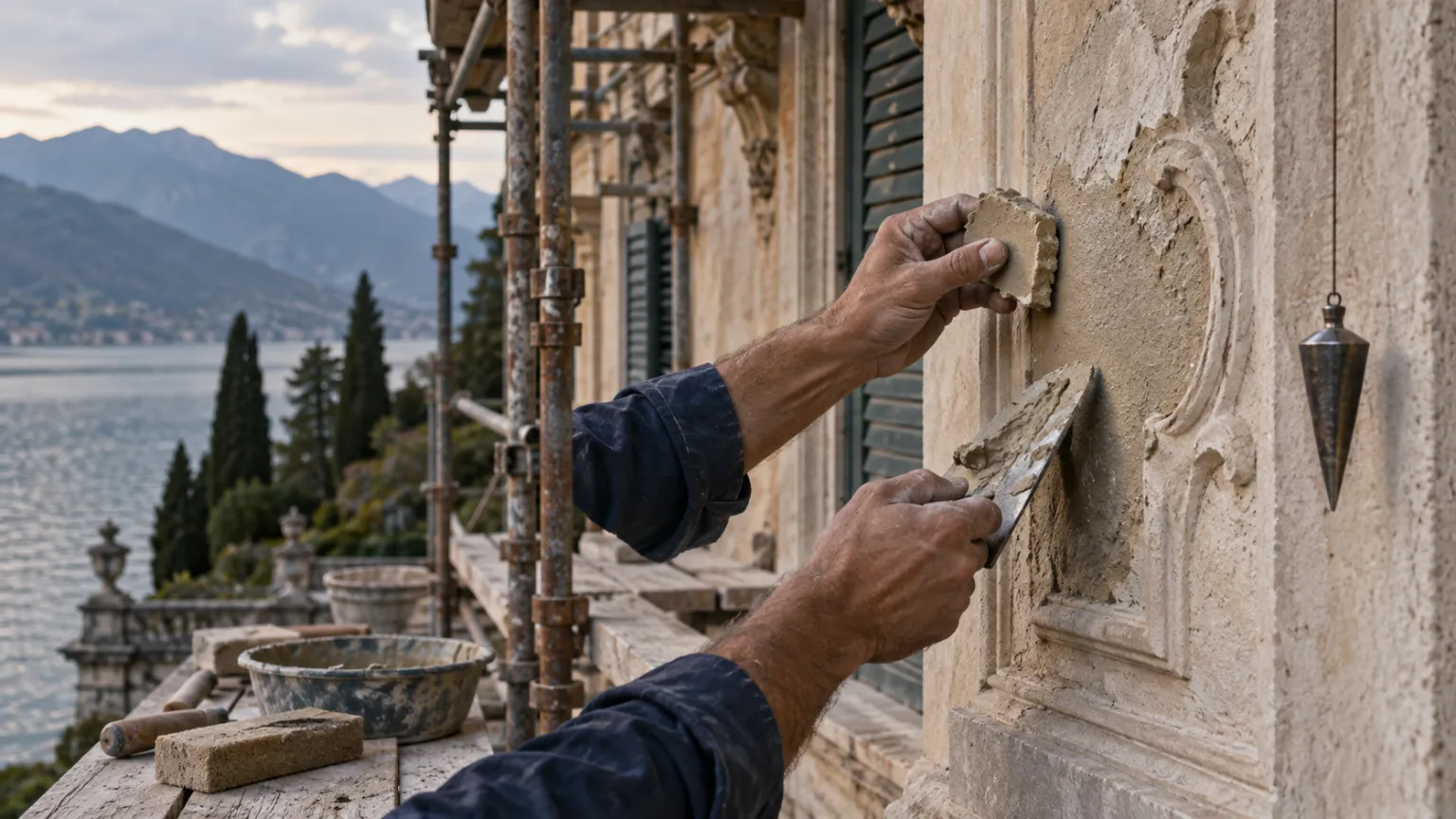 Illustration
Key takeaways
- - Legitimate state (stato legittimo) is fixed by Article 9-bis(1-bis) DPR 380/2001 through the original or last whole-building permit, and for pre-permit buildings through early cadastral data and other proof (statute, as summarised by Ingenio).
- - Land within 300 metres of a lake waterline is protected by law under Article 142(1)(b) D.Lgs. 42/2004, with carve-outs for areas zoned A or B on 6 September 1985 (statute text, Brocardi).
- - The principal's own technician should survey the villa against the municipal file and date every deviation, because the year of the work decides which tolerance applies (method, directional).
- - Salva Casa tolerances for works before 24 May 2024 run from 2% to 6% by unit size, and works after that date get a flat 2% (DL 69/2024 converted by L. 105/2024, as read by Biblus).
- - Tolerances are a detection through a technician's asseverazione and not a regularisation, and the execution tolerances of paragraph 2-bis are not relieved from landscape rules (Biblus and Emilia-Romagna region journal).
- - Article 36-bis tests urban planning at filing and building rules at execution, and in a constrained area it requires the Soprintendenza's binding opinion within 90 days, with 180 days for the whole procedure (Biblus, Lexambiente).
- - The Ministry of Culture circular of 2 April 2025 limits silent consent under Article 36-bis to marginal cases, so silence is a clock and not a clearance (Lexambiente, as summarised).
- - Corte di Cassazione ruling 27531 of 15 October 2025 holds the cadastral nullity formal and textual, and ruling SU 8230/2019 requires the deed to cite a title that refers to the sold building (Studio Legale Polidoro, Ambiente Diritto).
On this page (11)
Why does the legitimate state decide a Lake Como villa purchase?
On Lake Como, almost every villa purchase is the purchase of an existing building, and its legitimate state decides what can be restored and whether the deed can be signed. New construction on the shore is close to impossible (directional), a constraint set out in the landscape constraint on Lake Como. The principal therefore underwrites a document trail rather than a design. The test is one question. Does the building standing today match the building that the paper record says was lawfully made?
Legitimate state is a defined legal concept and not the seller's opinion. In Italian, stato legittimo, it is fixed by Article 9-bis, paragraph 1-bis of the Testo Unico dell'Edilizia (DPR 380/2001). The reference is the permit that authorised construction or legitimised the building, or the permit that governed the last intervention on the whole building, provided the administration verified earlier titles at that time. Later permits for partial works are added on top. Grade: measured, from the statute as summarised by Ingenio and Legislazione Tecnica.
For an old villa the permit itself may not exist, and the statute allows for that. Where a permit was not mandatory when the building was erected, the legitimate state is what the earliest cadastral data or other probative documents show, such as photographs, maps, archive records and acts of proven provenance. The same route applies where a permit is known to exist but no copy can be found. The principal should expect a villa from the period before building permits to be argued on this basis, and should budget the technical work accordingly.
The order of work in this article follows the order a careful principal would run it. Titles and condoni come first. Then a physical survey against those titles, then the cadastral plan, then the classification of every deviation. Only after that does it make sense to ask which Salva Casa instrument fits. This is a method for underwriting and is not legal advice. A notary and Italian counsel carry the legal opinion.
Titles and condoni to request before any survey
The request list starts with the title that created the building and ends with the title that last touched it. The principal should ask for the original permit, whether a licenza, a concessione or a permesso di costruire, every later permit, SCIA or CILA, any condono file with proof of payment and the final decision, and the habitability certificate. The principal should also ask for the approved drawings with the municipality's stamp, not the seller's photocopies.
The principal's technician should pull the municipal file directly and compare it with the seller's folder. Gaps between the two are findings. A permit with no approved drawings, or drawings with no permit, is a defect in the chain even if each paper looks fine alone. The same applies to a permit whose description does not match the building, which is the problem the Corte di Cassazione treats as fatal at the deed, as the clause section below explains.
A condono is a title only when it was completed. An application without a decision, or a decision with unpaid oblation, leaves the building in an open position. The principal should ask for the grant itself, the payment receipts and the drawings annexed to it. Where a condono covered part of the building, later enlargements need their own title. A villa with a long history of small additions is the usual case for this check.
On Lake Como the landscape layer adds a second file. A building inside the lake band may also have a landscape authorisation. The same request list applies to it, and the full inventory of what a seller or developer should be able to show is in the documents a developer should show you. A building file that is complete on building law and silent on landscape law is half a file.
| Document | What it proves | What it does not prove | Where it is checked |
|---|---|---|---|
| Original permit and later permits | The lawful volumes, layout and use at the date of issue | That the building was built as drawn | Municipal building file |
| Condono grant and payment receipts | That an unauthorised work was regularised | Works added after the grant | Municipal building file |
| Landscape authorisation | Landscape compatibility of the work when authorised | Conformity under building law | Municipal landscape office, with the Soprintendenza opinion |
| Cadastral plan | The recorded layout for cadastral purposes | Urban-planning legitimacy | Agenzia delle Entrate cadastre |
| Surveyor's as-built comparison | Today's deviations from the approved state | Their legal classification on its own | The principal's own technician |
| Technician's tolerance declaration (asseverazione) | That deviations sit inside the Article 34-bis bands | Works after 24 May 2024 beyond 2% | Single window office (sportello unico) filing |
What does the 300-metre lake band mean for a Lake Como villa?
The landscape band is a rule that attaches to the land and not a decision taken about a particular villa. Article 142, paragraph 1, letter b of the Codice dei beni culturali e del paesaggio (D.Lgs. 42/2004) declares of landscape interest “i territori contermini ai laghi compresi in una fascia della profondità di 300 metri dalla linea di battigia, anche per i territori elevati sui laghi”. In plain terms, land within 300 metres of the lake waterline is protected by law. Grade: measured, statute text.
The band has carve-outs, and they are parcel-specific. Paragraph 2 of the same article disapplies the lake band for areas that on 6 September 1985 were delimited in planning instruments as homogeneous zones A or B, among other cases. Whether a given villa sits inside a carve-out is a question for the municipal planning office and not for the broker. The principal should obtain written confirmation of the parcel's status and should not infer it from the address or the view.
Inside the band, works need a landscape authorisation, and the authorisation is a separate file from the building permit. In Lombardy, Article 81 of regional law 12/2005 requires every local authority that holds landscape functions under Article 80 to set up a landscape commission, and the Soprintendenza's opinion enters the procedure before the authorisation is released. For Como the relevant office is the Soprintendenza Archeologia, Belle Arti e Paesaggio for the provinces of Como, Lecco, Sondrio and Varese. Grade: directional on process detail, because procedure varies by municipality.
A building inside the band that was altered without that authorisation carries a landscape problem on top of any building-law problem. That is why the legitimate state of a Lake Como villa has two layers, and why the sections below keep them apart. The landscape step is walked through in the permit calendar, day by day. Victaura's public page for the Modern Villa on Lake Como sits in this setting, and nothing in this article describes that project's permits.
Surveying the villa against its approved state
The survey is a measurement against paper, and it belongs to the principal's own technician. The seller's surveyor has an interest in the answer. The principal's technician should take the approved drawings from the municipal file and measure the building against them, room by room, storey by storey and façade by façade. The deliverable is a table of deviations, each one located, measured and dated where evidence allows.
The checks that matter on a lakeside villa are the ones that change volume, footprint, height, openings and use. The technician should look for added floors or mezzanines, enclosed terraces and loggias, raised ridge lines, shifted openings, new basements, outbuildings, pergolas, retaining walls and swimming pools. Each can sit outside the approved state without the seller knowing. Differences inside the walls matter less than anything visible from the water. Grade: directional, a method note and not a statistic.
Dating each deviation is as important as measuring it. The Salva Casa tolerance for earlier works applies only to works realised before 24 May 2024, so the year a change was made decides which rule applies. Historic aerial photographs, old listing photographs, utility records and earlier deeds can fix that year. A deviation that cannot be dated should be treated as recent until shown otherwise.
The survey should be commissioned before the preliminary contract is signed, or the contract should be conditional on it. Once a deposit is paid, the seller controls the clock. The cost of a survey is small against the cost of discovering a deviation after closing, but this article quotes no fee because no verifiable source for Como-area fees was found.
A villa is only as sellable as its paper is true.
Victaura Research
The cadastral plan and the Lake Como deed
The cadastral plan is an identification and tax record, and it is checked at the deed for a different reason than the building permit. Article 29, paragraph 1-bis of Law 52/1985 requires deeds that transfer rights over existing buildings to contain the cadastral identification, a reference to the plans filed with the cadastre, and a declaration by the transferors that the cadastral data and plans conform to the actual state of the property. The sanction for omission is nullity. Grade: measured, statute as summarised by Federnotizie.
The declaration can be replaced by an attestation from a technician authorised to file cadastral updates. That option is in the statute. A principal who wants evidence rather than assurance should require the attestation and should have it checked by the principal's own surveyor.
On 15 October 2025 the Corte di Cassazione, in ruling 27531, held that this nullity is formal and textual. In the Court's reading, as reported by a law firm, validity depends on the presence of the declaration or attestation, regardless of whether it is true, unless it is manifestly false to a layperson. As reported, the ruling deals with cadastral conformity only, and the report says nothing about urban-planning conformity. Grade: measured as to the ruling, reported as to its reading.
The consequence for the principal is a gap between what the notary needs and what the principal needs. A deed can be valid with a cadastral declaration that is untrue. The principal then owns a villa whose plan does not match its walls, with the regularisation and the cadastral update still to do. A plan that matches the walls can also describe walls that were never permitted. The principal should read the cadastral plan and the building file side by side and treat any mismatch between them as a finding.
Classifying deviations in a Lake Como villa
Every deviation found on a Lake Como villa falls into one of four bands, and the band decides the tool. The first is no violation, because the deviation sits inside the Article 34-bis tolerances. The second is an execution irregularity under paragraph 2-bis. The third is a partial deviation from a permit or from a SCIA, or an essential variation, which Article 36-bis can address. The fourth is work with no title or a total deviation. Grade: directional, a framework built from the structure of the statute.
The first two bands are the ones the Salva Casa widened. Execution irregularities listed in paragraph 2-bis include lesser building dimensioning, omitted non-structural architectural elements, differing placement of internal doors and windows, and design errors corrected on site. As read by Biblus, the condition is that they do not breach technical norms on habitability and do not concern landscape-protected properties. For a villa inside the 300-metre band, that last condition needs checking by counsel before the second band is assumed.
The third band is where the real underwriting happens. Article 36-bis allows regularisation of partial deviations and essential variations on an attenuated conformity test. The work must comply with the urban-planning rules in force when the application is filed, and with the building rules in force when the work was carried out. Where the work fails either test, the route narrows.
The fourth band should be treated as a price and structure question and not as a paperwork question. Work with no title at all, or a total deviation from the permit, falls outside the categories of Article 36-bis as reported. The principal should assume the stricter regime and obtain a written opinion from Italian counsel before any deposit moves. A seller who calls such a defect a formality has told the principal something about the seller.
A tolerance is a measurement. A sanatoria is a procedure. Deeds go wrong where the two are confused.
Victaura Research
Do the Salva Casa tolerances apply to a Lake Como villa?
The Salva Casa is Decree-Law 69 of 29 May 2024, converted with amendments by Law 105 of 24 July 2024, and it rewrote the tolerance rules of Article 34-bis of the Testo Unico. The consolidated text is published on Normattiva, the official legislation portal. As of 2 October 2026 the principal should check that portal for later amendments, because the readings behind this article are secondary.
For works completed before 24 May 2024, a deviation from the approved parameters is not a building violation if it stays inside a sliding percentage. The bands run from 2% for units above 500 square metres, 3% from 300 to 500, 4% from 100 to 300, 5% from 60 to 100, to 6% below 60. The parameters covered include height, distances, cubic content and covered surface. Grade: measured, statute as read by Biblus and the Emilia-Romagna region journal. Some summaries quote 5% as the ceiling, which omits the 6% band for the smallest units.
For works carried out after that date the ordinary tolerance is a flat 2%. The ordinary regime applies to all interventions realised from 25 May 2024. A villa altered in 2025 therefore does not get the wider band, even if the unit is small. The year of the work decides, which is why the survey dates every deviation.
Tolerances are a detection and not a regularisation. They are declared through a technician's asseverazione filed with the single window office, with a check on the year of completion and, in seismic zones, on structural safety. There is no oblation because there is no violation. That is why a tolerance sits in the first band and why it needs dated proof rather than a procedure.
On landscape, the position is split. The paragraph 1-bis tolerances, as reported by Biblus and by the Emilia-Romagna journal, need no landscape authorisation for works before 24 May 2024. The execution tolerances in paragraphs 2 and 2-bis do not get that relief. On a Lake Como villa, the technician must say which tolerance is invoked for which deviation, and counsel should confirm the landscape consequence in writing.
Article 36-bis and the binding landscape opinion
Article 36-bis of DPR 380/2001 is a new conformity procedure for partial deviations, SCIA deviations and essential variations, tested on an attenuated double conformity. The classic test required conformity at the time of the work and at the time of the application. The new article splits it. Urban planning is judged at filing, building rules at execution. Grade: measured, statute as reported by Biblus and Infobuild.
In a landscape-constrained area, the municipality cannot decide alone. Paragraph 4 requires the office to ask the authority that manages the constraint for a binding opinion on landscape compatibility. The Soprintendenza has a peremptory term of 90 days, and the whole landscape procedure runs to 180 days. If the terms lapse, silent consent is provided for. Works that created or enlarged surfaces or volumes can now be assessed after the fact, where earlier law excluded them under Article 167 of the Codice. Grade: measured on the terms, directional on practice.
Silent consent is a clock and not a clearance. The Ministry of Culture circular of 2 April 2025, as summarised by Lexambiente, treats Article 36-bis as special later legislation that keeps the binding opinion of the Soprintendenza, and says silent consent after 90 days covers only marginal and residual cases. A principal who relies on silence is relying on the least safe reading.
The case law reviewed for this article points the same way. Council of State, section VII, ruling 2269 of 19 March 2025, requires a current and individualised assessment and rejects automatic outcomes. A Sicilian administrative court, TAR Catania section V, ruling 2191 of 24 June 2025, required the Soprintendenza to reason a refusal against the new article and not the old framework. Both are directional for Lake Como, since neither concerns Lombardy and the Como office is a different body.
Silence from the Soprintendenza is a clock, not a clearance.
Victaura Research
Time and cost of regularising a Lake Como villa
The statute gives caps on time, and the caps are the only time data this article can source. Reported terms are 45 days for the municipality to decide the application, with silent consent on expiry, 30 days for a SCIA filed in sanatoria under Article 19(6-bis) of Law 241/1990, and 90 and 180 days for the landscape opinion and the whole landscape procedure. Grade: measured, statute as reported by Biblus and Infobuild. No measured data on how long Como-area municipalities actually take was found.
The practical clock is longer than the statutory one, and the principal should say so in the plan. Requests for integration suspend the clock, as reported by Biblus, and the landscape step depends on the workload of the Soprintendenza. How much longer is unknown from the sources reviewed. The sound approach is to make closing conditional on completion and not on a date, and to price the carry of delay. The sequence of steps is shown in the permit calendar, day by day. Grade: directional.
Statutory sums are partial, and the two secondary sources differ. Biblus reports that for partial deviations the oblation is the building contribution in double amount, with a 20% increment unless the work conformed to both current and original rules. For SCIA deviations it reports double the increase in market value assessed by the tax authority, within a band of 1,032 to 10,328 euros, or 516 to 5,164 euros where the work conformed at both moments. Infobuild reports the SCIA multiple as double to triple. The principal should read the consolidated text before using any of these figures.
Everything else in the budget is unsourced and therefore not quoted. Professional fees, works to bring a building back to its approved state, cadastral filing fees and municipal charges all vary by case and by municipality. The honest figure is a range supplied by the principal's own technician after the survey, with the cost allocated to the seller in the contract wherever that can be negotiated.
The preliminary contract clause for a Lake Como villa
The preliminary contract is where a defect found before closing becomes a price, a delay or an exit. A clause for a Lake Como villa should do five things. It should have the seller represent the legitimate state and list the titles. It should make closing conditional on the principal's technician confirming that state. It should allocate regularisation to the seller's cost. It should tie payment to the landscape step. It should provide a clean exit with the deposit returned.
The representation should name the building and not only the title. In ruling 8230 of 22 March 2019 the Sezioni Unite of the Corte di Cassazione held that a transfer deed is null if the seller does not declare the title on which the property was built, or if that title does not exist or refers to a different building, while conformity or non-conformity to the title is irrelevant for the nullity. The clause should therefore tie each title to the surveyed building. Grade: measured as to the ruling, as summarised by Ambiente Diritto.
The condition should be written as a result and not as an effort. For example, closing is conditional on the seller delivering a surveyor's report stating that the building matches its legitimate state, or that each deviation has been regularised through Article 34-bis or Article 36-bis, with the landscape opinion issued in the form required. A seller who will use best efforts has promised nothing the principal can enforce.
Money should follow paper. The deposit stays with the notary or in escrow while the regularisation runs, a retention is held back from the price for any step not complete at closing, and the long-stop date is explicit. If the landscape opinion is negative, the principal may withdraw and recover the deposit without penalty. Wording of this kind is for Italian counsel and the notary to draft. This is not legal advice.
Weak points, honestly disclosed
The first weakness is the source layer. The statutory readings here come from secondary sources, namely Biblus, Infobuild, Ingenio, Lexambiente, Legislazione Tecnica and a regional journal, because the Normattiva consolidated text could not be read reliably in the research process. Where sources differed, the article says so. Anyone relying on a figure should check it against Normattiva on the day of use. The state of the law is not asserted beyond the sources reviewed, which are dated up to July 2026.
The second weakness is that the case law is thin and mostly outside Lombardy. The two administrative rulings cited concern Sicily and a national appeal, and the Ministry circular is a national guide. Practice at the Como office of the Soprintendenza and at the lakeside municipalities was not measured. Grade: directional only.
The third weakness is the missing cost and time data. No fee schedule or observed processing time for Como-area regularisations could be verified, so none is given. The article would rather carry a gap than an invented number.
The fourth weakness is scope. This is a method for a principal's underwriting and not a legal opinion. It does not cover waterfront concessions, heritage listings of individual villas, seismic rules, tax treatment, or the position of non-Italian buyers. Each can change the answer for a given villa. Italian counsel and a notary are required, and neither is replaced by this document.
Skin in the game disclosure. Victaura, through its parent Greystone B.V. (Netherlands), develops projects on Lake Como (Italy), in Nungwi, Zanzibar (Tanzania), on Gili Air and in Uluwatu, Bali (Indonesia), and holds an off-plan capital position on Al Marjan Island, Ras Al Khaimah (UAE). Readers should assume commentary may be influenced by, or benefit, these positions. This document is classified as marketing material under MiFID II Article 24(3). It is not investment advice.
References
- Presidente della Repubblica, DPR 380/2001 art. 9-bis, summarised by Ingenio (Testo Unico Edilizia, documentazione amministrativa e stato legittimo)
- Legislazione Tecnica, Stato legittimo degli immobili nel D.L. Salva casa, le nuove regole
- Normattiva, Decreto-legge 29 maggio 2024, n. 69 (Salva Casa)
- Normattiva, Legge 24 luglio 2024, n. 105 (conversione del DL 69/2024)
- Biblus-ACCA, Tolleranze costruttive dopo il Salva Casa, art. 34-bis DPR 380/2001, page dated 2 July 2026
- Biblus-ACCA, Art. 36-bis DPR 380/2001, Accertamento di conformità nelle ipotesi di parziali difformità e di variazioni essenziali
- Infobuild, Decreto Salva Casa, guida alle semplificazioni e sanatorie, 2024
- Regione Emilia-Romagna, Istituzioni del Federalismo 3/2025, Fabio Cusano, Le tolleranze edilizie alla luce del Decreto Salva Casa
- Lexambiente, Antonio Verderosa, Art. 36-bis del Testo Unico dell'Edilizia e tutela paesaggistica, 5 January 2026
- Repubblica Italiana, D.Lgs. 42/2004 art. 142 (Codice dei beni culturali e del paesaggio), Brocardi
- Regione Lombardia, Legge regionale 11 marzo 2005, n. 12 (Legge per il governo del territorio), art. 80
- Ministero della Cultura, Soprintendenza Archeologia, belle arti e paesaggio per le province di Como, Lecco, Sondrio e Varese (SABAP CO-LC)
- Federnotizie, Conformità catastale dopo il D.L. 50/2017, sintesi
- Studio Legale Polidoro, La dichiarazione di conformità catastale al momento del rogito (Cassazione n. 27531/2025), 2025
- Corte di Cassazione, Sezioni Unite, sentenza n. 8230 del 22 marzo 2019, Ambiente Diritto
- Presidente della Repubblica, DPR 31/2017 (interventi esenti da autorizzazione paesaggistica o a procedura semplificata)
- LavoriPubblici, Stato legittimo, stress test art. 9-bis d.P.R. 380/2001 e criticità
- Consiglio Regionale della Lombardia, Norme Lombardia, L.R. 12/2005 art. 81 (Istituzione delle commissioni per il paesaggio)
The information on this website is provided for informational purposes only and does not constitute an offer, solicitation, or financial advice. Indicated returns are estimates and are not guaranteed; past performance is not indicative of future results. Capital invested is at risk.
Considering an allocation to luxury real estate in the locations we operate? Speak to us about our current and upcoming projects.
Speak to Victaura →Related insights
Value-Add Methodology
Lake Como Landscape Constraint: Why It Is Hard to Build
The constraint is not regulation. The constraint is the law itself, written in 2004, codifying landscape protection that dates back to Law 1497/1939 and, for the 300-metre lake band, to Law 431/1985 (the Legge Galasso). On Lake Como, the 300-metre landscape band, the *autorizzazione paesaggistica* under Article 146, the Lombardia regional plan and the municipal regolamenti together set a permitting environment that filters out most new supply by design. For a value-add project, that filter sets both the timeline and the product that can be delivered.

Value-Add Methodology
Permit Calendar: Lake Como, Day by Day
A dated permit file is the cheapest proof of execution capacity, and almost nobody publishes one. This paper rebuilds the Lake Como calendar from the statutes. It names each body, the day its clock starts, the days the law grants it and the events that stop the clock, then sets the arithmetic against what practitioners report. The gap between the two is the underwriting fact.

Destinations
Direct Water Access: What It Means on Lake Como
Direct water access on Lake Como is a bundle of rights over State public domain, and the bundle differs from parcel to parcel. Frontage, a servitude and a concession of 4 to 40 years carry different terms, transfer routes and risks. This article sets out what the principal should verify, in the order that decides value.