
Value-Add Methodology
Off-Plan vs Direct Development: Two Protection Regimes
Off-plan and direct development are not opposite ends of a spectrum. They are different products with different buyer protections, different exit profiles, and different failure modes. The institutional question is not which is cheaper. It is which protection regime the buyer is actually paying for.
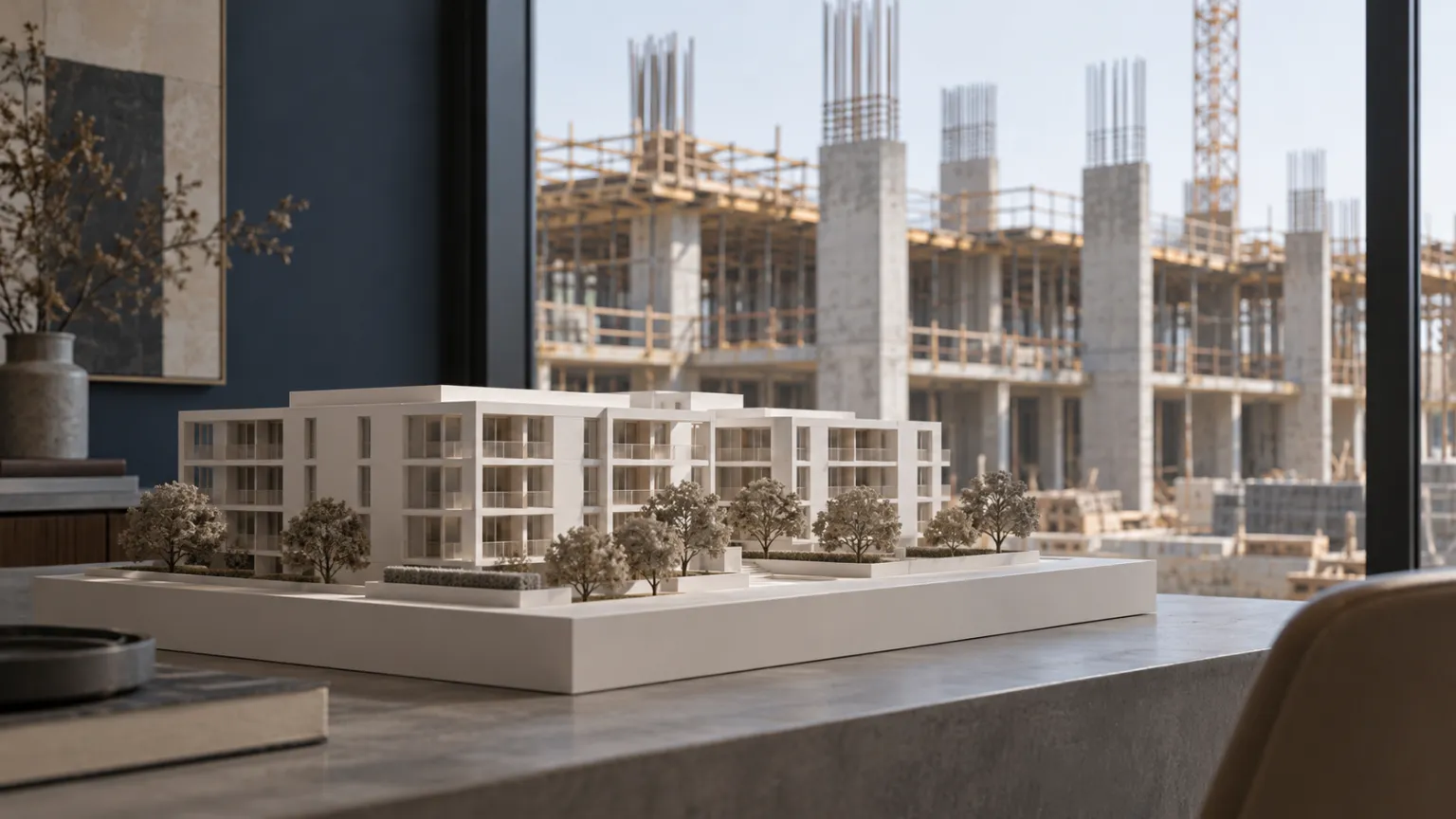 Illustration
Key takeaways
- - Off-plan, direct development and LP co-investment are three distinct products on three distinct legal substrates. They are not interchangeable, and the headline price is not a sufficient comparator.
- - Victaura Research assumes an off-plan discount to ready of 10 to 25 per cent at launch in Dubai, Bali and Mediterranean prime; no official series measures it. The discount is the sum of time-value-of-money, risk premium for the four failure modes, and operator-managed early-access premium. It is not a windfall (Victaura Research assumption).
- - Dubai Law 8/2007 places buyer payments in a project escrow account that the developer's creditors cannot attach, and Article 14 retains 5 per cent of the account after the completion certificate until one year after units are registered to purchasers. Remedies for delay are contractual, not statutory (Dubai Law No. 8 of 2007, Article 14).
- - Italy D.Lgs. 122/2005 garanzia fideiussoria covers buyer payments against constructor insolvency via bank or insurance surety bond. The 2019 reform requires atto pubblico or scrittura privata autenticata for the preliminary and transfer contracts. The guarantee is called on the constructor's crisis or, since 2019, on failure to deliver the ten-year policy, not on delay. Decennale postuma covers structural defects ten years post-completion (D.Lgs. 122/2005; D.Lgs. 14/2019).
- - Indonesia PPJB-to-AJB notarial framework relies on notarial discipline and developer selection more than statutory escrow. Foreign buyers transact through Hak Pakai (30 years, extendable by 20 and renewable by 30 under Government Regulation 18/2021) or Hak Guna Bangunan via PT PMA. Hak Milik freehold is reserved to citizens by Article 21(1) of the 1960 Basic Agrarian Law.
- - Four off-plan failure modes: delay (Knight Frank: 64 per cent of Dubai homes completed on time in 2025, 50 per cent in 2024), design change, brand pullout (largely uncovered by statute), developer insolvency. The mitigation regime varies by jurisdiction. The discount does not.
- - LP co-investment runs through a ring-fenced SPV, and real estate private funds most commonly set an 8 per cent preferred return with a 20 per cent carried interest above it (Cambridge Associates, Private Investment Fund Terms, 27 August 2024). Protection is contractual and audited, not statutory. Sponsor's own capital sits beside LP capital in the SPV.
- - Victaura is not a neutral party to this comparison. It develops projects of its own and holds an off-plan capital position on Al Marjan Island, Ras Al Khaimah, where it is an off-plan buyer in a jurisdiction this note does not compare.
On this page (12)
Revision notes
This article was corrected on 27 September 2026. A check of its figures and attributions against the cited sources found errors, which have been corrected in the text. The full list, with what the article said and what it says now, is in the corrections section at the end.
This article was corrected on 29 September 2026. An earlier version described co-investment arrangements and positions not set out on Victaura's public pages, and placed Victaura outside the off-plan lane. Victaura holds an off-plan capital position in Ras Al Khaimah; the text and the closing disclosure now follow its public project pages.
This article was corrected on 11 October 2026. An earlier version gave fund-term ranges as Victaura Research assumptions with no third-party source. They now follow a published review of fund terms, and the co-investment range, which that review does not give, was removed.
The off-plan question is almost always framed commercially. How much discount to ready. Which payment plan. Which developer. Whether the brand is confirmed. These are the questions a sales channel is built to answer, and they are the questions a serious investor should treat as secondary. The first question is structural: what protection regime governs the contract, what failure modes does it cover, and what residual risk does the buyer carry that no discount can compensate.
Off-plan, direct development for an end user, and limited-partner co-investment in a development SPV are three distinct products. They sit on three distinct legal substrates, distribute risk across three distinct stakeholder geometries, and exit through three distinct mechanisms. Treating them as interchangeable, on the basis of a headline price per square metre, is a common underwriting error in Victaura Research's reading.
This document is classified as marketing material under MiFID II Article 24(3). It is not investment advice.
What 'off-plan' actually means
Off-plan is the purchase of a residential unit from a developer before, or during, construction. The buyer signs a preliminary sale contract, pays a deposit, and pays additional instalments at defined construction milestones until the unit is completed and a final transfer deed is registered. The legal grammar is jurisdiction-specific; the economic substance is the same: the buyer provides development finance to the operator in exchange for a contractual right to a specific finished unit at a fixed price.
The standard Dubai schedule is the reference case because off-plan dominates that market. On a Victaura Research assumption drawn from developer payment plans, a typical plan runs 10 to 20 per cent deposit at signature, 50 to 60 per cent against construction milestones (foundation, structural shell, facade, MEP, finishing), and 20 to 40 per cent at handover or as a post-handover plan over 24 to 60 months. Dubai Land Department data, as compiled by Bayut, show off-plan accounted for 62.6 per cent of Dubai residential transactions in 2025.
The Italian and Indonesian grammars are materially different. In Italy the buyer signs a contratto preliminare before a notary, the constructor delivers a garanzia fideiussoria covering sums paid before transfer, and the final atto pubblico is registered at the Conservatoria dei Registri Immobiliari. In Indonesia the buyer signs a Perjanjian Pengikatan Jual Beli (PPJB) before a notary, pays staged instalments, and only on completion executes the Akta Jual Beli (AJB), the final deed prepared by a land deed official (PPAT), registered with the Badan Pertanahan Nasional (BPN). The same product, three legal regimes, three risk profiles.
The off-plan discount and where it actually goes
The headline argument for off-plan is the discount to ready. Across Dubai, Bali and the Mediterranean prime markets, Victaura Research assumes that off-plan units at launch are typically priced 10 to 25 per cent below comparable ready inventory in the same micro-location, with the spread widening during early launch phases and compressing toward handover. No official series measures this spread; the assumption is consistent with the cost-of-capital calculation that any developer running an escrow-funded construction makes when pricing first releases.
The question is not whether the discount exists. The question is what the discount is actually paying for, and to whom the spread accrues at exit. In the institutional reading, the off-plan discount has three components. The first is a time-value-of-money adjustment for the buyer's staged contribution of development capital ahead of delivery. The second is a risk premium for the failure modes catalogued below: delay, design change, brand pullout, developer insolvency. The third is an early-access premium that the operator captures by accelerating sell-out velocity. The discount is the sum of these three, not a windfall.
Capture of the spread depends on the development. In a well-run project with credible demand and a disciplined release schedule, the latest release approaches ready-market pricing as units sell down. In a weak project, the operator discounts later releases to clear inventory, and the early buyer underwrites the absorption risk of every unit released after theirs. The off-plan discount, in plain terms, is a contractual conversion of operator risk into buyer risk in exchange for a price concession.
Jurisdictional protections compared: Dubai, Italy, Indonesia
Three jurisdictions, three regimes. The protection a buyer actually owns at the moment of signing the preliminary contract is, in each case, the statutory and contractual stack that the local regime makes available. The institutional buyer should read the statute, not the brochure.
Dubai: Escrow Law 8 of 2007. Under Law No. 8 of 2007, any developer selling off-plan must open a dedicated escrow account with a Dubai Land Department-approved escrow agent. The account is opened in the name of the project, not the developer (Article 7), and payments deposited in it cannot be attached by the developer's creditors (Article 9). Article 14 requires the escrow agent to retain 5 per cent of the account's total value once the completion certificate is issued, releasing it one year after the units are registered to purchasers. If a project is not completed, Article 15 requires the escrow agent to act so that the project is completed or depositors are refunded. Off-plan sales are registered with the DLD through the Oqood system. The law grants no automatic refund for delay: delay remedies sit in the sale and purchase agreement. In Victaura Research's reading, the Dubai regime is the most articulated of the three compared here.
Italy: D.Lgs. 122/2005 and the 2019 notarial reform. Italian Legislative Decree 122 of 2005 requires the constructor to deliver a garanzia fideiussoria, a bank or insurance surety bond covering all sums paid before final transfer of ownership. Non-delivery results in nullità relativa: the contract is voidable at the buyer's election, with restitution. Following the 2019 reform (applicable to building permits requested from 16 March 2019), the preliminary contract and every other contract aimed at transferring the property must be executed by atto pubblico or scrittura privata autenticata (Article 6(1)), which brings a notary into the preliminary stage. The protection is procedural and structural, not commercial.
Indonesia: PPJB, AJB and BPN registration. Indonesian off-plan transactions execute through a two-stage notarial process. The Perjanjian Pengikatan Jual Beli (PPJB) is the preliminary commitment, signed before a notary. The PPJB does not transfer ownership. The final transfer occurs on completion, by Akta Jual Beli (AJB) before a Pejabat Pembuat Akta Tanah (PPAT), with registration at the Badan Pertanahan Nasional (BPN). Foreign buyers transact through Hak Pakai (30+20+30 years under Government Regulation 18/2021) or Hak Guna Bangunan held by a PT PMA. Hak Milik freehold is reserved to citizens by Article 21(1) of the Basic Agrarian Law (UUPA) 1960, and Article 26(2) voids any transfer of Hak Milik to a foreigner. The Indonesian regime relies more on notarial discipline and developer credit than on statutory escrow.
The four off-plan failure modes
Off-plan can fail in four distinct ways, each requiring a different mitigation. The underwriting question is not whether failure is possible but which mitigations the statutory and contractual stack actually delivers in each scenario.
Mode one: delay. Knight Frank's Q4 2025 Dubai review records that the proportion of homes completed on time improved to 64 per cent in 2025, when 39,700 units were delivered, from 50 per cent in 2024 (30,500 units). Dubai Law 8/2007 grants no automatic refund for delay; remedies depend on the sale and purchase agreement. In Italy, delay alone does not allow the garanzia fideiussoria to be called: Article 3 of D.Lgs. 122/2005 ties enforcement to the constructor's crisis (seizure of the property, bankruptcy or equivalent insolvency proceedings) and, since the 2019 reform, to the constructor's failure to deliver the ten-year insurance policy at transfer. The Indonesian regime depends on the contractual penalty clause in the PPJB and on developer solvency.
Mode two: design change. The unit delivered may not match the unit sold. Finishing changes, layout modifications, amenity downgrades and density increases above the master plan are routine off-plan outcomes. The mitigation is contractual: a specification annex with material-deviation thresholds and remedies. The protection is only as strong as the contract drafted at signature.
Mode three: brand pullout. Branded residence projects carry a specific failure mode in which the brand operator terminates the branding agreement during construction, for cause (developer breach, financial default) or for convenience (strategic exit from the geography). The unit is then delivered as a generic product, and the brand premium paid at signature loses the brand that justified it. The mitigation is contractual: a brand performance clause with a buyer remedy in the preliminary contract. Few buyers ask for one.
Mode four: developer insolvency. Under Dubai Law 8/2007, payments in the escrow account cannot be attached by the developer's creditors (Article 9), and if the project is not completed the escrow agent must act so that it is completed or depositors are refunded (Article 15). In Indonesia, a buyer holding only a PPJB has a contractual claim against the developer, because the PPJB does not transfer ownership. Under Italian law, once the constructor enters a crisis defined in Article 3 of D.Lgs. 122/2005 (seizure of the property, bankruptcy or equivalent insolvency proceedings), the garanzia fideiussoria is enforceable against the issuing bank or insurance company, which is precisely why the 2005 statute exists.
The geography of the failure mode matters more than the headline discount. A buyer who underwrites design change in a jurisdiction with weak specification enforcement is taking equity-like risk on a debt-like return. A buyer who underwrites developer insolvency in a jurisdiction with no escrow framework is unsecured. The discount does not cover these risks. The protection regime does.
Direct development: the custom alternative
Direct development is the alternative product for buyers who want a finished, bespoke asset on a specific site. The buyer (or a buyer-controlled vehicle) acquires the land, commissions the design, contracts the construction, manages the permits and delivers the unit. The result is a single asset, designed to specification, on a site selected for its merits, with no exposure to absorption risk on adjacent units.
The economics are different. The discount-to-ready is not a feature of the product. The buyer pays cost (land plus design plus construction plus permitting plus contingency) and captures the finished value at completion. The spread between cost and finished value, in a well-selected site and a well-executed build, is the value-add return. On Lake Como, Nungwi and Gili Air, Victaura Research's view is that the scarcity of substitutable inventory supports this spread (see Scarcity as Value Protection).
The trade-off is duration and complexity. On a Victaura Research assumption, direct development requires 24 to 48 months from land acquisition to certificate of occupancy in most prime jurisdictions, with the permitting horizon longest in landscape-protected jurisdictions such as the Italian lakes. The buyer who wants finished product in 18 months at a 15 per cent discount to ready is not a candidate. The buyer who wants a specific architectural statement on a specific shoreline, with full control of specification, is.
The protection profile is also different. The buyer is the principal. The construction contract, the architect's appointment, the contractor's performance bonds and a decennial defects insurance policy are the protection stack. In Italy the decennale postuma of D.Lgs. 122/2005 Article 4 is mandatory only when a constructor sells a unit still to be built, so in direct development the policy has to be required by contract. The grammar of protection is professional, not regulatory.
A discount unfunded by protection is not a discount. It is a transfer of risk from the operator to the buyer, priced as a concession.
Victaura Research
The LP route: institutional direct co-investment
There is a third product, which the retail off-plan channel rarely surfaces. The investor allocates to a dedicated single-asset SPV that owns a development project, alongside a sponsor that contributes its own equity and runs the project on behalf of the limited partners. The investor's economic interest is in the SPV's equity, not in a specific finished unit. Exit occurs on sale of the underlying asset, sale of the SPV shares, or refinancing distribution.
The economic structure follows market practice as a third party measures it. In a review of fund terms published on 27 August 2024, Cambridge Associates found an 8 per cent preferred return at every quartile of the real estate funds in its 2022 sample and a median management fee of 2.0 per cent of commitments; across asset classes, almost three-fourths of funds paid a 20 per cent carried interest, an 80/20 split above the hurdle. The review covers real estate funds in general, not value-add alone, and gives no range for sponsor co-investment, so this note quotes none.
Why this differs from off-plan. The LP investor does not own a unit. They own a slice of the equity of a project SPV, ring-fenced from other projects under the sponsor's umbrella. The protection regime is contractual, governed by the shareholder agreement, the construction contracts, the audit framework and the local building code. The sponsor's own capital sits in the same SPV on the same terms, making alignment structural rather than declarative (see How a Dedicated SPV Protects Investors).
The exit profile is also different. The LP investor exits when the asset is sold or refinanced at the SPV level, on a timeline calibrated to the project (36 to 72 months for a value-add cycle, on a Victaura Research assumption). The off-plan buyer exits when they sell their specific unit in the secondary market, on a timeline determined by personal liquidity and the project's absorption profile. The two products carry different liquidity grammars.
The figures in this section describe market practice, not the terms of any Victaura project. The cycle length is a Victaura Research assumption. Victaura's own positions are set out in the disclosure at the end of this note.
Pricing and exit: what each product offers
The three products price and exit on different mechanics. Off-plan prices on a discount to ready at launch and exits on the secondary market for that specific unit type. Direct development prices on cost (land plus build) and exits on the open market for the unique completed asset, with the spread between cost and finished value capturing the value-add return. LP co-investment prices on the SPV's net asset value at subscription and exits on realisation of the asset, with LP carry mechanics governing the proceeds split.
The buyer-protection capture is different. In off-plan, the buyer captures a contractual right to a specific unit. In direct development, the buyer captures legal title to a specific completed asset. In LP co-investment, the LP captures a defined economic interest in a ring-fenced legal entity. The instruments are not interchangeable, and the protection of each is documented at signature, not negotiated at exit.
| Dimension | Off-plan retail | Direct development | LP co-investment SPV |
|---|---|---|---|
| Pricing mechanic | Discount to ready at launch (10 to 25%, Victaura Research assumption) | Cost plus operator margin | NAV at subscription |
| Control of specification | Limited (contract annex) | Full (buyer commissions) | Delegated to GP under SPV governance |
| Statutory protection | Escrow / fideiussoria / PPJB regime, jurisdiction-specific | Contractual decennale + professional liability | Shareholder agreement + audit + reserved matters |
| Principal failure modes | Delay, design change, brand pullout, insolvency | Permit, cost overrun, market timing | Execution, market timing, sponsor risk |
| Typical cycle to exit | 24 to 48 months to handover, then secondary sale (Victaura Research assumption) | 24 to 48 months to certificate, then open-market sale (Victaura Research assumption) | 36 to 72 months to SPV realisation (Victaura Research assumption) |
| Liquidity at exit | Secondary market for that specific unit type | Open market for unique completed asset | Sale or refinancing of the underlying project |
| Who carries absorption risk | Buyer, on adjacent unreleased units | Buyer, on the specific finished asset only | LP, on the SPV's asset |
| Alignment of operator | Operator captures fees on sell-out velocity | Buyer is the principal | Sponsor co-invests at SPV level on same terms |
What the protection actually covers
Each protection regime covers a specific failure mode and leaves others uncovered. The Dubai escrow framework covers price: it does not cover delay, specification, or brand pullout. It covers the buyer's money against developer misappropriation. That is the design.
*The Italian garanzia fideiussoria covers price. It does not cover delay, which is not one of the crisis events in Article 3, or finished specification (the separate decennale postuma* covers collapse and serious construction defects, not specification). It covers the buyer's money against constructor insolvency. The 2019 notarial reform layers procedural certainty on top.
The Indonesian PPJB-to-AJB framework covers process. Notarial discipline reduces fraud and double-selling risk. It does not directly cover developer insolvency at the level of interim payments, which is why developer selection and notarial-escrow structuring of the deposit matter more in Indonesia than in either Dubai or Italy.
No regime, anywhere, fully covers brand pullout for branded residences. This is contractual, not statutory. The buyer who pays a brand premium without a brand performance clause in the preliminary contract is taking the brand-pullout risk uncompensated. In Victaura Research's view, this is the protection gap to price most explicitly.
The Dubai escrow framework covers price. The Italian fideiussoria covers price. No regime, anywhere, fully covers brand pullout. That is a contract, not a statute.
Victaura Research
What this means for the buyer: choose by protection, not by price
The framing question is not which product offers the headline discount. It is which product matches the underwriting the buyer is actually doing.
For a buyer who wants finished, branded, ready inventory in a regulated emerging market with a working escrow framework, off-plan in Dubai is a credible product. The protection is articulated in statute; the discount is a Victaura Research assumption rather than a measured figure. The buyer who buys an off-plan unit in a Dubai sub-market with a heavy branded pipeline is taking absorption risk that the Dubai prime headline number does not capture (see Scarcity as Value Protection).
For a buyer who wants a finished asset on a specific scarce site, with full specification control and a hold horizon measured in decades, direct development is the working product. The protection stack is professional rather than statutory. The output is a unique, bespoke, finished asset, with no exposure to absorption risk on neighbouring inventory.
For an institutional investor or family office that wants exposure to development-stage real estate without the operational burden of being principal, LP co-investment in a ring-fenced SPV is the institutional product. The sponsor co-invests on the same terms, the SPV is audited, and the exit is realisation-based. The investor reads the shareholder agreement and the construction contracts.
Victaura is not a neutral party to this comparison. It develops projects on Lake Como, in Nungwi, on Gili Air and in Uluwatu, and holds an off-plan capital position on Al Marjan Island, Ras Al Khaimah, in units built by an established local developer. There Victaura is an off-plan buyer, in a jurisdiction outside the three compared in this note.
The first question is the product. The price is the second question. The discount is the third. A discount to a ready market without disclosure of which failure modes are statutorily covered, and which are not, is incomplete underwriting. The product has to be named before the discount can be read.
Disclosure
Sources. Factual claims in this note are sourced to public primary documents or published market reports; figures without an official series are flagged in line as Victaura Research assumptions. The references section sets out the operative sources.
Classification. This note is not a personal recommendation, and it is not an offer to sell or a solicitation to buy any security or interest in any vehicle. Any investment decision should be taken on the basis of formal subscription documentation, independent professional advice, and a documented assessment of suitability for the investor's specific circumstances. Failure-mode examples in this note are described in sanitised form and do not refer to identifiable projects.
Skin in the game disclosure. Victaura, through its parent Greystone B.V. (Netherlands), develops projects on Lake Como (Italy), in Nungwi, Zanzibar (Tanzania), on Gili Air and in Uluwatu, Bali (Indonesia), and holds an off-plan capital position on Al Marjan Island, Ras Al Khaimah (UAE). Readers should assume commentary may be influenced by, or benefit, these positions. This document is classified as marketing material under MiFID II Article 24(3). It is not investment advice.
Corrections, 27 September 2026
What the article said and what it says now. The published version said Dubai Land Department data put the off-plan share of residential transactions at about 63 per cent in 2024 and 72 per cent in 2025, the highest of any prime market; the cited Knight Frank page gives no such share, and Dubai Land Department data compiled by Bayut show 62.6 per cent for 2025, which is now the figure used, without the superlative. It cited Knight Frank's 46 per cent on-time completion rate for Q1 to Q3 2025; Knight Frank's Q4 2025 review reports 64 per cent for full-year 2025 and 50 per cent for 2024, and those figures now appear. It said Dubai buyers are entitled to a full refund with interest after a twelve-month delay; Dubai Law 8/2007 contains no such right, and the text now says delay remedies are contractual. It said escrow releases require consultant certification and that the 5 per cent retention under Article 14 is a defects guarantee for one year after completion; the law provides that the account is in the project's name, cannot be attached by the developer's creditors, and that 5 per cent is retained after the completion certificate until one year after units are registered to purchasers. It attributed successor-developer protection to the 2024 UAE bankruptcy law, which the cited source does not discuss; the text now relies on Articles 9 and 15 of Law 8/2007. It said the Italian garanzia fideiussoria can be enforced on failure to deliver and independently of the constructor's solvency; under Article 3 of D.Lgs. 122/2005 it is called on the constructor's crisis. It said the 2019 reform requires an atto pubblico on pain of absolute nullity; Article 6 requires an atto pubblico or a scrittura privata autenticata. It described the decennale postuma as mandatory in direct development; Article 4 imposes it only on a constructor selling a unit still to be built. It said Hak Milik is reserved to Indonesian citizens by Article 33(3) of the 1945 Constitution; the restriction is in Articles 21(1) and 26(2) of the 1960 Basic Agrarian Law. The 10 to 25 per cent off-plan discount, the payment-plan structure and the 24 to 48 month development timeline are now labelled as Victaura Research assumptions, and unsourced statements on brand-pullout discounts of 15 to 30 per cent, a 9,000-unit branded pipeline, Indonesian deposit practice and Bali developer failures have been removed.
A further review on the same day refined some of the corrections above and fixed further points. The article presented a 6 to 9 per cent preferred return, an 80/20 carry split, sponsor co-investment of 1 to 5 per cent and management fees of 1.25 to 2.0 per cent as INREV-aligned market standards sourced to the INREV guidelines; the INREV guidelines publish none of these figures, and they are now labelled as Victaura Research assumptions, as are the 36 to 72 month LP cycle and the cycle ranges in the comparison table. It said the Italian garanzia fideiussoria is enforceable only on the constructor's crisis; following the 2019 reform of D.Lgs. 122/2005 it can also be enforced if the constructor fails to deliver the ten-year insurance policy, as reported by Federnotizie, and the text now says so. It described the off-plan discount in Dubai as real and the exit path as liquid; the discount is a Victaura Research assumption and no source supports the liquidity claim, so the sentence has been rewritten. It stated that scarcity structurally protects the development spread on Lake Como, Nungwi and Gili Air; this is now presented as Victaura Research's view. The reference for Government Regulation 18/2021 linked to Government Regulation 9/2021 and now links to the correct page.
From Victaura
References
- Dubai, Law No. 8 of 2007 Concerning Escrow Accounts for Real Estate Development in the Emirate of Dubai
- Dubai Land Department, Frequently Asked Questions and Escrow Account activation
- Knight Frank, Dubai Residential Market Review Q3 2025 (completion rates 2022 to Q3 2025)
- Italy, Decreto Legislativo 20 giugno 2005, n. 122 (tutela acquirenti immobili da costruire)
- Consiglio Nazionale del Notariato, Studio 5813/C/2005, garanzia fideiussoria e D.Lgs. 122/2005
- Federnotizie, TAIC, modelli standard di fideiussione e polizza assicurativa (DM 125/2022 and DM 154/2022, implementing the 2019 reform)
- Kementerian ATR/BPN, Indonesian national land agency (UUPA text: see Law No. 5 of 1960 below)
- Indonesia, Government Regulation 18/2021 (Hak Pakai 30+20+30 years)
- Seven Stones Indonesia, PPJB vs AJB in Indonesian property law
- BSA Law, Developer compliance in Dubai off-plan projects
- Al Tamimi & Company, Decree on uncompleted and cancelled off-plan projects in Dubai
- King & Spalding, The 2024 UAE Financial Restructuring and Bankruptcy Law
- INREV, Guidelines for non-listed real estate vehicles
- Property Monitor, Dubai off-plan transaction data 2024
- Knight Frank, The Wealth Report 2026 (prime market context)
- Knight Frank, Dubai Residential Market Review Q4 2025 (on-time completions 2024 and 2025)
- Bayut, Dubai Off-Plan Property Market Report 2025 (Dubai Land Department data)
- Indonesia, Law No. 5 of 1960 on Basic Agrarian Principles (UUPA), full text
- ILS Law Firm, Hak Pakai under PP 18/2021 (30 years, extension 20, renewal 30)
- Federnotizie, Modifiche al D.Lgs. 122/2005 (TAIC): preliminare per atto pubblico o scrittura privata autenticata
- Cambridge Associates, Private Investment Fund Terms: Fees and Distribution Waterfall, 27 August 2024 (2022 terms reviews; real estate preferred return 8.0% at every quartile)
The information on this website is provided for informational purposes only and does not constitute an offer, solicitation, or financial advice. Indicated returns are estimates and are not guaranteed; past performance is not indicative of future results. Capital invested is at risk.
Considering an allocation to luxury real estate in the locations we operate? Speak to us about our current and upcoming projects.
Speak to Victaura →Related insights

Value-Add Methodology
Scarcity as Value Protection: Lakefront and Island
At the very top of the market, the strongest protection of value is not a forecast, it is scarcity. The land in the most desirable locations cannot be recreated, the rules that govern it cannot be wished away, and the wealth that competes for it keeps growing. This dossier sets the structural conditions of scarcity against the data of 2025-2026, jurisdiction by jurisdiction, and against the transparency regime now permanent.

Branded Residences
Why Brands Choose Developers: The Off-Plan Stakes
Brands underwrite developers before they sign a tower. Reputation is the asset they cannot insure, and selection is the only protection. For the off-plan buyer, the brand's diligence on the developer is a co-signal that the registry alone cannot provide.

Value-Add Methodology
Contractor Track Records: What Verifies Them
A brochure names a brand. It rarely names the builder, and when it does, the claim is almost never independently checked. A track record is not a story a developer tells. It is a set of public registrations, licence classifications, filed accounts and court records that exist whether or not the developer produces them. This note reads that paper trail jurisdiction by jurisdiction, and sets out what to ask when the name is withheld.