
ESG & Stewardship
Island Utilities: Water, Power, Waste Costs
On a mainland site, water and power are a monthly bill. On a small island, they are a piece of process plant with a capital cost, a design life and a failure mode. This piece prices what that plant actually costs to build and run on Zanzibar's coast, and discloses where the data runs thin.
On this page (11)
The Utility Connection That Isn't There
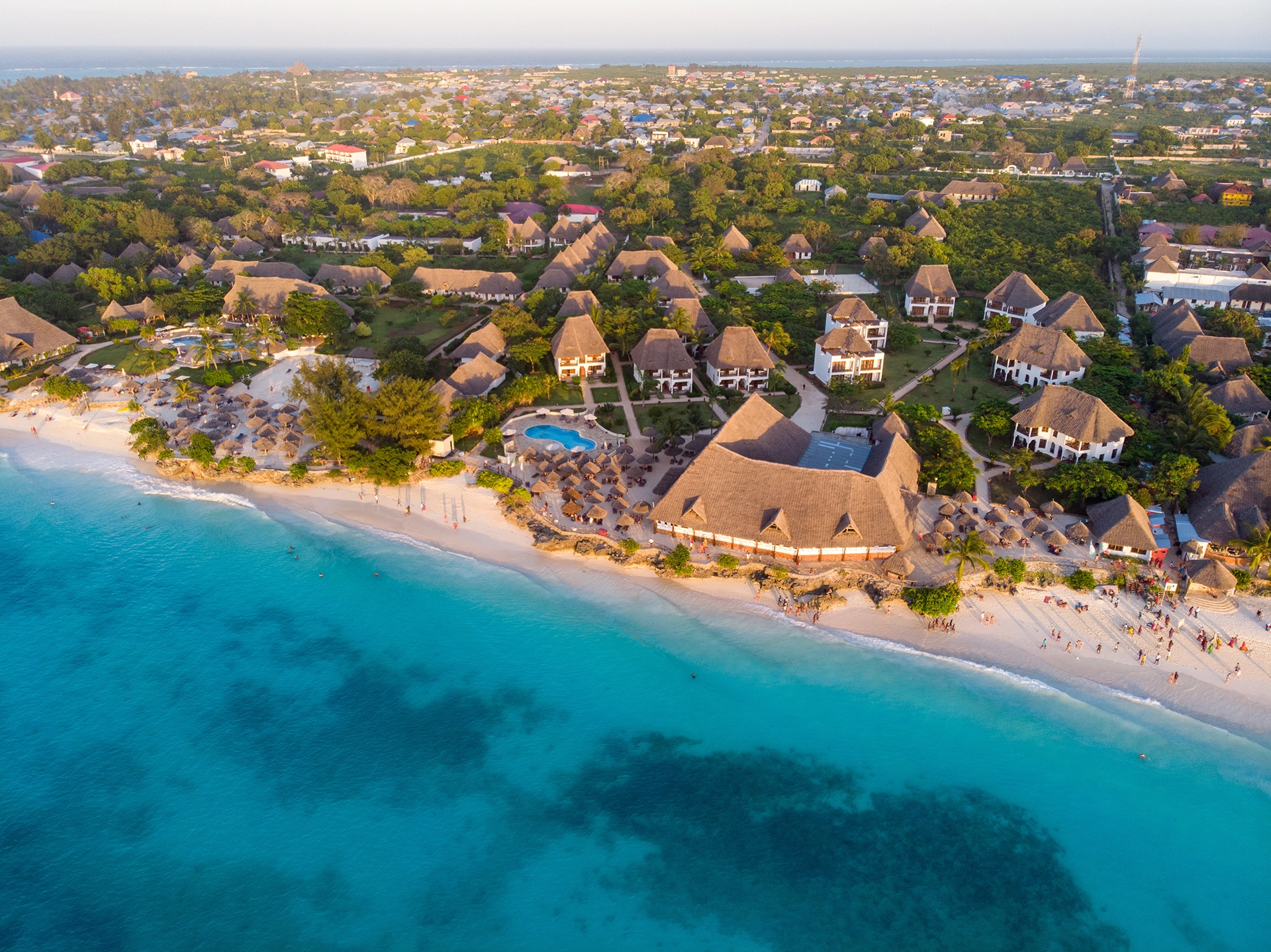
On a mainland site, water and electricity arrive as a monthly bill, not a construction line. A developer signs a connection agreement, pays a hookup fee, and the utility carries the capital risk of generation, treatment and distribution. On a small island — Zanzibar's east coast is the case in point — none of that applies cleanly. There is no municipal water main sized for a five-star occupancy curve. There is a national grid that reaches the island through a handful of submarine cables, built for a domestic and agricultural load, not for a resort's chillers and pool pumps arriving on top of it.
What a mainland developer buys as a service, an island developer builds as plant. A desalination unit, a generator bank with fuel storage, a wastewater treatment package — these are capital assets with a design life, a maintenance schedule and a failure mode, sitting on the balance sheet next to the guest rooms rather than below the line as a recurring utility cost. They are also, increasingly, a condition of the environmental permit itself, not an optional upgrade a hotel adds once it can afford one.
This is the numbers companion to a principle Victaura Research has stated elsewhere in general terms. A companion piece on responsible development across coasts and islands argued that infrastructure has to be treated as part of the asset, not an externality solved later by someone else. This piece narrows that claim to something an allocator can underwrite: what a resort's own water, power and waste infrastructure costs in capital and operating terms, and what happens to those costs once the island empties out for the rains.
The Freshwater Lens and Why It Fails
Zanzibar's fresh water sits in a lens, not a reservoir. The island's coral rag geology holds rainwater as a thin layer of fresh groundwater floating on denser saline water beneath it — a freshwater lens, the same hydrogeology found on atolls and small carbonate islands worldwide. It recharges only from direct rainfall on a seasonal cycle, and it has no large-scale storage buffer of the kind a dammed reservoir provides.
That geology has already tipped toward stress in studied coastal zones. Peer-reviewed hydrogeological work on Zanzibar's water supply found an integrated water balance deficit estimated at 39%, with groundwater abstraction outpacing the rate of natural recharge in the areas studied. Progressive salinisation of boreholes has been documented as a consequence, consistent with seawater intrusion replacing the fresh lens from below as it is drawn down.
Tourism did not create this hydrogeology, but it concentrates the draw on it. Gössling's foundational study of Zanzibar's tourism water use argued that hotel-scale demand — pools, irrigated gardens, laundry — falls disproportionately on the same coastal strip where the lens is thinnest and the recharge area smallest, and recommended rainwater harvesting, greywater reuse, adequate sewage treatment and desalination as the standard response. The exact consumption ratio between a hotel guest and a resident in that study was not independently re-verified for this piece and is not restated here as a current figure.
The consequence for a developer is that a borehole permit is not a grant of water; it is a claim on a shrinking, shared resource. Zanzibar's environmental impact assessment process for the hotel sector requires water supply to be addressed as part of the EIA itself, which is one reason resorts on the east coast increasingly treat desalination as the default rather than the backup.
Desalination as the Default Fix
Reverse osmosis has gone from contingency to house system on Zanzibar's coast. Multiple resorts along the east coast — the stretch most exposed to the freshwater-lens stress described above — now run their own seawater or brackish-water RO plants rather than relying on wells or the municipal network alone. The Karafuu Hotel Beach Resort & Spa's installed system is reported to produce 140,000 litres of clean water a day, sized to cover the property's own demand rather than to sell surplus.
The technology choice tracks the energy source available on site. Where a resort already runs a diesel-heavy power plant, RO is typically bolted onto that supply, at whatever marginal fuel cost the generators already carry. Where a resort has invested in solar generation, desalination increasingly runs off that supply directly, since RO's power draw — a continuous, predictable load — pairs well with a mid-day solar profile if there is enough battery buffer to keep producing water after dark.
None of this is exotic engineering; it is procurement and sizing. Specialist vendors serving Zanzibar and comparable Indian Ocean markets sell containerised or skid-mounted units scoped to a resort's projected occupancy and room count, with output typically quoted in litres or cubic metres per day rather than as a headline plant rating — a detail that matters when comparing quotes, since a unit sized for December occupancy will run at a fraction of capacity, and a fraction of efficiency, in April.
A desalination plant is not a tap. It is a piece of process plant with a design life, a maintenance contract and a failure mode, and it belongs on the balance sheet, not in a footnote.
Victaura Research
What Desalination Costs, Capital and Operating
Capital cost scales with nameplate capacity, not with room count. AMPAC Water Systems, a US vendor, publishes 2025-2026 capital cost ranges for seawater reverse osmosis of $15 to $50 per gallon of daily capacity for small systems of 1,000 to 10,000 gallons a day, falling to $8 to $18 for medium systems of 50,000 to 500,000 gallons a day, because cost per unit of capacity falls as plants get larger. Its worked example of a 200-room coastal resort drawing 30,000 gallons a day, about 114 cubic metres, prices the plant at $600,000 installed and $65,000 a year to operate. None of these figures is quoted for Zanzibar, where shipping, brine outfall construction and commissioning on an island with no local fabrication base are site-specific costs. A resort sized well under 100 m³/day still carries much of the fixed cost of mobilisation, containerisation and commissioning, which does not shrink in proportion to a smaller unit.
Operating cost is where the energy-source choice shows up in the model. Vendor cost modelling for decentralised, off-grid desalination puts the levelised cost of water, over a system's roughly fifteen-year life, at €1 to €3 per cubic metre for solar-powered systems against €3 to €6 per cubic metre for diesel-powered ones. A separate account of Maldivian resort practice — a market with no natural groundwater at all, and so a useful upper-bound comparison — puts realised operating cost for conventional diesel-driven RO at around $5 per cubic metre, with energy consumption of 7 to 10 kWh per cubic metre for older-generation systems.
The spread between those two operating figures is the whole argument for pairing desalination with on-site solar. Newer energy-recovery RO technology is marketed at closer to 3 kWh per cubic metre, the efficiency gain vendors cite as cutting operating cost by roughly 70% relative to older units. None of these figures resolve into a single cost-per-room-night an allocator can drop into a pro forma without first fixing occupancy, since the plant's fixed operating cost — labour, membrane replacement, chemical dosing where used — is largely occupancy-insensitive while its output is not.
Power: The Mainland Cable Is Not Enough
Zanzibar's electricity does not originate on Zanzibar. The island draws power from mainland Tanzania through submarine cables, and the documented history of that link is one of chronic strain: a three-month island-wide blackout in 2016, ageing cable capacity repeatedly cited by the Zanzibar government as a cause of outages, and a sequence of donor- and state-financed fixes stretching back more than a decade.
Those fixes have been large relative to the island's size, and still incomplete. A 100-megawatt submarine cable, financed within a $698 million US–Tanzania compact, was installed around 2010 specifically to reduce the blackout frequency described above. A larger 220-kilovolt, 44-kilometre interconnector between Dar es Salaam and Zanzibar, financed by a $282.57 million African Development Bank loan, has since been contracted to add further capacity. In 2025 a further $8.4 million project installed voltage regulators, capacitor banks and a STATCOM system at the Mtoni substation specifically to stabilise the 33-kilovolt distribution grid feeding Unguja.
For a resort operator, the relevant fact is not that these projects exist, but that they have been necessary at all, repeatedly, for close to two decades. A grid that has required three separate large-capital interventions since the 2008 blackout is not a grid an allocator can treat as background infrastructure. It belongs in the same due-diligence file as the desalination plant: what backup generation exists on site, what its fuel logistics look like on an island, and what the resort's own outage history has actually been, not what the national utility's press releases say it should be.
| Project | Period | Investment | Scope |
|---|---|---|---|
| Submarine power cable, mainland–Zanzibar | ~2010 | $28.1 million | 100 MW capacity, financed within a $698m US–Tanzania compact |
| 220kV submarine interconnector, Dar es Salaam–Zanzibar | Contracted, ongoing | $282.57 million | 44km cable, African Development Bank loan |
| Mtoni substation grid stabilisation | 2025 | $8.4 million | Voltage regulators, capacitor banks, STATCOM system on the 33kV distribution grid |
The Diesel Backstop and Its Arithmetic
Where the grid cannot be trusted, diesel is not a contingency; it is the base case. IRENA's comparative work on island and isolated-grid power found diesel-only generation costs at studied sites ranging from $0.30 to $0.44 per kilowatt-hour — several multiples of a typical grid-connected tariff in a mainland market, and the number against which any on-site solar or hybrid investment has to be justified.
Fuel price volatility compounds that arithmetic rather than sitting outside it. Tanzania's energy regulator publishes monthly capped diesel prices; over the first four months of 2026 alone, the published cap moved from roughly 2,726 Tanzanian shillings per litre in January to roughly 3,806 shillings in April. A resort budgeting diesel as a fixed opex line is budgeting against a figure that moved more than 30% in a single quarter.
This is the practical case for hybrid solar-diesel systems on islands, independent of any sustainability positioning. IRENA's broader case-study work found that solar PV can generate electricity more cheaply than either utility tariffs or diesel self-generation on most islands studied, and that solar thermal and solar-assisted cooling systems have produced documented six- and seven-figure annual savings at specific resort properties in the Caribbean, the Pacific and French Polynesia — cited here as comparable-market evidence, not as a Zanzibar-measured result.
Diesel is not a backup on a small island. It is the base case, and every solar panel on the roof is a hedge against its price, not a sustainability statement.
Victaura Research
Wastewater: The Permit Condition Nobody Markets
A sewage outfall on a reef is not a design choice; it is the fastest way to damage the asset a resort is selling. Zanzibar's Environmental Management Authority requires an environmental impact assessment for hotel development, with wastewater treatment addressed as part of that process rather than left to post-construction discretion. The specific numeric discharge standards applied case by case were not independently obtained for this piece.
Untreated or under-treated effluent interacts with the same coastal ecology a beach resort depends on. This sits alongside, but is distinct from, the desalination brine question already raised: a seawater RO plant returns roughly 1.5 cubic metres of concentrated brine for every cubic metre of freshwater it produces, with salinity in the immediate discharge zone typically measured at 1 to 10% above ambient seawater in studied installations. A well-flushed outfall and a poorly flushed lagoon produce very different outcomes from the same brine volume.
Coral is specifically intolerant of the salinity and chemical variability both brine and untreated sewage introduce. Published research on reef-adjacent desalination has documented reduced coral calcification and increased bleaching susceptibility under elevated salinity and antiscalant exposure, and separate review literature on brine discharge more broadly finds ecological effects ranging from negligible to severe, depending overwhelmingly on where the outfall sits and how well the receiving water flushes.
A wastewater permit is not filed once. It runs with the asset for as long as the resort operates, and it changes the moment the discharge method does.
Victaura Research
What Treatment Costs and Where It Sits in the Capital Stack
Package wastewater treatment plants are priced by capacity, in the same way desalination units are. Industry cost surveys for hotel- and resort-scale package sewage plants put equipment cost for a roughly 100 cubic metre per day system at $45,000 to $120,000, with the fully installed cost — civil works, tankage, piping, electrical — typically running 1.5 to 3 times the equipment price once site conditions are factored in.
That installed-cost multiplier is where island logistics bite hardest. Concrete, steel and skilled installation labour on Zanzibar carry a freight and mobilisation premium a mainland cost survey does not capture, and the same is true of the desalination and generator installation described earlier. Any resort pro forma should treat vendor-quoted equipment prices as a floor, not an estimate of total installed cost.
Treated effluent is, in principle, a resource rather than only a cost. Reused for irrigation of gardens and landscaping — a practice already described by sustainability-reporting hotels in the Zanzibar market — treated wastewater can offset part of the freshwater draw discussed earlier in this piece. That credit only shows up in the model if the treatment plant is sized and permitted for reuse from the outset, not retrofitted for it once the discharge method already set in the original EIA is difficult to change.
The Off-Season Arithmetic
Utility infrastructure does not idle the way a hotel wing can. Zanzibar's long rains, roughly March through May, plus a quieter November, are the period when occupancy falls hardest and some smaller properties close outright, while the peak June-to-October season and the December holiday period run close to full — December 2025 bed occupancy was reported at close to 89%, against a much thinner base in the low months.
A desalination plant, a generator bank and a treatment system are sized for the peak, not the average. That means most of the year they run below the throughput at which their per-unit operating cost is lowest — RO membranes and generator sets both lose efficiency running well under rated load — while their fixed costs, staffing, standing maintenance contracts, and membrane or filter replacement scheduled by calendar rather than usage, continue regardless of how many rooms are occupied.
The EU's own frontrunner benchmark for hotel water use — no more than 140 litres per guest-night in a fully serviced property — is useful precisely because it is a ceiling, not a Zanzibar-measured average. A resort that tracks its own consumption against that figure month by month, rather than only in an annual average, is the way an operator or an allocator actually sees off-season inefficiency show up before it shows up in the utility opex line at year-end.
Honestly Disclosed: Where the Numbers Are Thin
The clearest gap in this analysis is Zanzibar-specific cost data. Almost every capital and operating figure cited above — desalination capex per cubic metre, package treatment plant pricing, diesel generation cost per kilowatt-hour — comes from global or comparable-market industry surveys, not from an audited Zanzibar installation. Vendor case studies name specific properties and specific output figures, such as Karafuu's 140,000 litres a day, but do not publish the capital or operating cost behind that number, so the cost ranges in this piece should be read as a planning envelope, not a quote.
The Gössling academic literature this piece draws on for Zanzibar's tourism-water dynamic is more than two decades old. It remains the most-cited foundational study of the subject, and its policy recommendations — rainwater harvesting, greywater reuse, adequate sewage treatment, desalination, drought-resistant landscaping — track closely with what resorts on the island are reported to be doing today. The specific consumption ratios in the original study were not independently re-verified for this piece and are not restated here as current figures.
Brine and effluent ecological impact is genuinely site-dependent, and this piece cannot resolve that to a Zanzibar-specific verdict. The peer-reviewed literature cited is explicit that outcomes range from negligible to severe depending on local currents, outfall design and receiving-water flushing, which means a due-diligence process has to include a site-specific marine assessment of the actual outfall location, not an assumption drawn from the general literature in either direction.
Fuel and currency volatility make any single operating-cost figure a snapshot, not a forecast. The diesel price movement recorded by Tanzania's regulator across just the first four months of 2026 is evidence enough that an opex line modelled on a single year's fuel price, without a sensitivity band, understates the risk a resort's utility budget actually carries.
Underwriting Implication
For the allocator, the practical takeaway is that island utility infrastructure belongs in the capital budget and the diligence file, not the operating assumptions. A resort's water plant, power plant and treatment plant should be underwritten the way any other piece of process equipment is: replacement cost, remaining useful life, maintenance contract terms, and a fuel or energy cost sensitivity run at more than one price scenario, not the single-year number a seller's pro forma typically shows.
The permit conditions attached to that infrastructure are not paperwork to close once at acquisition; they run with the asset. Zanzibar's EIA framework for hotel development, and the wastewater and water provisions embedded in it, are conditions an owner carries for the life of the property, and a change in discharge method, water source or capacity down the line is itself a regulatory event, not a maintenance decision.
None of this is a reason to avoid island development; it is a reason to price it correctly. Properties that treat water, power and waste as engineered systems — sized to actual, seasonally variable demand, paired with on-site generation where the diesel arithmetic justifies it, and permitted for reuse rather than only disposal — carry a materially different risk and cost profile than those that treat utilities as an afterthought to the room count.
Skin in the game disclosure. Victaura, through its parent Greystone B.V. (Netherlands), holds an active operating position in prime resort property. Readers should assume commentary may be influenced by, or benefit, Greystone's position. This document is classified as marketing material under MiFID II Article 24(3). It is not investment advice.
Key takeaways
- - A single Zanzibar resort's desalination plant is reported to produce 140,000 litres of freshwater a day, sized as process infrastructure rather than a tap (Genius Watter).
- - Seawater reverse osmosis costs $15-$50 per gallon of daily capacity for small systems and $8-$18 for medium ones, and a vendor's worked example prices a 30,000-gallon-a-day resort plant, about 114 m³/day, at $600,000 installed (AMPAC Water Systems, 2025-2026 ranges).
- - Levelised water cost splits sharply by energy source: €1–3/m³ solar-powered vs €3–6/m³ diesel-powered decentralised RO over a 15-year system life (Elemental Water Makers, 2026).
- - Diesel-only power generation at studied island sites costs $0.30–$0.44 per kWh, the benchmark against which any hybrid solar investment must be underwritten (IRENA, 2015).
- - Zanzibar's grid has absorbed at least $28.1 million (2010 cable), $282.57 million (contracted 220kV interconnector) and $8.4 million (2025 substation stabilisation) in mainland-side fixes since the 2008 blackout (MCC; African Development Bank; Government of Zanzibar).
- - Studied Zanzibar coastal aquifers show groundwater abstraction outpacing recharge, with an estimated 39% deficit in the integrated water balance — the geological reason desalination has become the default (Environmental Earth Sciences/Springer, 2020).
- - EU frontrunner practice caps total hotel water use at 140 litres per guest-night — an official target ceiling, not a measured Zanzibar average, but the only public benchmark available (European Commission JRC).
- - Seawater RO produces roughly 1.5 m³ of brine per 1 m³ of freshwater, with mixing-zone salinity typically 1–10% above ambient — the reef-adjacent variable an EIA has to price, not just permit (peer-reviewed review, ScienceDirect, 2025).
References
- Genius Watter, Karafuu Hotel Beach Resort & Spa desalination project
- Elemental Water Makers, Desalination in Tanzania
- Elemental Water Makers, "How much does desalination cost per cubic meter in 2026?"
- AMPAC Water Systems, "True Cost of Desalination: CAPEX, OPEX & ROI"
- WaterWorld, "Cost and energy positive desalination: fact or fiction in the Maldives?"
- IRENA, "Renewable Energy in Hybrid Mini-Grids and Isolated Grids: Economic Benefits and Business Cases" (2015)
- Millennium Challenge Corporation, "Increasing the reliability of electricity in Tanzania"
- African Development Bank, "Tanzania: Submarine Cable to Zanzibar Project"
- Daily News (Tanzania), "Zanzibar launches $8.4m power stabilisation project"
- ESI-Africa, "Zanzibar gets 100 MW cable link to mainland"
- Environmental Earth Sciences (Springer), "Assessment of the impact of groundwater pumpage on water supply sustainability in Zanzibar, Tanzania" (2020)
- European Commission Joint Research Centre, Best Environmental Management Practice (BEMP) for the Tourism Sector
- ScienceDirect, "Impact of brine discharge from desalination plants on marine ecosystems: A review" (2025)
- RO AGUA, "Cost of a Hotel Sewage Treatment Plant"
- Weilan, "What Is the Price of a Package Wastewater Treatment Plant?"
- The Citizen (Tanzania), "Zanzibar tourism hits nearly one million arrivals in 2025"
- Zanzibar Environmental Management Authority (ZEMA), Environmental Impact Assessment (EIA)
- PubMed, Gössling, S., "The consequences of tourism for sustainable water use on a tropical island: Zanzibar, Tanzania" (2001)
The information on this website is provided for informational purposes only and does not constitute an offer, solicitation, or financial advice. Indicated returns are estimates and are not guaranteed; past performance is not indicative of future results. Capital invested is at risk.
Considering an allocation to luxury real estate in the locations we operate? Speak to us about our current and upcoming projects.
Speak to Victaura →Related insights
Value-Add Methodology
Island Construction: The Real Cost Curve
An island's building cost is not a coastal markup on a continental base rate. It is the sum of four variables that mainland underwriting rarely prices correctly: freight and port dwell time, the depth of the local skilled-trades market, the lead time on imported specification, and the number of usable construction months once the rains are subtracted. Victaura treats each as a separate line, not a rounding error.
Branded Residences
Branded Residences: The Developer's Real Bill
The premium a brand adds to a sale price is the number every report quotes. The number that decides whether the deal works is the one nobody puts on the rendering: a licence fee, key money that no public filing reviewed here promises, a technical services fee due before any unit sells, and a Brand Standards Manual that dictates capex for the life of the agreement. This is the developer's ledger.
Destinations
Leasehold in Prime Resorts: Pricing a Term-Bound Right
Foreign buyers in prime resort markets rarely buy freehold. In Zanzibar they buy a 99-year leasehold. In Bali they buy an 80-year right of use. A term-bound right is not a title, and it does not price like one. This is how the allocator underwrites the countdown, and where the marketing line quietly fails.