
ESG & Stewardship
Responsible Coastal Development: Underwriting Input
Responsible development on coasts and islands is an underwriting input, not a marketing claim. Where the ecosystem is the value, the discipline that protects it (permitting, water, energy, mangroves, supply chain, disclosure) is the same discipline that protects the asset.

Key takeaways
- - IPCC AR6 projects 0.32–1.01 m of global mean sea level rise by 2100 (SSP1-2.6 to SSP5-8.5); a low-likelihood, high-impact storyline adds more than one additional metre under high emissions.
- - East Unguja shoreline retreat measured at 15.56 m/y 1990-2020, projected 25.65 m/y by 2040 (Mbezi et al., Regional Studies in Marine Science 2024). Asset selection at parcel level is the underwriting input.
- - Gili Matra forecast to enter annual severe coral bleaching from 2026 (De Clippele et al., Marine Policy 2023, University of Glasgow with WWF Indonesia). Reef as breakwater is part of the asset.
- - Coastal permitting comparison: Indonesia AMDAL (ToR appraisal within 30 working days, ANDAL review within 75), Zanzibar EIA under ZEMA (Zanzibar Environmental Management Act 2015), Italy autorizzazione paesaggistica (D.Lgs 42/2004, 40+45 days), UAE Federal Decree-Law 11/2024 (in force 30 May 2025, fines AED 50k–2M).
- - EDGE 20-20-20 envelope (energy / water / embodied carbon) is the working floor in emerging-market coastal hospitality. Victaura does not currently hold EDGE certification.
- - Carbon prices of US$3–13/tCO2 could achieve conservation of 90% of remaining mangroves and US$4.5–18/tCO2 could support restoration of 90% of deforested mangroves (Jakovac et al. 2020); mangrove restoration and conservation credits averaged US$26.03 in 2023 (Ecosystem Marketplace).
- - TNFD: 502 companies committed by October 2024 (US$6.5tn market cap; 129 financial institutions with US$17.7tn AUM), 802 adopters by September 2026; GRESB 2025 standing investments avg 79, 81.5% with net-zero policy.
- - Skin in the game disclosure: Victaura, through its parent Greystone B.V. (Netherlands), develops projects on Lake Como, in Nungwi, Zanzibar, on Gili Air and in Uluwatu, Bali, and holds an off-plan capital position on Al Marjan Island, Ras Al Khaimah. Commentary may be influenced by, or benefit, these positions.
On this page (11)
Revision notes
This article was corrected on 27 September 2026. A check of its figures and attributions against the cited sources found errors, which have been corrected in the text. The full list, with what the article said and what it says now, is in the corrections section at the end.
This article was corrected on 29 September 2026. An earlier version described Victaura's positions, and some of its working practices, beyond what its public pages set out. The text, and the disclosure at the end, now follow those pages.
Coral reefs cover less than 1% of the seafloor yet support at least 25% of marine species, with an estimated value of goods and services of around US$2.7 trillion a year (UNEP). On the coasts and small islands where prime hospitality and residential capital concentrates, this natural capital is not a backdrop. It is the asset. Degrade the shoreline, the reef, the mangrove or the fresh-water aquifer, and the location stops being worth what the underwriting assumed.
What follows is the frame through which Victaura reads its developments on Lake Como, in Zanzibar, on Gili Air and in Bali, and the market around its off-plan capital position in Ras Al Khaimah, set against the climate, regulatory and disclosure standards the institutional buyer now expects documented. Technical, jurisdictional, conservative by design. Not a claim about certifications we do not hold.
The exposure asset class faces
Sea level rise is no longer a long-horizon abstraction. IPCC AR6 (Working Group I, 2021) projects global mean sea level rise of 0.32 to 0.62 metres by 2100 under the low-emissions SSP1-2.6 scenario, and 0.63 to 1.01 metres under SSP5-8.5, relative to 1995-2014. The current rate of rise is approximately 3.7 mm per year (2006-2018), close to three times the 1.3 mm per year recorded between 1901 and 1971. AR6 also describes a low-likelihood, high-impact storyline in which, under high emissions, ice-sheet processes that cannot be ruled out (disintegration of marine ice shelves and ice-sheet instability around Antarctica, faster-than-projected mass loss from Greenland) could in combination contribute more than one additional metre of sea level rise by 2100. For an asset with a 30-to-50 year operating horizon, the question is no longer whether sea level rises, but where, how fast and against what setback discipline.
The regional signal is material. In the Western Indian Ocean, sea level rose at an average of 3.85 mm per year between 1993 and 2024, against a global mean of 3.4 mm per year (WMO, State of the Climate in Africa 2024). On the east coast of Unguja, Zanzibar, remote-sensing analysis of Landsat imagery between 1990 and 2020 measured a shoreline retreat of approximately 15.56 metres per year, with model projections of 25.65 metres per year by 2040 (Mbezi et al., Regional Studies in Marine Science, 2024). These describe specific east-coast segments. Nungwi, on the northern tip, has materially different bathymetry, tidal range and reef-platform geometry. The implication is not that Zanzibar is uninvestable. The parcel matters, the orientation matters, and a generic destination thesis is not underwriting.
For Indonesia, the projection is similar in scale and different in geometry. In a 2009 report cited by Mongabay, Indonesian researchers using IPCC SRES scenarios projected sea level rise of 13 to 35 centimetres by 2050 along the Lombok coastline. The shock vector for the Gili archipelago, however, is less about absolute sea level and more about coral mortality. The De Clippele et al. study (University of Glasgow, with WWF Indonesia and the Indonesian Ministry of Maritime Affairs and Fisheries; Marine Policy, 2023) projects annual severe bleaching at Gili Matra from 2026, among 12 Indonesian marine protected areas bleaching every year by 2030, rising to 99 MPAs, more than half of Indonesia's marine protected areas, by 2044, and to all 161 MPAs with coral reefs by around 2075. A reef that bleaches annually loses the geomorphic function that protects the shoreline behind it. The asset class is exposed not only to rising water but to the loss of the natural breakwater that has kept the water at bay.
This is the underwriting frame. Climate exposure is not an externality netted out with a discounted insurance premium. It is an input into FAR, into setback, into structural specification, into water and energy planning, into the timeline over which the operator can credibly hold and operate the asset.
The permitting frame: jurisdictional review
Permitting is where the responsible-development thesis is tested. Each of the four jurisdictions in which Victaura, through Greystone B.V., holds positions imposes a distinct environmental review regime. Reading them side by side is the first diligence step.
*Indonesia: AMDAL. Analisis Mengenai Dampak Lingkungan is grounded in Law No. 32 of 2009, as amended by the Job Creation Law (Law No. 6 of 2023, which replaced Law No. 11 of 2020), and implemented by Government Regulation No. 22 of 2021. AMDAL is mandatory for projects with significant environmental impact, including coastal construction, dredging, reclamation and hospitality at scale. The process involves a Terms of Reference (KA-ANDAL), the ANDAL technical analysis, the Environmental Management Plan (RKL-RPL), and a ten business-day public consultation window. Statutory steps include appraisal of the Terms of Reference within 30 working days and review of the ANDAL within a maximum of 75 working days (Netherlands Commission for Environmental Assessment, 2023); the full cycle depends on project preparation. Failure mode: a project that begins construction before the Persetujuan Lingkungan* is issued is, in legal grammar, unauthorised. The remediation cost is not a fine. It is the asset.
*Tanzania (Zanzibar): ZEMA.* On Zanzibar, environmental impact assessments are submitted to and reviewed by the Zanzibar Environmental Management Authority (ZEMA) under the Zanzibar Environmental Management Act 2015; the National Environment Management Council (NEMC) is the mainland authority. On the mainland, the EIA and Audit Regulations 2005 set a nine-step process from registration, screening and scoping through assessment, review, recommendation by a cross-sectoral Technical Advisory Committee and ministerial approval, with 60 days for NEMC review of the statement. The certificate is issued before the project proceeds, with general and specific conditions attached and compliance monitored afterwards. No official source reviewed gives a typical duration for a Zanzibar coastal EIA. Failure mode: conditions signed but not operationally implemented (waste-water treatment commissioned on paper but not running at design capacity) become enforcement triggers downstream.
*Italy: autorizzazione paesaggistica. On Lake Como, interventions within the 300-metre landscape band from the shoreline (D.Lgs 42/2004 Art. 142(1)(b)) are subject to landscape authorisation under Article 146. Ordinary authorisation: the competent administration transmits the file to the Soprintendenza within 40 days, which issues its binding opinion within 45 days; the authorisation is valid five years. Simplified authorisation, for interventions of minor significance defined by Presidential Decree 31/2017, must be concluded within 60 days, with the Soprintendenza opinion due within 20 days. The Lombardy Piano Paesaggistico Regionale adds site-specific tutela for the insubric lakes. Failure mode: work carried out without authorisation leads to restoration of the pre-existing state at the developer's expense. The accertamento di compatibilità paesaggistica under Article 167 is available only in limited cases (works that created no new usable surfaces or volumes, non-conforming materials, maintenance); it is decided within 180 days on a binding Soprintendenza* opinion due within 90 days, and a positive outcome still carries a payment equal to the greater of the damage caused or the profit obtained.
United Arab Emirates: Federal Decree-Law No. 11 of 2024. Issued on 28 August 2024 and in force from 30 May 2025 (BDO summary of the decree-law), it sets a binding national framework for greenhouse gas reporting. It applies to public and private entities whose activities emit greenhouse gases, including those in free zones. Entities must measure, report and verify greenhouse gas emissions and keep records for at least five years (BDO; Hadef & Partners). Under Cabinet Resolution No. 67 of 2024 on the National Register for Carbon Credits, businesses with annual Scope 1 or Scope 2 emissions above 0.5 MtCO2e must establish GHG monitoring and reporting systems, while businesses below that threshold may register voluntarily (Hadef & Partners). Victaura Research assumption: a villa or boutique hospitality developer on Al Marjan Island sits well below that threshold, so for such projects operational carbon disclosure remains largely voluntary for now, set against a rising national baseline. Fines range from AED 50,000 to AED 2,000,000 and are doubled for a repeat violation within two years (BDO); a legal summary of Article 15 counts the two years from a prior conviction (Ahya). This sits alongside the EIA regime administered by the federal Ministry of Climate Change and Environment and the RAK Environment Protection and Development Authority (EPDA).
| Jurisdiction | Instrument | Statutory scope | Typical timeline | Primary failure mode |
|---|---|---|---|---|
| Indonesia (Gili Air, Bali) | AMDAL | Coastal construction, reclamation, hospitality at scale (Law 32/2009) | ToR appraisal within 30 working days; ANDAL review within 75 working days; 10 working-day public comment | Build before Persetujuan Lingkungan issued: project is unauthorised |
| Tanzania (Zanzibar) | ZEMA EIA (Zanzibar); NEMC on the mainland | Zanzibar Environmental Management Act 2015 (mainland: EMA Cap. 191 + EIA & Audit Regs 2005) | No published typical duration for Zanzibar; mainland NEMC review window 60 days | Conditions attached to the certificate but not operationally implemented |
| Italy (Lake Como) | Autorizzazione paesaggistica (D.Lgs 42/2004 Art. 146) | 300-m landscape band from shoreline + PPR Lombardia tutela | Ordinary: 40 + 45 days; Simplified: 60 days (20-day Soprintendenza opinion); valid 5 years | Unauthorised works: restoration; Art. 167 accertamento only in limited cases (180 days) |
| UAE (Ras Al Khaimah) | Federal Decree-Law 11/2024 + EPDA EIA | Public and private GHG-emitting entities incl. free zones; mandatory GHG monitoring and reporting above 0.5 MtCO2e Scope 1 or 2 (Cabinet Resolution 67/2024); emirate-level EIA | EIA: no published typical duration; GHG law in force from 30 May 2025 | Fines AED 50k–2M, doubled for a repeat within 2 years of a conviction |
Light footprint as design principle
Light footprint is not an aesthetic. It is a sequence of measurable design choices: floor-area ratio held below the carrying capacity of the parcel, mangrove and reef buffers treated as inviolable, set-back lines drawn from the highest measured spring tide rather than the average, foundation systems specified for storm-surge return periods consistent with the building's operating horizon. These choices are the difference between an asset that operates for fifty years and one that requires retrofit within fifteen.
FAR ceilings are the first protection. On the Gili archipelago, the absence of internal combustion vehicles and high-rise zoning is not a policy preference. It is the carrying capacity of a finite landmass with finite fresh-water aquifers, codified into local practice. A villa scheme that respects an effective FAR consistent with the historical low-density character is, by construction, less exposed to the second-order failures (sewage overflow, fresh-water depletion, sand-mining-induced erosion) that have degraded comparable destinations elsewhere in the region.
Mangrove and reef buffers carry an engineering function as well as a biodiversity function. Across 100 metres of mangroves, wave height can be reduced by between 13 and 66% (McIvor et al., 2012, for The Nature Conservancy and Wetlands International). The fringe traps sediment, helps stabilise the coastline against the kind of retreat measured on east Unguja, and stores carbon: NOAA puts the carbon stored per acre by mangroves and salt marshes at three to five times that of tropical forests. Reef-friendly construction protocols add to this: anchor placement that avoids living coral, sediment-plume management during marine works, no-discharge zones within reef-flat distance, motorised-watercraft restrictions. Each adds cost in construction and protects revenue in operation. The cost of a reef-friendly mooring system is a small fraction of the cost of a closed dive operation.
Light footprint is not an aesthetic. It is a sequence of measurable design choices that determine whether the asset operates for fifty years or requires retrofit within fifteen.
Victaura Research
Water and energy: the real constraint
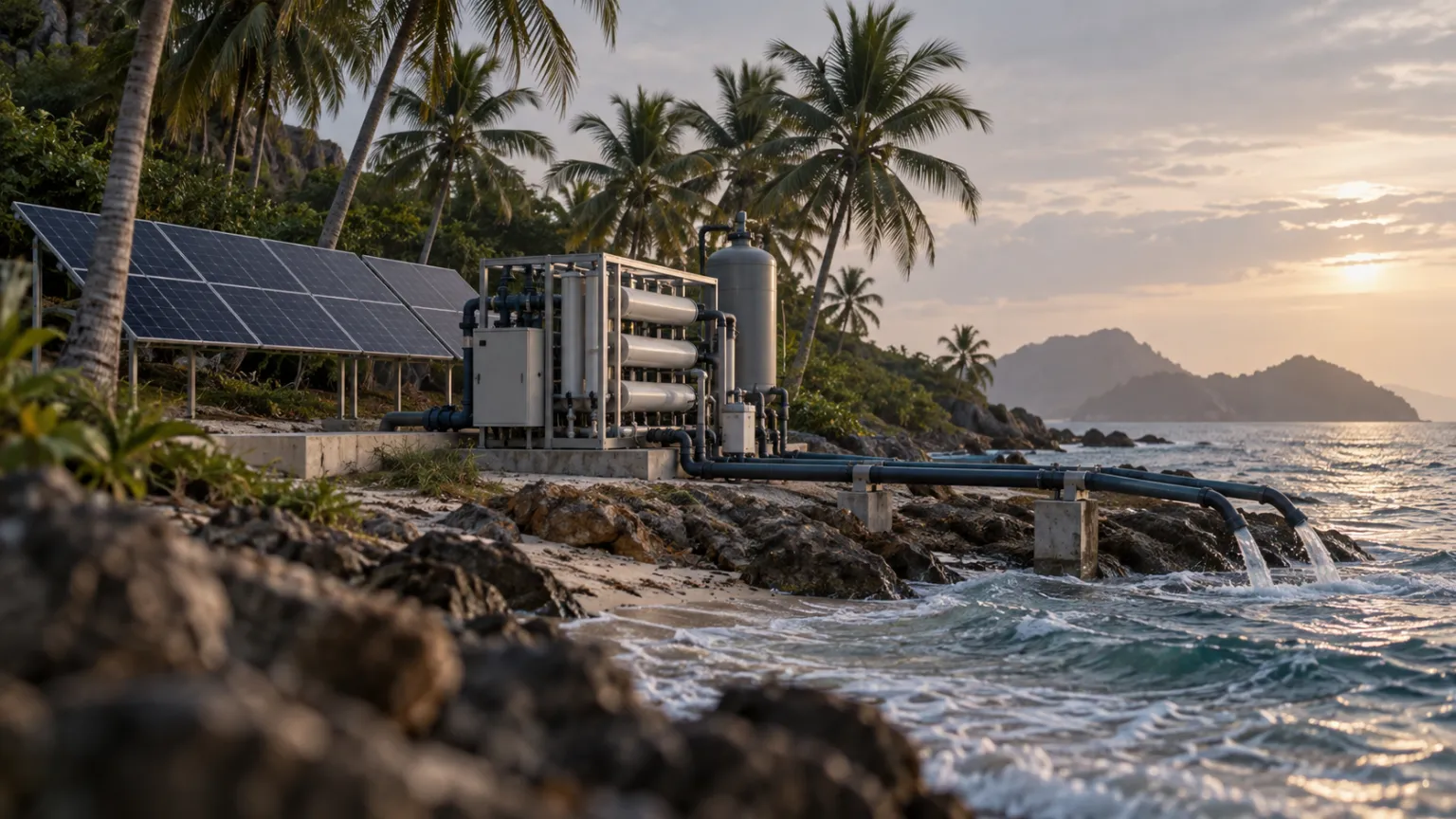
On a small island, the binding constraint is rarely land. It is fresh water and electrical capacity. Supply differs island by island: as of September 2026, Gili Air receives PDAM water through an undersea pipe from Lombok, while Gili Trawangan, where an earlier groundwater supplier closed because drilling is prohibited, faces a clean-water crisis as its seawater desalination operator, working with PDAM, holds back amid a dispute over its permits (Radar Lombok, 8 September 2026). Where the pipe does not reach, operations rely on rainwater harvesting, brackish-water boreholes drawn from a thin freshwater lens, and reverse-osmosis desalination. Over-extraction induces saltwater intrusion that is slow to reverse. A development that designs for hotel-style consumption without a desalination plan is designing for failure.
The EDGE standard (IFC, World Bank Group) sets a useful baseline. EDGE Certified requires a minimum projected reduction of 20% in energy use, water use and embodied carbon in materials, benchmarked against a standard local building (earlier IFC wording refers to embodied energy). EDGE Advanced requires 40% or more on-site energy savings. Used in nearly 140 countries according to IFC, EDGE is, in Victaura's assessment, the framework most directly applicable to emerging-market coastal hospitality, because the local-benchmark methodology adapts to climate zone and grid carbon intensity. We do not currently hold EDGE certification. The 20-20-20 envelope serves here as the reference against which a coastal design can be checked. Claiming a certification that is not issued is a misrepresentation we will not make.
On the energy side, the grid limit is binding before the carbon limit is. PLN supplies the Gili islands via submarine cable from Lombok. The islands were originally powered by diesel generators; two additional 20 kV submarine cables reported in 2020 raised capacity from 16 MW to 36 MW (Dunia Energi, February 2020). Capacity remains finite. Rooftop solar with battery storage sized to the daily evening load reduces the marginal grid call and the single-point-of-failure risk during cable maintenance windows. On Zanzibar the same logic applies to supply from ZECO, the island utility. On Lake Como the question inverts (peak load is winter heating, not summer cooling, and historic-villa restoration carries embodied-carbon and thermal-envelope constraints that no off-the-shelf certification fully captures). The principle holds: design to a measurable envelope, document the calculation, disclose the assumption.
Embodied carbon is the third leg. Cement accounts for around 8% of global CO2 emissions (Chatham House, 2018). A coastal villa scheme built on imported Portland cement with steel shipped through sea freight carries an embodied-carbon footprint fixed before the first night of operation; Victaura Research assumption: it can outweigh many years of operational emissions, and it is calculated project by project. Substituting locally sourced lime mortars and coral-stone (where harvested under permit from quarried, not living, sources) reduces both the carbon line and the supply-chain risk line. The historic buildings of Stone Town are mostly coral rag masonry set in lime, earth and sand mortar under lime plaster (UNESCO Urban Heritage Atlas), not Portland cement. The technical evidence is in the masonry.
Mangrove restoration economics
Mangroves are among the most carbon-rich forests in the tropics (Donato et al., Nature Geoscience, 2011). NOAA puts the carbon stored per acre by mangroves and salt marshes at three to five times that of tropical forests. For the operator on a coast where mangroves have been degraded, restoration is not a cost line. It is a coastal-protection line, a community-engagement line, and (with discipline) a carbon-revenue line layered together.
The economics are measurable. A 2020 global analysis (Jakovac et al., Ecological Economics) found that conservation of 90% of remaining mangroves could be achieved at carbon prices between US$3 and US$13 per tCO2, and that prices between US$4.5 and US$18 per tCO2 could support the restoration of 90% of deforested mangroves. A 2025 Nature Communications analysis puts the global benefit-cost ratio of mangrove restoration at 6.35 to 15.0, with net gains in ecosystem service value of US$231 to US$725 billion against US$40.0 to US$52.1 billion in investment. Verified Carbon Standard (Verra VCS) and Plan Vivo are the operating frameworks: Plan Vivo certifies Tahiry Honko in Madagascar and Mikoko Pamoja in Kenya, which it describes as the world's first community-led blue carbon project. Ecosystem Marketplace reports volume-weighted average prices for mangrove restoration and conservation credits of US$28.15 in 2022 and US$26.03 in 2023, on small traded volumes (State of the Blue Carbon Market 2024). The operator's own offset claim is a separate question, one Victaura does not currently make in public communications.
The community line is not optional. A review in PLOS Biology (Lovelock, Barbier and Duarte, 2022) attributes mangrove restoration failures mainly to short-term, large-scale planting programmes in unsuitable locations with inadequate community support. Victaura Research assumption: programmes that pay community members to plant, monitor and police restoration sites, with carbon revenue underwriting the wage line, are the ones most likely to last. On Zanzibar, where mangrove cover declined between 1973 and 2020 by about 48.5 hectares a year in Chwaka Bay and 6.8 hectares a year in Menai Bay (Mohamed, University of the Witwatersrand, 2024), the restoration runway is wide, and the natural public partner is Zanzibar's own Department of Forestry, within the Ministry of Agriculture, Irrigation, Natural Resources and Livestock. The operating question is whether the scheme is designed with that partnership as a load-bearing element or as a CSR addendum.
The supply chain question
A coastal villa is the sum of what was shipped to the site. Cement, rebar, glass, marine plywood, sanitary ware, tile, fit-out, HVAC, technical wiring: each line carries an embodied-carbon footprint, a sea-freight footprint, and a counterparty risk. Local sourcing has technical limits. Coral-stone masonry, lime mortars, hardwood frames, woven palm and rattan finishes are local strengths in Zanzibar and Indonesia with deep craft traditions. Glass and steel structural elements typically are not. The credible model is segmentation: structural systems imported from optimised supply chains, finish and craft layer sourced within a regional radius defined project by project.
Sea freight has its own emissions profile and its own disruption profile. The Red Sea disruption re-escalated in July 2026 when the Houthis announced a naval blockade against Saudi Arabia, and war-risk insurance for ships crossing the Strait of Hormuz rose from between 1 and 3 percent of hull value to between 7.5 and 10 percent (Al Jazeera, citing S&P Global, 23 July 2026). As of 26 September 2026 the war involving Iran had no formal ceasefire (GlobalSecurity.org), a reported Iranian offer of a seven-day ceasefire had been called unacceptable by President Trump, and US and Gulf forces had begun daytime tanker transits of the Strait (Fortune). As of 18 September 2026 the Strait of Hormuz was not closed but transits remained far below normal (Cyprus Shipping News). Lloyd's List Intelligence reported on 3 September 2026 that no attacks on shipping had been reported since 24 August while threat levels remained elevated; on 24 and 26 September 2026 Saudi air defences intercepted missiles and drones over Saudi territory (GlobalSecurity.org, 26 September 2026). The supply-chain plan that worked in 2019 is not the plan that works in 2026. Contingency on imported materials must be sized to current freight volatility, not historical means. In practice that means buffer stock on critical-path materials at site or in a regional warehouse, and cost contingency on imported structural systems revised upward against 2023 baselines. On cement specifically, replacing a portion of Portland with locally available pozzolanic substitutes (volcanic ash on Bali and Lombok, coral-derived limes on Zanzibar) is technically possible and has historical precedent, with trade-offs in curing time and quality control under tropical humidity. The decision is project-specific. The point is that it is made deliberately and documented, not defaulted because that is what the foreign architect specified by habit.
The operator advantage
The structural difference between an operator and a flip-and-exit developer is time horizon. A scheme designed to be built, sold and exited within 24 to 36 months has an incentive structure that rewards visible finish and discounts non-visible system integrity. A scheme designed to be built, operated and held for 15 to 30 years has the opposite incentive. The operator pays the operating cost of every design shortcut. The flipper does not.
Responsible development is, in practice, an operator's discipline. Mangrove restoration takes years to mature into measurable coastal-protection function. Reef-friendly mooring systems pay back through preserved dive-tourism revenue over a multi-year horizon. Water systems designed to the desalination-plus-rainwater envelope cost more in year one and dramatically less in year ten when the borehole salinises. None of these decisions look optimal on a 24-month exit underwriting. All of them look optimal on a 20-year hold.
A stated hold horizon is a claim for the allocator to test, not to accept. Any developer can call itself an operator. The incentive shows in the documents: the hold assumption in the underwriting, the operating budget for water, energy and restoration systems, and who carries those costs after handover. A pro-forma that exits within 24 months describes a flip, whatever the marketing calls it.
Responsible development is an operator's discipline. The flipper does not pay the operating cost of a design shortcut. The operator does, for fifteen years.
Victaura Research
Disclosure framework: TNFD, GRESB, EDGE
Institutional capital reads three frameworks first. The Taskforce on Nature-related Financial Disclosures (TNFD) released its final recommendations in September 2023. By October 2024 (COP16), 502 companies across 54 jurisdictions, representing more than US$6.5 trillion in market capitalisation, had committed to TNFD-aligned reporting, with 129 financial institutions representing US$17.7 trillion in AUM among the commitments (ESG Today). The TNFD 2026 Status Report, as reported in September 2026, counts 802 TNFD Adopters, while more than 1,000 organisations across 56 countries and regions have published disclosures (Sustainability Online). In April 2025 the IFRS Foundation and the TNFD signed an MoU signalling both parties' commitment to build upon the TNFD recommendations in the work of the ISSB. In November 2025 the ISSB announced it would undertake standard-setting on nature-related disclosures, and in 2026 it agreed to propose the requirements as an IFRS Practice Statement, with an exposure draft planned for October 2026 (IFRS). For real estate developers in nature-sensitive locations, the LEAP approach (Locate, Evaluate, Assess, Prepare) is becoming the expected diligence trail.
GRESB sets the real-estate operating benchmark. The 2025 GRESB Real Estate Assessment received 2,382 submissions from 1,002 fund managers, with standing investments scoring 79 on average (up 3.1 points year on year). Energy data coverage exceeded 75% globally for the second consecutive year. The share of real-estate entities with net-zero policies reached 81.5%, up from 78.8% in 2024 and 72.4% in 2023. The 2025 cycle introduced unscored test criteria for embodied carbon and biodiversity, unscored data collection on building certifications, and an inaugural Residential Component. GRESB is the closest thing to a standardised peer comparison the asset class has.
In Victaura's assessment, EDGE is the most operable certification in emerging coastal markets. Calibrated to the local benchmark in each climate zone, it adapts where LEED and BREEAM struggle. EDGE Certified, EDGE Advanced and EDGE Zero Carbon form a three-tier ladder. For a new-build coastal project, the certified envelope is a sensible internal floor. We do not currently hold the certification and will disclose where and when that changes.
The pattern across these frameworks is the same. They reward operators that publish assumptions and disclose conflicts. They penalise opacity. Institutional capital evaluating branded-residence and coastal-resort schemes runs its due diligence against these frameworks before running the yield calculation. A project that cannot answer TNFD LEAP questions on biodiversity, water and nature dependencies fails diligence before the financial model is opened.
What this means for the buyer: real diligence questions
For the family office, institutional allocator or principal advisor evaluating a coastal or island development, the diligence question is no longer whether it is responsible. It is whether the responsibility is documented, technical and verifiable. The questions that matter are operational, not narrative.
*Permitting: has the AMDAL / ZEMA / autorizzazione paesaggistica / EPDA EIA been issued, and have its conditions been operationally implemented or only signed?* The signed version is paper. The operational version is the asset. Ask for the most recent monitoring report under RKL-RPL or equivalent.
Water and energy: what is the designed per-guest-day water consumption, the desalination back-up, the rooftop-solar plus battery sizing, and how was the embodied-carbon line in the bill of materials calculated? Round numbers without method are marketing. The calculations exist or they do not.
Mangrove and reef: is the restoration programme funded as an operating line in the asset's pro-forma, or as a CSR addendum? Is the carbon credit revenue (if any) flowing to community wage support, to asset-level offset claims, or both? The answer changes how the claim should be read.
Supply chain: what percentage of the bill of materials is sourced within a defined regional radius, what is the freight contingency, what is the cement substitution strategy? The percentage exists. Ask for it.
Disclosure: is the operator publishing TNFD LEAP, GRESB submission, EDGE design envelope? If not, why not? Operators that decline to disclose at the institutional standard are operators not being read by institutional capital. The standard is disclosure over narrative. Numbers triangulated, conflicts named, methodology published.
Skin in the game disclosure. Victaura, through its parent Greystone B.V. (Netherlands), develops projects on Lake Como (Italy), in Nungwi, Zanzibar (Tanzania), on Gili Air and in Uluwatu, Bali (Indonesia), and holds an off-plan capital position on Al Marjan Island, Ras Al Khaimah (UAE). Readers should assume commentary may be influenced by, or benefit, these positions. This document is classified as marketing material under MiFID II Article 24(3). It is not investment advice.
Corrections, 27 September 2026
What the article said and what it says now. The published version gave the IPCC AR6 SSP1-2.6 range as 0.33 to 0.62 m and a high-end branch above 1.5 m by 2100; it now gives 0.32 to 0.62 m and the AR6 Chapter 9 storyline of more than one additional metre under high emissions. It said Western Indian Ocean sea level was rising at about 3.5 mm a year, 4% above the global mean; it now gives 3.85 mm a year against 3.4 mm globally for 1993 to 2024 (WMO, State of the Climate in Africa 2024). It attributed the Unguja shoreline study to the Journal of Sea Research; it was published in Regional Studies in Marine Science (Mbezi et al., 2024). It said twelve Indonesian marine protected areas would face annual severe bleaching from around 2026; De Clippele et al. (Marine Policy, 2023) project that for Gili Matra from 2026 and for 12 areas by 2030. It described Zanzibar EIA as run by NEMC under the Tanzanian Environmental Management Act 2004, with a certificate issued only after verified mitigation and a nine to fifteen month timeline; on Zanzibar EIAs are reviewed by the Zanzibar Environmental Management Authority under the Zanzibar Environmental Management Act 2015, mainland certificates are issued before construction with conditions attached, and the timeline has been removed for lack of a source. It gave a twelve to eighteen month AMDAL cycle and cited Law 11/2020; it now gives the statutory 30 and 75 working-day review steps and Law 6/2023. It described the Italian Article 167 procedure as a 90-day review open to any unauthorised work; it is decided within 180 days, on a Soprintendenza opinion due within 90, and only in limited cases, and simplified authorisation runs 60 days rather than 20. It called the UAE Federal Decree-Law 11/2024 the first binding climate framework in MENA with no thresholds; both claims have been removed. It attributed a 13 to 66% reduction in wave energy to Nature Communications (2018); the figure refers to wave height and comes from McIvor et al. (2012). It said the Gili islands have no piped water and rely on diesel in peak season; Gili Air receives piped PDAM water from Lombok and power arrives by submarine cable. It gave blue carbon credit prices of US$15 to 35 in 2024 to 2025 without a source; it now gives Ecosystem Marketplace averages of US$28.15 (2022) and US$26.03 (2023). It named Tanzania Forest Services and ZAWA as Zanzibar mangrove partners; ZAWA is the Zanzibar Water Authority, and the reference is now to Zanzibar's forestry department. Unsourced figures on EDGE country coverage (now nearly 140 countries per IFC), cement (now around 8% per Chatham House), restoration timelines, sourcing radius and internal buffer stock have been corrected or removed, TNFD and GRESB figures have been dated and updated, and the shipping paragraph now dates the Red Sea and Strait of Hormuz disruptions as of September 2026.
A further review on the same day refined some of the corrections above and fixed further points. The article said the UAE Federal Decree-Law 11/2024 requires third-party verification and doubles fines for any repeat within two years; it now says entities must measure, report and verify emissions and keep records for at least five years, with fines doubled for a repeat within two years (BDO), counted from a prior conviction according to a summary of Article 15 (Ahya). It said Gili Trawangan faces a water crisis after a groundwater operator was shut down; per Radar Lombok (8 September 2026) the groundwater supplier closed earlier and the current crisis stems from the desalination operator holding back amid a permit dispute. It said one additional submarine cable raised Gili capacity from 16 to 36 MW; Dunia Energi (February 2020) reports two 20 kV cables. It described the EDGE threshold as covering embodied energy and EDGE Advanced as a 40% energy reduction; EDGE now specifies embodied carbon in materials and 40% or more on-site energy savings. It said 99 Indonesian marine protected areas are more than half of the 161 with coral reefs; The Conversation reports 99 as more than half of Indonesia's MPAs and all 161 reef MPAs by around 2075. It described Jakovac et al. (2020) as finding mangrove conservation feasible at US$3 to 13 per tCO2; the study says conservation could be achieved and restoration could be supported at those prices, and the unconfirmed two-decade period for the Nature Communications figures has been removed. It named DFNRNR as Zanzibar's forestry department; the current body is the Department of Forestry within the Ministry of Agriculture, Irrigation, Natural Resources and Livestock. It said the war involving Iran began on 28 February 2026, citing Al Jazeera, which does not give that date; the shipping paragraph now gives the Iran war status and Red Sea events as of 26 September 2026 (Fortune; GlobalSecurity.org). It said 502 organisations had committed to TNFD reporting and that the ISSB began nature standard-setting in November 2025 under an MoU committing it to build on TNFD; the source counts 502 companies, the MoU signals both parties' commitment, and the ISSB announced standard-setting in November 2025 and in 2026 agreed to propose an IFRS Practice Statement with an exposure draft planned for October 2026 (IFRS). The Stone Town mortar sentence and the AR6 high-end storyline have also been sourced and worded as in the originals.
A third review on the same day corrected further points. The article said that under UAE Federal Decree-Law No. 11 of 2024 operational carbon disclosure becomes a regulatory obligation for developers on Al Marjan Island and other Ras Al Khaimah freehold zones. It now says that Cabinet Resolution No. 67 of 2024 on the National Register for Carbon Credits requires GHG monitoring and reporting systems only from businesses with annual Scope 1 or Scope 2 emissions above 0.5 MtCO2e, and that businesses below that threshold may register voluntarily (Hadef & Partners). It also states, as a Victaura Research assumption, that villa and boutique hospitality projects sit below the threshold. The permitting table and its source line have been updated accordingly.
References
- IPCC AR6 WG1, Chapter 9: Ocean, Cryosphere and Sea Level Change (2021)
- IPCC SROCC Special Report on the Ocean and Cryosphere in a Changing Climate (2019)
- Mbezi et al., Exploring shoreline changes on eastern beaches of Unguja, Tanzania (Regional Studies in Marine Science 75, 2024)
- De Clippele et al., Indonesia coral bleaching projections, Gili Matra (Marine Policy 2023; reported in The Conversation, 22 November 2023)
- Mongabay (2023), citing a 2009 Indonesian projection of 13-35 cm sea level rise on Lombok by 2050 (IPCC SRES)
- Jakovac et al., Costs and Carbon Benefits of Mangrove Conservation and Restoration, Ecological Economics (2020)
- Mangrove restoration global benefit-cost ratio, Nature Communications (2025)
- IFC EDGE green building standard (World Bank Group)
- Netherlands Commission for Environmental Assessment, Indonesia: legislation at project level (AMDAL, 2023)
- Tanzania NEMC, EIA Procedures (EIA & Audit Regulations 2005)
- Italy, Code of Cultural Heritage and Landscape D.Lgs 42/2004, Articles 142, 146, 167
- UAE Federal Decree-Law No. 11 of 2024 on the Reduction of Climate Change Effects
- TNFD final recommendations and 2025 Status Report
- GRESB 2025 Real Estate Assessment Results
- UNEP, Why protecting coral reefs matters
- IPCC AR6 WG1 Chapter 9, Executive Summary (official PDF)
- WMO, State of the Climate in Africa 2024
- The Conversation, More than half of Indonesia's protected coral areas look set to suffer severe bleaching every year by 2044 (2023)
- AKSET, Perppu Job Creation becomes law based on Law No. 6 of 2023
- ZEMA, General Terms of Reference for conducting EIA/ESIA in Zanzibar (2021)
- Netherlands Commission for Environmental Assessment, EIA and environmental permitting in Zanzibar
- D.Lgs 42/2004, Article 167 (Brocardi)
- DPR 31/2017, simplified landscape authorisation (text)
- BDO, Federal Decree-Law No. (11) of 2024 on the Reduction of Climate Change Effects
- McIvor et al., Reduction of wind and swell waves by mangroves (TNC / Wetlands International, 2012)
- NOAA Office for Coastal Management, Blue carbon fast facts
- Donato et al., Mangroves among the most carbon-rich forests in the tropics, Nature Geoscience (2011)
- Ecosystem Marketplace, State of the Blue Carbon Market 2024
- Plan Vivo, Mikoko Pamoja (Kenya)
- Plan Vivo, Tahiry Honko (Madagascar)
- Lovelock, Barbier and Duarte, Tackling the mangrove restoration challenge, PLOS Biology (2022)
- Mohamed, mangrove cover change in Chwaka Bay and Menai Bay, Zanzibar, 1973-2020 (University of the Witwatersrand, 2024)
- Chatham House, Making Concrete Change: Innovation in Low-carbon Cement and Concrete (2018)
- IFC, Green buildings and EDGE
- Radar Lombok, water supply on Gili Trawangan and Gili Air (8 September 2026)
- Dunia Energi, PLN submarine cable for the three Gili islands (2020)
- ESG Today, Over 500 companies commit to report using TNFD framework (28 October 2024)
- IFRS Foundation and TNFD formalise collaboration (April 2025)
- IFRS, ISSB welcomes TNFD support for nature-related disclosure (November 2025)
- Sustainability Online, TNFD 2026 Status Report (September 2026)
- Al Jazeera, How shipping insurance rates are rising as Hormuz and Bab al-Mandeb shut down (23 July 2026)
- Cyprus Shipping News, The war premium has moved into the balance sheet (18 September 2026)
- Lloyd's List Intelligence, Red Sea Brief (3 September 2026)
- Hadef & Partners, UAE Federal Law on Reduction of Climate Change Effects enters into force (2025)
- Ahya, Federal Decree-Law No. 11 on the Reduction of Climate Change Effects (summary of Articles 6 and 15)
- EDGE certification levels (EDGE Certified, EDGE Advanced, Zero Carbon)
- UNESCO Urban Heritage Atlas, Stone Town of Zanzibar
- Jakovac et al., Ecological Economics 176 (2020), open repository version (UEA)
- Zanzibar Restoration Stakeholder Engagement Plan, Department of Forestry (October 2025)
- IFRS, ISSB agrees proposed way forward on nature-related disclosures (2026)
- Fortune, Iran war ceasefire offer and daytime Hormuz transits (26 September 2026)
- GlobalSecurity.org, Iran war operational report (updated 26 September 2026)
- Houston, The latest sea level rise projections of the IPCC, Shore & Beach 92(3), 2024 (AR6 table by scenario)
The information on this website is provided for informational purposes only and does not constitute an offer, solicitation, or financial advice. Indicated returns are estimates and are not guaranteed; past performance is not indicative of future results. Capital invested is at risk.
Considering an allocation to luxury real estate in the locations we operate? Speak to us about our current and upcoming projects.
Speak to Victaura →Related insights

Market Views
JLL Transparency Index 2026: Four Markets Read
JLL and LaSalle published the 14th Global Real Estate Transparency Index on 14 September 2026, scoring 88 countries and 146 cities across 260 factors. Transaction volumes in the 13 Highly Transparent markets rose 64% in two years, 20 points faster than the rest. Dubai, Abu Dhabi, Italy, Indonesia and Tanzania sit at four different points on that scale, and the index prices liquidity, not safety.

Market Views
Cost of Capital: An Underwriting Input for Prime
The European Central Bank raised rates in June and again in September 2026, and the Federal Reserve raised on 16 September after holding in July against three dissents to raise; the Bank of England held on 17 September with three votes to raise. The institutional read is not to time the prime market against the cycle, but to name the cost of capital as an underwriting input and price it against a statutory landscape constraint that out-lasts the rate cycle.
ESG & Stewardship
Island Utilities: Water, Power, Waste Costs
On a mainland site, water and power are a monthly bill. On a small island, they are a piece of process plant with a capital cost, a design life and a failure mode. This piece prices what that plant actually costs to build and run on Zanzibar's coast, and discloses where the data runs thin.