
Destinations
Zanzibar: An Emerging Luxury Destination
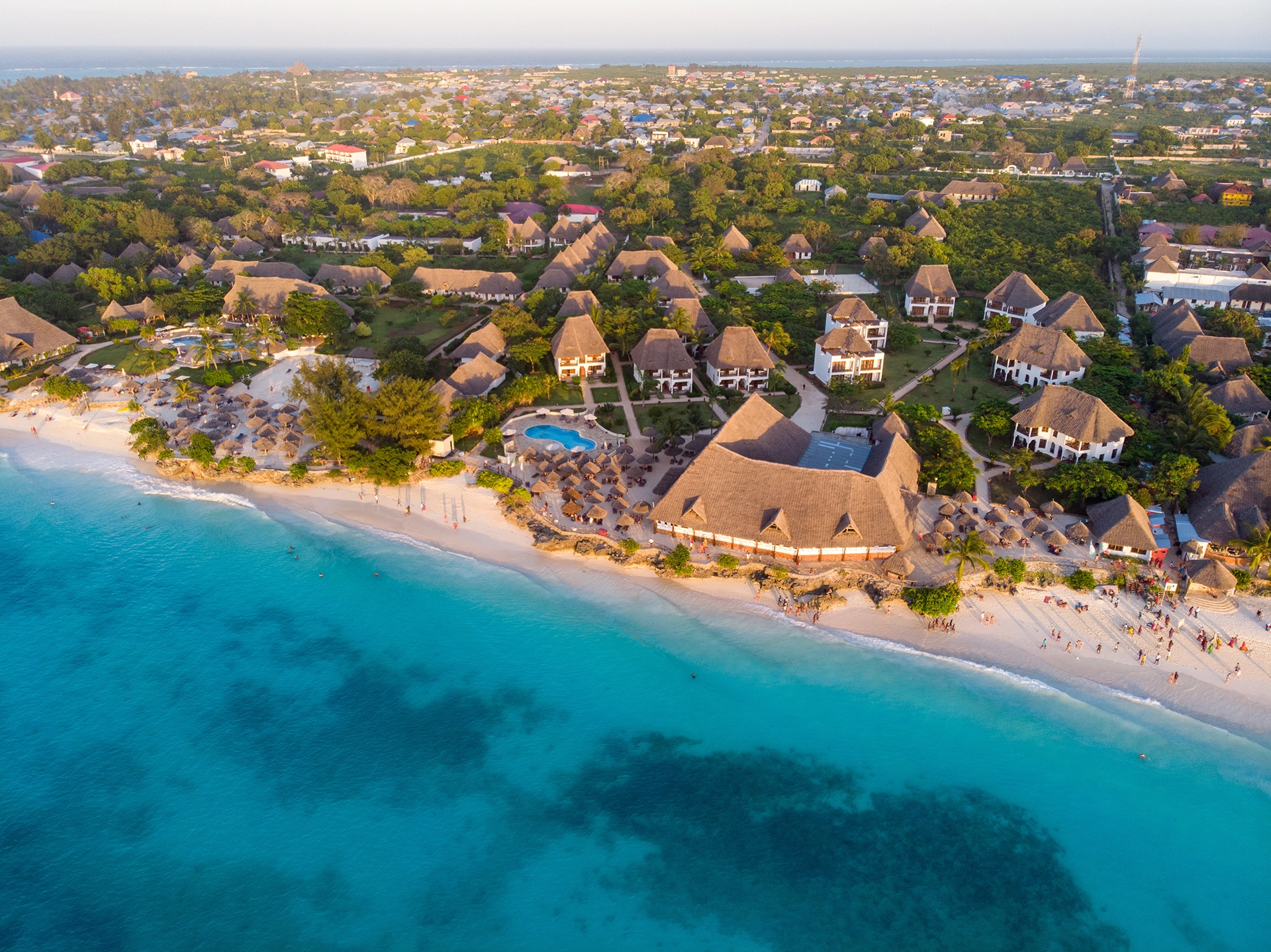
Zanzibar is transitioning from a mid-tier coastal destination to a luxury and ultra-luxury market by statute and by demand, but on leasehold tenure with a 99 year ceiling and with disclosed climate exposure. The 2024 and 2025 arrivals data, the framework of the Land Tenure Act 1992 and the Zanzibar Investment Act 2023, and the operator pipeline at Nungwi tell a consistent story: the conditions are forming, the constraints are real, and the underwriting requirements are explicit.
Key takeaways
- - Zanzibar recorded 917,167 international arrivals in 2025, +24.5% on the 736,755 of 2024 (OCGS; the Bank of Tanzania exit survey, a second official series, gives 654,880); in 2024 Europe was 72% and Italy the single largest source at 11.8% (87,202 travellers).
- - Foreign tenure is a lease of public land, maximum 99 years, granted in terms of up to 33 years, no freehold (Land Tenure Act 1992, Section 47, as amended in 2010 and 2018). Renewal of a term follows a ministerial assessment of the investment; it is not automatic.
- - Strategic Investment Status under the Zanzibar Investment Act 2023 (Section 25, Second Schedule): USD 50M on Unguja, USD 5M on Pemba, with at least 30% in equity; it adds tax and land-lease incentives. The guarantees on seizure, transfer of funds and arbitration, ICSID rules included, apply to every approved investment (Sections 34, 35 and 57).
- - Premium operator footprint: Park Hyatt (Stone Town, 2015), Meliá, Marriott Le Méridien, Anantara Zanzibar Resort & Residences (Nungwi, 111 keys + 70 branded apartments, USD 150M GDV, opening 2027, Infinity Developments).
- - Climate exposure disclosed: WIO sea level rise approximately 3.5 mm/y (4% above global mean); east-coast Unguja erosion approximately 15.6 m/y (1990 to 2020 monitored segments). Setback discipline and light operational footprint are underwriting requirements.
- - Investor Residence Permit Class C-11 at USD 100,000 qualifying property threshold; residence only, no citizenship pathway; favourable interaction with Italian Art. 24-bis regime (Tanzania Investment Centre).
- - Tanzania FDI 2024 USD 1.72 billion (UNCTAD); GDP growth 5.6%; tourism approximately 17% of GDP.
On this page (11)
Revision notes
This article was corrected on 27 September 2026. A check of its figures and attributions against the cited sources found errors, which have been corrected in the text. The full list, with what the article said and what it says now, is in the corrections section at the end.
This article was corrected on 29 September 2026. An earlier version described Victaura's position at Nungwi beyond its public project page and presented it as an example of the advantage of completed project cycles. The text, the table of zones and the disclosure at the end now follow Victaura's public project pages.
This article was corrected on 12 October 2026. An earlier version attributed the freehold zones of the United Arab Emirates to a federal law that concerns another subject. It now cites the Ras Al Khaimah law under which the Ruler designates the areas where foreigners may own property.
This article was corrected on 13 October 2026. An earlier version gave a delivery period for Victaura's project at Nungwi that its public project page does not give. It has been removed. The section on the Italian buyer now ties the rise in the Article 24-bis charge to the transfer of residence.
This article was corrected on 13 October 2026. The deck, the sections on the legal architecture and on Strategic Investment Status, the points for the foreign buyer and the key takeaways cited an investment act repealed in 2024 and a Tanzanian act that does not set Zanzibar's thresholds. They now follow the Land Tenure Act 1992 as amended and the Zanzibar Investment Act 2023, as published by Zanzibar's House of Representatives. The description of the lease term, of its renewal and of the investor guarantees has changed with them.
This article was corrected on 13 October 2026. The section on the visa frame and the reference list gave a wrong date for the Italy-Tanzania double taxation treaty, and the section on the Italian buyer gave an estimate of Italian property holders with no public source; the treaty dates now follow Italy's Ministry of Economy and Finance, and the estimate has been removed.
The 2024 and 2025 numbers
Zanzibar recorded 917,167 international arrivals in 2025, up 24.5% on the 736,755 of 2024, according to the December 2025 Tourism Statistical Release of the Office of the Chief Government Statistician (OCGS Zanzibar) and the Zanzibar Commission for Tourism. The 2024 figure, itself up 15.4% on the previous year, is the one this article originally reported as the record. The 2025 figure is now the highest in the archipelago's recorded history. The trajectory is consistent: the post-pandemic recovery did not plateau in 2022 or 2023 as it did in most African coastal destinations, it accelerated, and the growth rate rose from 15.4% in 2024 to 24.5% in 2025. A second official series, the 2025 International Visitors' Exit Survey released by the Bank of Tanzania, attributes 654,880 arrivals to Zanzibar, up 9%. The two series use different denominators and agree on direction.
The composition of that visitor base is the more interesting data point. In 2024 Europe accounted for approximately 72% of arrivals. Italy was the single largest source market at 11.8%, equivalent to roughly 87,202 Italian travellers across the calendar year, and it led again in 2025, at 14.4% of December arrivals in the OCGS release and 18.8% of Zanzibar visitors in the Bank of Tanzania exit survey for the year. Germany, the United Kingdom and France completed the top of the European contribution in 2024, with the United States contributing the principal long-haul share outside Europe. The dependency on a narrow European corridor is itself a market characteristic that allocators should price, but it is also the structural reason why the operator footprint described further below has consolidated where it has.
The macro backdrop supports the trend. The World Bank Tanzania Economic Update reports mainland Tanzanian GDP growth at approximately 5.6% in 2024, among the more stable trajectories in Sub-Saharan Africa. Tourism contributes around 17% of Tanzanian GDP and approximately 25% of total foreign exchange receipts, with Zanzibar accounting for a disproportionate share of the high-spend segment. Tanzania foreign direct investment reached USD 1.72 billion in 2024, with tourism real estate the second largest sectoral allocation after extractives.
For an Italian buyer in particular, the implication is straightforward. The clientele is already present, in volume, before any new product is delivered. A finished luxury asset on the north-west coast does not need to create demand. It needs to capture an existing demand profile that, on the OCGS series, has grown for four consecutive years.
Whether these numbers make Zanzibar a good investment is a separate question, and no public statistic answers it on its own. The eight checks a principal can run, from the OCGS arrivals series and the investment statute to the central bank data and dated travel advisories, each with its publisher and its limits, are set out in Investing in Zanzibar: What a Buyer Can Verify.
The legal architecture
Foreign tenure in Zanzibar is leasehold, with a maximum term of ninety-nine years. There is no freehold. The statute is the Land Tenure Act 1992. Rights of occupancy are granted only to Zanzibaris above eighteen (Section 24). A non-Zanzibari takes a lease of public land from the Minister responsible for lands, and a lease for investment purposes is subject to approval of the investment by the Zanzibar Investment Promotion Authority (ZIPA) or another relevant authority (Section 46). Under Section 47, as amended in 2010 and 2018, the lease may not exceed ninety-nine years and is granted in terms of no more than thirty-three years each. Under Section 27 of the Zanzibar Investment Act 2023, which repealed the ZIPA Act 2018, the Authority grants leases itself only inside Special Economic Zones and elsewhere facilitates the lease through that Minister.
This is materially different from the freehold designated zones of the United Arab Emirates, such as the areas the Ruler of Ras Al Khaimah designates for foreign ownership under the emirate's Law No. 11 of 2021 on the real estate register (Al Tamimi & Company, October 2021), and it is closer in legal grammar to the Indonesian framework where Hak Milik is reserved for citizens and foreign buyers access land through Hak Pakai or Hak Guna Bangunan. The constitutional Article 33(3) constraint that defines the Indonesian case does not exist in the Zanzibar architecture in the same form, but the statutory effect is comparable: foreign capital participates in the land economy on a long-term derivative basis, not on a perpetual basis. Allocators that underwrite Zanzibar as if it were a freehold market are misreading the regulation.
The ZIPA permitting process is consequential. Approved investment in designated zones (Nungwi, Kendwa, Pingwe-Michamvi and selected Stone Town parcels) is processed through ZIPA on a single-window principle, with environmental impact assessment under the National Environment Management Council (NEMC) standards and parallel coordination with the Department of Lands and Registration. The process is slower than a Gulf master-developer route. It is also more defensible at exit, because the chain of title from ZIPA approval through registered lease is documented at each stage. Investors that have completed the cycle treat the permitting layer as part of the asset, not as friction to be discounted.
A practical consequence for capital structuring. The ninety-nine years are a ceiling, not a single term: the lease is granted in terms of up to thirty-three years, and before a term is renewed the Minister responsible for lands assesses the performance of the investment, in consultation with the Minister responsible for investment (Section 47). An institutional investor underwriting on a thirty to fifty year horizon is inside the ceiling, but any hold longer than the first term, thirty-three years at most, crosses a renewal; and an investor expecting perpetual title transmission across multiple generations needs to plan around every renewal and around the ceiling itself. The renewal is not automatic. For the long-duration family allocator, this is an underwriting input, not a deal-breaker, provided it is named and priced.
Foreign tenure in Zanzibar is leasehold, maximum ninety-nine years. There is no freehold. The statute is explicit. Underwriting that ignores this is not underwriting.
Strategic Investment Status
On Zanzibar, Strategic Investment Status is set by the Zanzibar Investment Act 2023. Under Section 25 and the Second Schedule, an approved investment on Unguja, the larger island, qualifies with USD 50 million invested and at least thirty per cent of the capital in equity, and one on Pemba, the smaller island whose development corridor remains lightly built, with USD 5 million on the same condition; outside the hotel sector the thresholds are USD 10 million with at least 500 direct jobs on Unguja and USD 2 million with at least 100 on Pemba. The investor applies to ZIPA for the status, which adds incentives: under the Fourth Schedule, fuller exemptions on duties and corporate income tax and up to five years' grace on land-lease payments. The guarantees do not depend on it. Protection against seizure, allowed only in the public interest and with fair and timely compensation (Section 35), the transfer abroad of dividends, loan service and sale proceeds (Section 34) and arbitration, including under the rules of the International Centre for Settlement of Investment Disputes (ICSID) (Section 57), apply to every approved investment.
The institutionally consequential feature is that the protection is written into the Act for every approved investment, while the strategic status is a matter of incentives. That ordering tells an allocator what Zanzibar will and will not do at the political margin: the guarantee against seizure is explicit, the guarantee against discretionary regulatory disruption is partial, and the dispute resolution venue can be international. It also means that a project below the strategic thresholds does not sit outside the Act's protection, only outside its fuller incentive package.
Foreign direct investment flows are consistent with the framing. UNCTAD World Investment Report 2025 records Tanzania FDI inflows at USD 1.72 billion in 2024, up from USD 1.34 billion in 2023, a 28% year-on-year increase that places Tanzania among the four largest FDI destinations in East Africa. The tourism-real-estate sector absorbed an estimated 18% of that flow, with Zanzibar capturing a disproportionate share of the high-end segment.
Political risk is the input the statute cannot remove, and in 2025 it materialised. The 2025 vote was not a transition. President Samia Suluhu Hassan, in office since the death of President John Magufuli in 2021, was declared re-elected after the general election of 29 October 2025 with close to 98 per cent of the vote, in a contest from which major opposition candidates had been barred. On 11 November 2025 UN News reported that, according to information obtained by the UN human rights office, hundreds of protesters and others had been killed and more than 150 people arrested since polling day, and that the security situation and the internet shutdown had prevented the UN from verifying exact casualty figures. Internet services were restricted and a nationwide curfew was imposed during the unrest (Freedom House, Freedom in the World 2026). As of 27 September 2026 the toll remains disputed. The most recent official count located for this revision, the report of a government-appointed commission published in April 2026, records at least 518 deaths, a figure its chair said might not be final, while opposition and religious groups estimate thousands (DW, 24 April 2026). The Mo Ibrahim Foundation did not read the vote as orderly. On 3 November 2025 it wrote that "an election which excludes the opposition parties is neither fair nor legitimate". Freedom House rates Tanzania Not Free, with a score of 28 out of 100 in Freedom in the World 2026, down from 35 a year earlier. The statutory guarantees described above are unchanged on paper. What the episode changes is the weight an allocator gives to discretionary state action, from permitting to lease renewal, across a thirty to fifty year hold.
The Italian buyer specificity
Italy is not one source market among many for Zanzibar. It is the dominant European source market. The 87,202 Italian travellers recorded by OCGS for 2024, equivalent to 11.8% of total arrivals, place Italy ahead of Germany, France and the United Kingdom on absolute volume, and ahead of every other single country source. The pattern is not a 2024 anomaly. Italian arrivals to Zanzibar have led the European table consistently across the post-pandemic recovery, a position reinforced by direct charter capacity from Milan Malpensa, Bergamo and Rome Fiumicino throughout the high season.
The composition of the Italian flow is differentiated. Volume is dominated by the package-holiday segment routed through northern Italian operators, but the high-spend tail is concentrated in the wedding, honeymoon and repeat-luxury-stay categories. Industry estimates from Federalberghi and the Confturismo segment surveys suggest that approximately 8 to 12% of Italian arrivals to Zanzibar are concentrated in five-star and above accommodation, against a global Zanzibar average of around 4 to 6%. That over-indexation in the premium tier is, in commercial terms, the reason Italian operators have led on luxury investment at Nungwi for a decade.
The diaspora and second-home dimension has no public count. Italian residence-by-investment in Tanzania is not a structured programme of the kind discussed in the visa frame section below; the Class C-11 Investor Residence Permit is a working framework rather than a marketed scheme. No public source found for this article gives the number of Italians who own property on Zanzibar, and the article does not estimate it.
The fiscal layer connects to the European map described in the flagship dossier. Italians repatriating to take advantage of the Article 24-bis regime, whose annual substitute tax rose from EUR 200,000 to EUR 300,000 for those who transfer residence from 1 January 2026, have shown a documented preference for African and Indian Ocean second-home exposure as part of the platform reconfiguration. The Zanzibar position within that map is specific: it is the African coastal destination where Italian institutional knowledge, charter capacity and operator presence have already compounded. The buyer base is not theoretical.
Climate exposure honestly disclosed
Climate is an underwriting input, not an externality. The honest disclosure of physical risk is the single feature that most distinguishes institutional underwriting in 2026 from the cycle that preceded it, and Zanzibar carries documented exposures that have to be named at the parcel level.
Sea level rise in the Western Indian Ocean is running at approximately 3.5 millimetres per year, around four per cent above the global mean, according to Nature Communications Earth and Environment (2026) and corroborated by AVISO satellite altimetry data over the 1993 to 2024 series. The acceleration trajectory matches the Indian Ocean Dipole signal documented by NOAA and the Indian Ocean Climate Initiative. Across a thirty year holding horizon, the projected cumulative SLR sits in the 30 to 50 centimetre range on central scenarios, with upper-bound scenarios reaching 70 to 90 centimetres in the most aggressive Hansen-aligned trajectories.
Coastal erosion on the east coast of Unguja has been measured at approximately 15.6 metres per year between 1990 and 2020 in specific monitored segments (ScienceDirect, Ocean and Coastal Management 2023). The east-coast erosion signal is materially higher than the west-coast erosion signal because of the prevailing wind, tidal exchange and exposure to the open Indian Ocean. The north-west coast, where Nungwi sits, benefits from reef-protected lagoon geometry and minimal tidal variation, which is the geomorphological reason the highest-value developments have consolidated there.
Coral bleaching events are now annual in the monitored reef segments of the Indian Ocean MPA network, with the first multi-year consecutive bleaching window opened in 2024 and confirmed by NOAA Coral Reef Watch. Bleaching does not directly destroy beachfront property, but it does compromise the reef-protection mechanism that buffers wave energy reaching the shoreline. Over a thirty to fifty year horizon, the reef integrity question is a material variable in coastal asset valuation.
The implication for asset selection is procedural, not narrative. Setback discipline, elevation of habitable floor levels, light operational footprint (low-rise, dispersed structures, no rigid seawall infrastructure that destroys natural beach replenishment), and parcel-level coastal geomorphology surveys are not optional. They are underwriting requirements. The setback is also a regulatory floor. Zanzibar's Development Control Unit requires building lines at least thirty metres from the highest high-water mark on plots with a sand beach at the sea side, and at least ten metres on plots with a cliff, under its 2018 building-permit guidelines; the setback line and the buildable envelope reads what that strip removes from a lot. Allocators that price Zanzibar oceanfront without these inputs are not pricing the asset.
The visa frame
The Zanzibar Investor Residence Permit, designated Class C-11, is the working residence framework for foreign investors at the property tier. The threshold is set at USD 100,000 of qualifying real estate investment in a ZIPA-approved development, with the permit issued for a renewable term and extending to the principal investor's spouse and dependent children. The Class C-11 is administratively distinct from the strategic investor permit attached to USD 50 million SIS-qualifying projects, and it is calibrated for the individual property buyer rather than the operating investor.
The permit framework is neither a golden visa nor a citizenship-by-investment scheme. It does not carry a path to Tanzanian citizenship, it does not provide the visa-free travel scope of a UAE or Caribbean structure, and it does not extend automatic European travel access. What it does provide is legal residence in the Zanzibar archipelago, with full property rights within the leasehold envelope, and a tax position that is interactive with the bilateral treaty network Tanzania maintains.
For an Italian buyer specifically, the Class C-11 framework interacts with the Italian Article 24-bis regime in a way that is favourable rather than conflicting: the substitute tax on foreign-source income in Italy covers passive rental income generated from the Zanzibar asset, while the Tanzanian withholding regime applies at source. The double taxation treaty between Italy and Tanzania, signed on 7 March 1973 and in force since 6 May 1983 together with the protocol of 31 January 1979 that amends it (Italy's Ministry of Economy and Finance), is the operative document for tax-position planning. This is not advisory commentary, it is the regulatory frame.
Compared to the Mauritius or Seychelles equivalents, the Class C-11 threshold is materially lower (USD 100,000 against USD 375,000 minimum on the Mauritius PDS scheme) and the administrative process is shorter, but the absence of freehold and the absence of citizenship optionality are real differences. Allocators weighing the East African coastal residence map should treat the three jurisdictions as distinct tenure architectures, not as variants of the same framework.
The operator advantage
The combination of ZIPA permitting, leasehold tenure structure and statutory climate constraint produces a market where the operator advantage compounds with experience. A first-time foreign developer entering the Zanzibar market through the ZIPA single-window must learn the documentation chain, the NEMC environmental review timing, the Department of Lands and Registration registration cadence, the customary land use overlays at the parcel level, and the local construction supply chain that operates on a small-island logistics envelope. The cumulative time-to-learn on a first project is meaningfully longer than the same cycle in a master-developer Gulf jurisdiction.
Operators that have completed at least one full project cycle retain a structural advantage on the next cycle: pre-existing relationships with ZIPA, NEMC and the Ministry of Lands, established local construction partnerships, validated supplier logistics, and an installed operating team that does not need to be rebuilt. The institutional buyer that allocates to a Zanzibar project on the back of an operator that has not completed a previous cycle is, in plain language, pricing first-time-developer risk that should be discounted accordingly.
Victaura is itself a developer at Nungwi. Its project there, Secret Zanzibar Hotel & Villas, is in active development. The disclosure at the foot of this article is the skin-in-the-game requirement that institutional buyers should expect from any developer publishing market commentary.
| Zone | Buyer profile | Operator pipeline | Climate flag |
|---|---|---|---|
| Nungwi (NW Unguja) | Luxury / ultra-luxury second home; institutional investor | Anantara Resort & Residences (2027, Infinity Developments); Secret Zanzibar Hotel & Villas (Victaura); multiple boutique | Reef-protected lagoon; lowest erosion exposure |
| Kendwa (NW Unguja) | Premium leisure; established 5-star | Meliá-anchored cluster; multiple operators | Reef-protected; modest erosion |
| Pingwe-Michamvi (SE Unguja) | Wellness-led luxury; lower-density | Six Senses (announced); boutique resorts | East-coast exposure; setback discipline critical |
| Stone Town (UNESCO) | Cultural anchor; historic restoration | Park Hyatt; restoration-led, no new-build | Heritage perimeter; not an SLR-exposed parcel cohort |
| Pemba | Frontier; SIS USD 5M threshold | Substantially pre-build; under-allocated | Lower data coverage; conservative underwriting |
The operator that has completed a full Zanzibar project cycle is the operator that knows where the permitting friction sits. The operator that has not is, in plain language, learning at the institutional buyer's expense.
The conditions are forming, the constraints are real, the underwriting requirements are explicit. A maturing luxury market is not a fully mature one. The distinction is the entire allocation question.
What this means for the foreign buyer
For a family office, principal advisor or single private buyer considering Zanzibar exposure in 2026, the implications are practical and can be stated in five points.
First, the tenure constraint is the binding underwriting input. The asset is a lease of public land capped at ninety-nine years and granted in terms of up to thirty-three years; no freehold is available, and each renewal follows a ministerial assessment of the investment rather than happening automatically. A holding horizon of thirty to fifty years sits inside the ceiling but, beyond the first term, depends on a renewal. Multi-generational transmission plans that assume perpetual title should price the lease renewal risk explicitly. The choice is not whether to underwrite the constraint; it is whether to underwrite it accurately.
Second, the Zanzibar Investment Act 2023 protects every approved investment, and Strategic Investment Status adds incentives on top. The guarantees on seizure, on the transfer of funds abroad and on arbitration do not wait for the USD 50 million Unguja threshold; what that threshold adds is the fuller package of tax and land-lease incentives. The smaller individual buyer does not access the status directly, but does benefit from the broader institutional confidence the framework creates for the operator and the market.
Third, climate exposure is parcel-specific. The north-west coast and the south-east coast carry different geomorphological profiles. Reef-protected lagoon parcels carry materially lower erosion exposure than open-coast east-side parcels. Setback discipline, elevation, light operational footprint and parcel-level coastal surveys are not optional. The thirty to fifty year holding horizon makes climate diligence economically rational, not an externality.
Fourth, the operator chain matters more than the brand. Institutional buyers should distinguish between a brand-flag operator (Anantara, Meliá, Park Hyatt) and the underlying development manager that delivers the asset to completion. Brand validates the segment. The development manager delivers the building. Confusing the two is the most common error in branded-residence underwriting.
Fifth, the visa frame is residence, not citizenship. Class C-11 provides legal residence and full property rights within the leasehold envelope at a USD 100,000 threshold. It does not provide a path to Tanzanian citizenship and it does not provide global travel scope. The interaction with the Italian Article 24-bis regime, in particular, is favourable for Italian buyers structuring a multi-jurisdictional platform.
Skin in the game disclosure. Victaura, through its parent Greystone B.V. (Netherlands), develops projects on Lake Como (Italy), in Nungwi, Zanzibar (Tanzania), on Gili Air and in Uluwatu, Bali (Indonesia), and holds an off-plan capital position on Al Marjan Island, Ras Al Khaimah (UAE). Readers should assume commentary may be influenced by, or benefit, these positions. This document is classified as marketing material under MiFID II Article 24(3). It is not investment advice.
Corrections, 27 September 2026
This article described Tanzania's 2025 election as an orderly handover and attributed that reading to the Mo Ibrahim Foundation. Both statements were wrong. There was no handover. President Samia Suluhu Hassan, in office since 2021, was declared re-elected after the general election of 29 October 2025, in a contest from which major opposition candidates had been barred (Freedom House, Freedom in the World 2026). UN News reported on 11 November 2025, citing the UN human rights office, that hundreds of protesters and others had been killed and more than 150 people arrested. Internet services were restricted and a nationwide curfew was imposed (Freedom House). On 3 November 2025 the Mo Ibrahim Foundation wrote that "an election which excludes the opposition parties is neither fair nor legitimate". The same passage gave the Freedom House rating as Partly Free. Freedom House has rated Tanzania Not Free since its 2025 edition, with a score of 28 out of 100 in 2026. The passage also cited a Eurasia Group ranking of Tanzania for which no public source could be located, and that sentence has been removed. Two further passages are corrected against their sources. The coastal setback now states Zanzibar's 2018 building-permit rule, thirty metres from the highest high-water mark on sand beaches and ten on cliffs, in place of a twenty-metre minimum the rule does not contain. The arrivals section now leads with the 917,167 international arrivals recorded by OCGS for 2025, which replaced 2024 as the record year. What remained of the thesis was the statutory and physical frame. That correction left the leasehold ceiling, the investor guarantees and the climate inputs unchanged; the description of the lease term and of the guarantees was then corrected on 13 October 2026. The political reading did change. As of 27 September 2026, political risk in Tanzania is a documented 2025 event with a disputed death toll, and it belongs in the underwriting file as such.
References
- OCGS Zanzibar / Zanzibar Commission for Tourism, Annual Tourism Report 2024
- Zanzibar Investment Act 2023 (Act No. 10 of 2023), Sections 25, 27, 34, 35, 57 and 62, Second and Fourth Schedules (text published by the Zanzibar House of Representatives)
- Land Tenure Act 1992 (Act No. 12 of 1992), Sections 24, 46 and 47 (text published by the Zanzibar House of Representatives)
- UNCTAD World Investment Report 2025 (Tanzania FDI 2024 = USD 1.72 billion)
- World Bank, Tanzania Economic Update (GDP growth 2024)
- Anantara / Minor Hotels press release, Anantara Zanzibar Resort & Residences (Nungwi)
- Nature Communications Earth & Environment, Western Indian Ocean sea level rise (2026)
- ScienceDirect, Ocean and Coastal Management, Unguja east-coast erosion 1990 to 2020 (2023)
- NOAA Coral Reef Watch, Indian Ocean bleaching alert series 2024 to 2026
- Tanzania Investment Centre, Investor Residence Permit Class C-11 guidance
- Italian Ministry of Economy and Finance, Department of Finance, double taxation conventions: Tanzania (signed 7 March 1973; amending protocol signed 31 January 1979; in force since 6 May 1983)
- Freedom House, Tanzania country report 2025
- Mo Ibrahim Foundation, Ibrahim Index of African Governance 2024
- UN News, Tanzania: Reports of hundreds killed and detained following deadly election violence, 11 November 2025
- Mo Ibrahim Foundation, Madame President, this is not acceptable, 3 November 2025
- Freedom House, Freedom in the World 2026: Tanzania (Not Free, 28/100; 35/100 in 2025)
- DW, Tanzania's opposition criticizes 'whitewashing' of violence (government-appointed commission: at least 518 deaths), 24 April 2026
- Zanzibar Development Control Unit (DCU), Building Permit for Investors, Drawing Guidelines and Procedures, 2018 (setback 30 m sand beach, 10 m cliff)
- The Citizen, Zanzibar tourism hits nearly one million arrivals in 2025 (OCGS: 917,167 in 2025, 736,755 in 2024), 18 January 2026
- Bank of Tanzania and Ministry of Natural Resources and Tourism, The 2025 International Visitors' Exit Survey Report, July 2026 (Zanzibar: 654,880 arrivals, +9%; Italy first source market, 18.8%)
- Al Tamimi & Company, Law No. 11 of 2021 in respect of the Real Estate Register in the Emirate of Ras Al Khaimah: What you need to know (3 October 2021)
- Land Tenure (Amendment) Act 2010 (Act No. 11 of 2010), Sections 5 and 6: leases of public land, ceiling of 99 years (Zanzibar House of Representatives)
- Written Laws (Miscellaneous Amendment) Act, Act No. 1 of 2018, Section 6: Land Tenure Act 1992, Section 47, terms of up to 33 years within the 99-year ceiling (Zanzibar House of Representatives)
The information on this website is provided for informational purposes only and does not constitute an offer, solicitation, or financial advice. Indicated returns are estimates and are not guaranteed; past performance is not indicative of future results. Capital invested is at risk.
Considering an allocation to luxury real estate in the locations we operate? Speak to us about our current and upcoming projects.
Speak to Victaura →Related insights
Destinations
Zanzibar Title: What a Foreigner Can Own
Zanzibar offers a foreign principal no freehold. The primary land right, the Right of Occupancy, is reserved to Zanzibaris, and the foreign holder takes a government lease or a unit title instead. A lease of public land is capped by statute at 99 years and granted in terms of up to 33. This note maps who issues each title, what a bare plot lacks against an approved project, what the February 2026 ZIPA notice added, and what stays unverified.
Destinations
Zanzibar Nears the Million: A Market Matures
Zanzibar recorded 917,167 international arrivals in 2025 on the official OCGS archipelago series, and in 2026 it set successive monthly records: 107,801 in July, then 124,481 in August, the highest monthly figure on record as of 10 September 2026. The million-visitor threshold the frontier thesis anticipated is now within reach, and its approach changes the underwriting. Three things reprice when the volume is real: the frontier discount compresses, infrastructure becomes an input rather than a footnote, and the luxury tier separates from the mass-beach product it was once bracketed with. This is a maturation print, not a maturity certificate, and the distinction is the whole allocation question.
Market Views
Who Develops in Zanzibar: The Operator Map
Zanzibar has no register of developers. It has an investment authority that issues certificates, a land regime built on leases, and, since April 2025, a trade association. This note maps the operators that can be named from public sources, what each is documented to have built and where, and the tests an allocator can use to tell a developer from an intermediary. Every name carries its source. Every gap is disclosed.