
Destinations
Pemba: The Quieter Island
Fifty kilometres north of an island the market has already priced, Pemba receives a fraction of Zanzibar's arrivals, carries a statutory investment threshold one tenth of Unguja's, and is building an international airport. The constraints are frontier-grade: leasehold tenure, thin airlift, minimal advisory infrastructure. The case for looking now echoes Unguja a decade ago, and carries the same underwriting requirements, honestly disclosed.
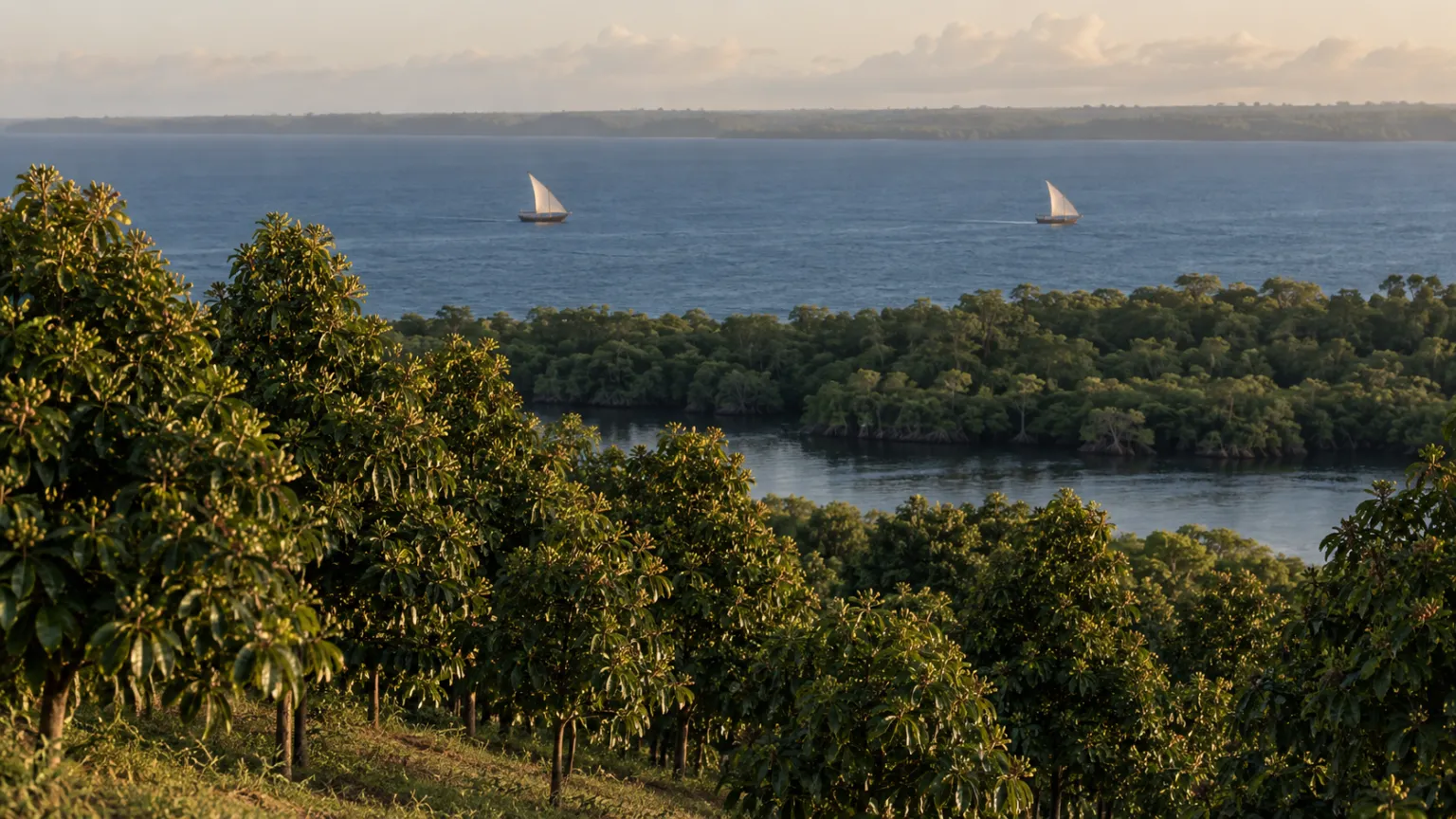 Illustration
Key takeaways
- - Pemba is the archipelago's frontier: a fraction of Zanzibar's 917,167 international arrivals in 2025 (736,755 in 2024, OCGS), with its own airport serving only ~100,000 mostly domestic passengers a year pre-upgrade.
- - Strategic Investment Status attaches at USD 5M on Pemba against USD 50M on Unguja (Zanzibar Investment Act 2023, Section 25): a deliberate 10x differential in the threshold for enhanced tax and land-lease incentives; the core investor guarantees apply to every certified investment.
- - Tenure is identical to Unguja: leasehold under the Land Tenure Act 1992, 99-year ceiling, no freehold for foreign entities; the Zanzibar Investment Act 2023 sets a 33-year land lease for real estate projects. The smaller island is not a looser jurisdiction (Land Tenure Act 1992; Zanzibar Investment Act 2023; Rive & Co, September 2025).
- - The catalyst is a real, financed airport: contractor Propav Infrastructure, ~EUR 170M, 2,510m runway, ~330,000-passenger capacity, ~250-seat aircraft; site handed over Sep 2025, ~2028 target, timeline risk live (The Citizen, September 2025; UK Export Finance).
- - Premium supply is minuscule: The Manta Resort (Underwater Room, ~250m offshore), Fundu Lagoon (12 suites plus standard rooms), Constance Aiyana (30 villas). Quality product with no depth, comps or resale market.
- - Conservation is both constraint and moat: Ngezi Forest Reserve (1959, ~1,440 ha), Misali Marine Conservation Area (1998, 300+ fish species), Pemba Channel Conservation Area (2005).
- - Climate exposure is the archipelago's: Western Indian Ocean sea level rose ~3.88 mm/y over 1993 to 2024 against a 3.45 mm/y global mean; bleaching-level heat stress hit 84% of the world's reef area in 2023 to 2025 (NOAA). Setback and light footprint are underwriting requirements.
- - Pemba is a patient development market for capital with a 7-10 year horizon and a local partner, not a liquid market for a passive buyer; the exit must be underwritten conservatively because no resale market yet exists (Victaura Research).
Revision notes
This article was corrected on 27 September 2026. A check of its figures and attributions against the cited sources found errors, which have been corrected in the text. The full list, with what the article said and what it says now, is in the corrections section at the end.
This article was corrected on 29 September 2026. An earlier version described Victaura's positions in the archipelago beyond its public project pages and used them as evidence of first-hand knowledge of the constraints the article sets out. The text, and the disclosure at the end, now follow those pages.
This article was corrected on 13 October 2026. The statutory frame section called the lease a derivative right, a term the Land Tenure Act 1992 does not use, and gave lease terms in blocks without the statute. It now gives the rule of Section 47 of that Act as amended, read in the acts published by Zanzibar's House of Representatives, and attributes the blocks to the guide that describes them. The reference to the Zanzibar Investment Act 2023 now points to the text published by the same House.
This article was corrected on 13 October 2026. The corrections section of 27 September misdescribed the Rive & Co guide on lease renewal. It now says that the guide calls the land leasehold renewable in general terms and gives a 99-year renewable leasehold for condominium units.
Fifty kilometres north
Pemba is the second island of the Zanzibar archipelago, and it trades on the difference. It sits roughly fifty kilometres north of Unguja, the island the market simply calls Zanzibar, and everything that has made Unguja an institutional conversation over the last decade is present on Pemba only in outline. The arrivals are a fraction. The premium operating capacity is measured in dozens of keys. The airlift is light domestic aircraft and a ferry. This is what quieter means here: it is market structure, not a marketing adjective.
The scale gap is best read against the archipelago headline. The Office of the Chief Government Statistician recorded 736,755 international arrivals to Zanzibar in 2024 and a new record of 917,167 in 2025, an increase of nearly 25 per cent (OCGS, reported by The Citizen, January 2026). Pemba's own airport, the 1950s-era facility outside Chake Chake, currently serves about 100,000 domestic travellers a year (The Citizen, September 2025). The published figures read for this article do not separate Pemba from Unguja, so any Pemba share is a directional read, not a measured one.
The reason to look at Pemba in 2026 rather than in 2020 is a single piece of infrastructure. After a contract signed in January 2023 and delays over compensation and logistics, the Revolutionary Government of Zanzibar handed the Pemba airport construction site to its contractor on 25 September 2025 for a three-year works programme on the runway extension and new terminal. Infrastructure of this kind does not create demand on its own. The working hypothesis here, a Victaura Research assumption rather than a measured result, is that it tends to precede repricing rather than follow it. No published Pemba price series was found for this article, so whether prices have already moved is not measured.
Pemba today is closer to where Unguja was around 2015 than to where Unguja is now. Our Unguja coverage described that island as a frontier in the institutional sense, where the conditions were forming and the constraints were real. Pemba is a further step back along the same curve. That is the opportunity and the warning in one sentence: the differential is real, and so is the reason it exists.
The statutory frame
Pemba's tenure architecture is identical to Unguja's, and it is leasehold. Foreign investors in the Zanzibar archipelago hold land on a government lease under the Land Tenure Act 1992, with ZIPA managing the process for approved investment projects. Under Section 47 of that Act, as amended in 2010 and 2018, a lease of public land may not exceed ninety-nine years and is granted in terms of no more than thirty-three years each. A practitioner guide describes leases in blocks of 33, 66 or a maximum of ninety-nine years, says freehold is not available to foreign entities, and gives condominium units in approved developments a 99-year renewable leasehold (Rive & Co, September 2025). The Zanzibar Investment Act 2023, which repealed the ZIPA Act 2018, sets the land lease for real estate development projects at thirty-three years. An allocator underwriting Pemba as if the smaller island offered a looser tenure than Unguja is misreading the statute: the two islands sit under the same law.
Where the two islands diverge is the Strategic Investment Status threshold, and the gap is deliberate. Under Section 25 of the Zanzibar Investment Act 2023, a project qualifies for Strategic Investment Status at a minimum investment of USD 50 million on Unguja and USD 5 million on Pemba, or, outside the hotel sector, at USD 10 million with at least 500 direct jobs on Unguja against USD 2 million with at least 100 direct jobs on Pemba. The threshold on the smaller island is one tenth of the threshold on the larger one. This is not an accident of drafting. It is a policy instrument, a legislated attempt to route long-duration capital toward the under-built island by lowering the bar at which the Act's enhanced incentives attach: under the Fourth Schedule, strategic investments receive fuller tax exemptions and a grace period on land-lease payments of up to five years, against at most one year for ordinary certified projects. The guarantees against seizure without fair and timely compensation, on the transfer of funds abroad and on ICSID arbitration apply in the Act to every certified investment, not only to strategic ones.
The differential changes which projects can reach the strategic incentive package. On Unguja, the USD 50 million floor confines Strategic Investment Status to large resort-and-residence schemes; the individual buyer and the boutique developer sit outside it. On Pemba, a USD 5 million project, a credible ticket for a boutique lodge or a small branded residential cluster, can clear the strategic threshold and access the same incentive package. The effect is to make incentivised, mid-scale development conceivable on Pemba in a way it is not on Unguja. Whether the capital follows the incentive is the open question the airport is meant to answer.
The individual-buyer layer is the same on both islands. The Class C-11 residence permit attaches to a real estate purchase of at least USD 100,000 on a ZIPA recommendation, and residence permits run for a maximum of two years, renewable (Rio Times, September 2026); the Zanzibar Investment Act 2023 extends resident permits to the buyer, the spouse and up to four children under twenty. On Pemba this framework is untested at any volume, because the approved-development supply a Class C-11 buyer would purchase into barely exists yet. It is a working framework waiting for product, not a marketed scheme with a resale market behind it.
The airlift constraint and the airport
Airlift is the binding constraint on Pemba, and it is close to single-threaded. Access today runs through the existing Pemba airport near Chake Chake, served by light domestic aircraft on short hops from Unguja and Dar es Salaam, plus a passenger ferry. There is no direct international scheduled capacity of the kind that feeds the archipelago's arrivals: in 2024, 592,613 visitors to Zanzibar came on international flights, and Italy was the leading source market with 87,202 arrivals (OCGS Annual Tourism Report 2024, reported by The Citizen, April 2025). A destination whose only reliable connection to its source markets is a domestic feeder flight cannot build a high-spend leisure base at scale, and this is the precise gap the current works are designed to close.
The airport project is real, financed and under construction, and the specifications are institutional. The upgrade was awarded to the Spain-based contractor Propav Infrastructure and, after compensation and logistical delays, the site was formally handed over in September 2025. On the figures reported at handover (The Citizen, September 2025), the airport carries a cost of approximately EUR 170 million, a 2,510-metre runway and a new passenger terminal, financed through a facility involving UK Export Finance, Deutsche Bank, Citibank and CRDB Bank, over a build programme of around three years. For the first time the island would receive aircraft in the 250-seat class, with FlyDubai, Oman Air and Airbus-fleet operators named as the target profile.
The capacity step is large in relative terms and modest in absolute terms. Design throughput is stated at around 330,000 passengers a year, against the roughly 100,000, largely domestic, the old facility handles now. That is a material multiple for Pemba and a small number against the archipelago's 917,167 international arrivals in 2025. The honest read is that the airport does not turn Pemba into Unguja; it makes Pemba directly reachable, which is a necessary condition for a luxury market and not a sufficient one. Earlier reporting cited a contract value nearer USD 230 million and larger passenger figures; the handover-stage EUR 170 million and 330,000-passenger numbers are the more recent and specific, and are the ones used here.
The timeline is a risk, not a certainty. A three-year programme from a September 2025 handover points to completion toward 2028, and infrastructure of this scale here has already slipped: the contract was signed in January 2023 with completion then expected in 2025, and the site did not change hands until September 2025. Underwriting Pemba on the assumption that the airport opens on schedule is underwriting a government construction timeline, a category of risk to be named and discounted, not assumed away. The catalyst is committed. Its delivery date is not.
The existing benchmark
Pemba already has an ultra-boutique layer, and it is tiny, which is exactly the point. A handful of small high-end properties operate on the island; no published rate series was found for this article, so their pricing against Unguja's best is not measured here. The Manta Resort is the recognised marker: its Underwater Room, a three-level structure anchored roughly 250 metres offshore (Expert Africa), has run for more than twelve years in the Pemba Channel as a low-footprint product tied explicitly to marine conservation, and the resort states that, once operating costs are covered, all remaining Underwater Room proceeds go to the management of the Pemba Channel Conservation Area. It shows that scarce, conservation-anchored accommodation on Pemba can find a market.
The rest of the premium supply can be counted on one page. Fundu Lagoon, on the south-western shore, is a boat-access-only lodge of twelve hillside and beachfront suites plus standard rooms, on a mangrove-fringed beach. Constance Aiyana, in the far north, is an all-villa property of thirty villas under Constance Hotels (Tanzania Odyssey). Together with The Manta Resort's eighteen rooms and its Underwater Room (Expert Africa), these three properties hold a few dozen premium keys, more than sixty once Fundu Lagoon's uncounted standard rooms are added, not hundreds. On Unguja, premium supply is counted in international flags and branded-residence schemes rather than in individual lodges.
Minuscule supply with no depth behind it is the frontier signature. The reading is not that Pemba is under-supplied the way a growth market is, with demand visibly outrunning stock. It is that the market barely exists yet: the few operators present are enough to show that quality product can find guests, not enough to constitute a market with depth, comps or liquidity. That is the difference between a maturing market like Unguja and a forming one like Pemba, and it is the difference an allocator is actually pricing.
The absence of a resale market is the load-bearing caveat. Because the premium inventory is so thin and so young, there is effectively no observable secondary market for high-end Pemba assets, and an investor cannot triangulate an exit price from comparable transactions that do not exist in public form. This is not a data problem to be smoothed over with an estimate. It is a structural feature of the market at this stage, and the correct response is to underwrite the exit conservatively rather than invent the number the market has not yet produced.
| Variable | Pemba | Unguja |
|---|---|---|
| Air access | Light domestic feeder + ferry; international airport under construction (~2028 target) | Archipelago, 2024: 592,613 visitors by international flights, 89,925 by sea; Italy the leading source market (OCGS) |
| Premium keys | A few dozen (Manta 18 rooms plus Underwater Room, Fundu Lagoon 12 suites plus standard rooms, Constance Aiyana 30 villas) | Multiple international flags plus branded-residence pipeline |
| SIS threshold | USD 5M, or USD 2M with 100 direct jobs outside hotels (enhanced incentives from a mid-scale ticket) | USD 50M, or USD 10M with 500 direct jobs outside hotels (enhanced incentives confined to large schemes) |
| Tenure | Leasehold, 99-year ceiling, no freehold (identical statute) | Leasehold, 99-year ceiling, no freehold |
| Economy | Cloves (the archipelago's greatest concentration of clove trees); tourism small-scale | Tourism-led; most of the archipelago's premium supply (Victaura Research reading; no island-level split published) |
| Conservation status | Ngezi forest, Misali MCA, PECCA channel: high protection, low build | Zoned development corridors; heavier built footprint |
Unguja proved the archipelago. Pemba is where the archipelago's market is still forming.
Victaura Research
Conservation as constraint and moat
Pemba carries a dense layer of statutory conservation, and that protection cuts two ways. The interior holds the Ngezi Forest Reserve in the north, established in 1959 and covering roughly 1,440 hectares, mostly primary forest. Around the coast, the Misali Island Marine Conservation Area was established in 1998 to protect reefs holding more than 300 fish species and 40 coral species, and it now sits inside the wider Pemba Channel Conservation Area (PECCA), established in 2005. This is a regulatory environment, not an empty frontier.
For a developer, the conservation overlay is a real constraint on what can be built and where. Protected forest, gazetted marine areas and channel-wide restrictions narrow the developable coastline, lengthen the environmental-review path, and raise the standard of scrutiny that any coastal footprint must survive. A scheme that ignores the Misali and PECCA perimeters, or that treats the Ngezi buffer as developable, is not a scheme that reaches permitting. The constraint is binding, and it is the first thing a serious Pemba underwriting has to map at the parcel level.
The same constraint is the moat. Scarcity protected by statute rather than merely by present under-supply is durable in a way market scarcity is not, because it cannot be competed away by the next wave of development capital. Our coverage has argued the point on Lake Como landscape constraint and Zanzibar setback discipline: the environmental rule that limits the developer is the same rule that protects the asset's value against future over-building. On Pemba the conservation architecture is unusually strong, so the moat is unusually deep for whatever limited, compliant product does get built.
The Manta model shows how the two sides resolve. The property that has served as Pemba's recognised marker for over a decade is the one whose entire proposition is a tiny, conservation-linked footprint, and that is not a coincidence. In a market defined by protection, the products that work treat the protection as the point rather than the problem, and the light-footprint operator is structurally advantaged over the one trying to maximise density against the environmental grain.
Climate exposure, honestly disclosed
Pemba carries the same Western Indian Ocean climate exposure as the rest of the archipelago, and it has to be named at the parcel level. Climate is an underwriting input, not an externality. Pemba is hillier and more fertile than Unguja (Wikipedia), but the coastal-asset exposures are the archipelago's exposures, and none is removed by the island being quieter.
Sea level in the Western Indian Ocean rose at 3.88 ± 0.08 millimetres per year over 1993 to 2024, against a global average of 3.45 millimetres per year, on the satellite-altimetry analysis published in Communications Earth & Environment (Nature Portfolio) in January 2026. The paper does not break the rate down to Zanzibar, and no parcel-level erosion rate for Pemba was found for this article. Pemba's reef-and-channel geometry differs segment by segment, which is exactly why parcel-level survey, not island-level generalisation, is the only defensible basis for siting.
Coral bleaching is now a recurrent, basin-wide event that includes the Indian Ocean: NOAA reports that from early 2023 to mid-2025 the fourth global bleaching event exposed 84% of the world's coral reef area to bleaching-level heat stress in all three reef basins, and judged in June 2026 that the event had likely ended. Bleaching does not destroy beachfront directly, but it degrades the reef-protection mechanism that buffers wave energy reaching the shore, which over a multi-decade horizon is a material variable in coastal valuation. On Pemba, where PECCA and Misali exist precisely because the reef system is ecologically significant, reef integrity is simultaneously a conservation asset and an underwriting exposure.
The implication is procedural, and it is the same discipline the archipelago already demands. Setback above the highest recorded spring-tide line, elevation of habitable floors, low-rise dispersed structures, avoidance of rigid seawall infrastructure that destroys natural beach replenishment, and parcel-level geomorphology surveys are not optional refinements. They are the conditions to underwrite. An allocator pricing Pemba oceanfront without these inputs is not pricing the asset, and a quieter market does not make the ocean any less of a counterparty.
The frontier risk register
Pemba's risk register is longer than Unguja's, and pretending otherwise would be the opposite of the honesty our coverage claims. The tenure risk is shared: leasehold to a ninety-nine-year ceiling, renewal on the terms of the lease, no freehold. The title and registration process runs through the same ZIPA, Commission for Lands and Zanzibar Land Registry sequence (Rive & Co), but with far fewer completed precedents on Pemba, which means less institutional muscle memory and longer time-to-learn for a first-time developer. The chain of title is documentable, but the queue of people who have documented it before is short.
Airlift is the register's headline entry. Until the new airport opens, Pemba depends on a light-aircraft feeder and a ferry, and even after it opens the island will run on a single primary airport with no redundancy. A market whose entire access proposition rests on one facility, still under construction, on a government timeline that has already slipped once, carries a concentrated infrastructure risk on which cash-flow and exit both depend. It is the single variable most capable of moving the Pemba thesis in either direction.
The advisory and services layer is close to absent. Unguja has, over a decade, accumulated a working ecosystem of lawyers, surveyors, contractors and agents who understand the archipelago's specific requirements. On Pemba that ecosystem is thin, which raises execution cost and lengthens every timeline, and makes the local operating partner a precondition rather than a convenience. There is also the political layer. As of 27 September 2026, the most recent general election, held on 29 October 2025, returned President Hussein Mwinyi in semi-autonomous Zanzibar with 448,892 votes (The Citizen, September 2026), while nationally it was followed by days of protests met with live ammunition and by internet restrictions from 29 October into November 2025 (Human Rights Watch, 4 November 2025). Electoral-period disruption, including disruption to connectivity, belongs on the register.
Exit liquidity is the register's quiet killer. With almost no premium resale market, an investor buying into Pemba today is buying an asset whose eventual sale depends on a secondary market that does not yet exist and may take a full cycle to form. That liquidity is a function of the airport succeeding, the operator base thickening and the advisory layer maturing, none of which is guaranteed and all of which takes years. The honest disclosure is that Pemba is a development market for patient capital, not a liquid market for a passive buyer, and an investor who needs to sell on a normal timetable should not be here.
The conditions are forming a decade behind Unguja. So, for now, is the liquidity.
Victaura Research
The operator advantage
On Pemba the operator advantage is not a marginal edge; it is close to the whole game. The combination of leasehold tenure, a strong conservation overlay, an absent advisory ecosystem and a single, still-unbuilt airport produces a market where local knowledge of permitting, logistics and conservation perimeters can decide whether a project completes or stalls. The variables a Gulf master-developer environment abstracts away, title chain, environmental review timing, local logistics, community and conservation relationships, are all live and all unforgiving on Pemba.
Experience on Unguja is transferable, but it is not a substitute for a Pemba operating partner. The statute, the permitting authority and the climate discipline are shared, so knowledge of Unguja carries over. But Pemba's logistics, conservation perimeters and far thinner supply chain are their own learning curve, and the operator who pairs archipelago experience with a genuine local partner on the smaller island is the one positioned to price the constraints rather than discover them mid-build.
Greystone has a position in the archipelago, and that is the relevant disclosure here. Victaura, through its parent Greystone B.V., is developing Secret Zanzibar Hotel & Villas in Nungwi, on Unguja's north coast, one of the positions listed in the disclosure at the end of this article. The reader should weigh this article knowing the author has an interest in the archipelago market it describes. That interest is not a credential. The Nungwi project is still in development, and the constraints set out above rest on the statutes, reports and operator disclosures cited here, against which they should be checked. This disclosure is the same skin-in-the-game requirement institutional buyers should demand of any operator publishing market commentary: name the position, then let the analysis be judged against it.
What this means for the investor
For a family office, principal advisor or single private buyer weighing Pemba exposure in 2026, the conclusion is specific about who this market is and is not for. Pemba is a patient development market, suited to capital with a seven-to-ten-year horizon, a genuine local operating partner, and the appetite to underwrite a catalyst that is committed but not yet delivered. It is not a market for a passive buyer seeking a finished, liquid, cash-flowing asset with a comparable-sale exit, because that market does not exist on Pemba yet.
The differential that makes Pemba interesting is the same differential that lists its risks. The USD 5 million Strategic Investment Status threshold, one tenth of Unguja's, is a legislated invitation, and the airport is the infrastructure meant to make it pay. But the invitation exists because the market is thin, the airlift single-threaded, the advisory layer sparse and the exit unproven, and none of those conditions is retired by the incentive. Whether a Pemba position is early-cycle or a value trap depends on horizon, partner and honesty about liquidity.
The underwriting checklist is short and non-negotiable. Map the conservation perimeters and the developable coastline first. Survey the parcel for climate exposure rather than generalising from the island. Structure inside the ninety-nine-year leasehold envelope with the renewal risk named and priced. Secure a local operating partner as a precondition, not an afterthought. And underwrite the exit conservatively, on the explicit assumption that a resale market may not exist at exit. The decision to look at Pemba now is defensible. The decision to look at it without pricing these constraints is not underwriting. This article is not a personal recommendation, and it is not an offer to sell or a solicitation to buy any security or interest in any vehicle. Any investment decision should be taken on the basis of formal subscription documentation, independent professional advice, and a documented assessment of suitability for the investor's specific circumstances.
Skin in the game disclosure. Victaura, through its parent Greystone B.V. (Netherlands), develops projects on Lake Como (Italy), in Nungwi, Zanzibar (Tanzania), on Gili Air and in Uluwatu, Bali (Indonesia), and holds an off-plan capital position on Al Marjan Island, Ras Al Khaimah (UAE). Readers should assume commentary may be influenced by, or benefit, these positions. This document is classified as marketing material under MiFID II Article 24(3). It is not investment advice.
Corrections, 27 September 2026
What the article said and what it says now. The published version called Zanzibar's 736,755 international arrivals in 2024 the highest on record; OCGS figures reported by The Citizen in January 2026 show 917,167 arrivals in 2025, and the article now uses that figure. The published version cited the Zanzibar Investment Promotion and Protection Authority Act 2018 for land tenure and Strategic Investment Status; that Act was repealed by the Zanzibar Investment Act 2023, and tenure now rests on the Land Tenure Act 1992 (leases of up to 99 years, no freehold for foreign entities). The published version said Strategic Investment Status carries guarantees against nationalisation, on repatriation and on ICSID arbitration; under the 2023 Act those guarantees apply to every certified investment, and Strategic Investment Status (still USD 50 million on Unguja and USD 5 million on Pemba) adds enhanced tax and land-lease incentives. The ten-fold differential stands, but it is a differential in incentives, not in legal protection. The published version gave Western Indian Ocean sea level rise as about 3.5 mm a year, three per cent above the global mean, with a projected 30 to 50 cm over thirty years; the cited Communications Earth & Environment paper gives 3.88 mm a year for 1993 to 2024 against a 3.45 mm global mean (3.54 mm is its figure for all African waters) and no such projection, so the projection has been removed. An erosion rate of 15.56 metres a year for Unguja's east coast has been removed because the study could not be opened to confirm it. The published version said the airport followed more than a decade of delay; The Citizen reports a contract signed in 2023 and delays over compensation and logistics. Claims about Pemba room rates matching Unguja's best, a Unguja charter network from Milan, Bergamo and Rome, thousands of premium keys on Unguja, tourism at 17 per cent of GDP and the Anantara key comparison had no source and have been removed or rewritten. Room counts for Fundu Lagoon and Constance Aiyana now follow the operators' own pages. The sentence on electoral risk now carries a date: the 29 October 2025 election was followed nationally by lethal protests and internet restrictions (Human Rights Watch, 4 November 2025).
A further review on the same day refined some of the corrections above and fixed further points. The article said Zanzibar land leases of 33, 66 or 99 years are renewable; Rive & Co (September 2025) describes the land leasehold as renewable only in general terms, typically granted for up to 99 years, and gives a 99-year renewable leasehold for condominium units in approved developments; the article now attributes the lease blocks and the condominium leasehold to the guide. The article gave a flat five-year land-lease grace period for strategic investments against one year for ordinary projects; the Zanzibar Investment Act 2023 gives up to five years against at most one year. The article described the premium keys on Pemba as numbering in the low dozens; Expert Africa lists 18 rooms plus the Underwater Room at The Manta Resort, Fundu Lagoon has twelve suites plus standard rooms and Constance Aiyana has thirty villas, so the three properties hold a little over sixty keys, and the article and table now say a few dozen. The article said the airport site changed hands two years after the contract; The Citizen reports a contract signed on 5 January 2023 with completion then expected in 2025, and a handover on 25 September 2025. The article described the Ngezi Forest Reserve as among the last significant stands of the primary vegetation that once covered Pemba; the cited source says only that it is mostly primary forest, and the claim has been removed. The article described Pemba's economy as cloves and subsistence fishing and credited Unguja with a disproportionate share of high-spend visitors; no source supports either point, so the table now cites Pemba's concentration of clove trees and labels the Unguja cell a Victaura Research reading. The Italy figure of 87,202 arrivals in 2024 was attributed to a TanzaniaInvest summary that gives only a share of 11.8 per cent; it now cites The Citizen (April 2025). The 100,000 domestic passengers at Pemba's current airport and the airport cost and specifications are now attributed to The Citizen's handover report rather than to a government baseline, CRDB Bank has been added to the financiers, the registration process now names the Commission for Lands and the Zanzibar Land Registry as the cited source does, and the 2005 date for the Pemba Channel Conservation Area now also cites CORDIO East Africa.
A third review on the same day corrected further points. The article described Pemba as having a more forested, higher-relief topography than Unguja's low coral-rag flats; the cited Wikipedia entry says only that Pemba is hillier and more fertile than Unguja, and the article now says that. The article said The Manta Resort channels proceeds to the management of the Pemba Channel Conservation Area; the resort states that once operating costs are covered, all remaining Underwater Room proceeds go to that management, and the article now says so. The article called Constance Aiyana a beachfront property and put the three premium properties at a little over sixty keys; Tanzania Odyssey gives thirty villas in the far north without calling the property beachfront, and because Fundu Lagoon does not publish a count of its standard rooms, the article now says more than sixty keys. The airline profile for the new airport was credited to the Zanzibar Ministry of Infrastructure, but The Citizen (September 2025) reports it without naming a ministry, and the source label has been corrected.
From Victaura
- Where the World's Wealth Is Moving (Vol.1 dossier 2026)
- Zanzibar: An Emerging Luxury Destination
- Tanzania Tourism and Foreign Investment
- Scarcity as Value Protection: Lakefront, Oceanfront and Island Freehold
- Our Approach: Location, Timing, Execution
- Secret Zanzibar Hotel & Villas (Nungwi)
- Invest with Victaura
References
- TanzaniaInvest, summary of the OCGS Zanzibar Annual Tourism Report 2024 (736,755 arrivals; 592,613 by international flights; 89,925 by sea; Italy leading market at 11.8%)
- The Citizen, Zanzibar hands over Pemba Airport project to contractor (Sep 2025; EUR 170M, 2,510m runway, 330,000 passengers)
- The Citizen, Zanzibar signs $230 million contract to upgrade Pemba Airport (original 2023 contract)
- UK Government / UK Export Finance, Expansion and upgrade of Pemba Airport (Category A project notice)
- Zanzibar Investment Act 2023 (Act No. 10 of 2023, repealing the ZIPA Act 2018), text published by the Zanzibar House of Representatives: Section 25 strategic investment (USD 50M Unguja, USD 5M Pemba), Fourth and Fifth Schedules, investor guarantees
- Rive & Co, Registering a land interest in Zanzibar (Sep 2025): Land Tenure Act 1992, derivative right, 33/66/99-year leases, no freehold
- Ngezi Forest Reserve, Micheweni District, North Pemba (established 1959, ~1,440 ha)
- Wikipedia, Misali Island (Marine Conservation Area established 1998; 300+ fish species; now within PECCA)
- Blue Alliance, Pemba Channel Conservation Area (PECCA, established 2005)
- The Manta Resort, Pemba (Underwater Room, Pemba Channel conservation)
- Expert Africa, Manta Resort (Underwater Room anchored 250m offshore, three levels)
- Tanzania Odyssey, Constance Aiyana, Pemba (30 villas, far north of the island)
- Communications Earth & Environment (Nature Portfolio), Western Indian Ocean sea level rise (2026)
- The Citizen, Zanzibar tourism hits nearly one million arrivals in 2025 (Jan 2026; 917,167 arrivals, OCGS)
- NOAA NESDIS, World's Fourth Mass Coral Bleaching Event Likely Ended in 2025 (June 2026; 84% of reef area)
- Fundu Lagoon, Pemba (twelve hillside and beachfront suites, boat access only)
- The Rio Times, Retire in Tanzania: Class C-11 permit for property of at least USD 100,000 (Sep 2026)
- The Citizen, Mwinyi receives 2025 Zanzibar election report (Sep 2026)
- Human Rights Watch, Tanzania: Killings, Crackdown Follow Disputed Elections (4 Nov 2025)
- The Citizen, Zanzibar tourism booms as arrivals rise 15 percent (15 Apr 2025; OCGS 2024: Italy 87,202, 592,613 by international flights, 89,925 by sea)
- CORDIO East Africa, Pemba's Complex Reefs (Pemba Channel Conservation Area established 2005)
- Wikipedia, Pemba Island (about 50 km north of Unguja; hillier than Unguja; greatest concentration of clove trees in Zanzibar)
- Land Tenure Act 1992 (Act No. 12 of 1992), Sections 24, 46 and 47 (text published by the Zanzibar House of Representatives)
- Land Tenure (Amendment) Act 2010 (Act No. 11 of 2010), Sections 5 and 6: leases of public land, ceiling of 99 years (Zanzibar House of Representatives)
- Written Laws (Miscellaneous Amendment) Act, Act No. 1 of 2018, Section 6: Land Tenure Act 1992, Section 47, terms of up to 33 years within the 99-year ceiling (Zanzibar House of Representatives)
The information on this website is provided for informational purposes only and does not constitute an offer, solicitation, or financial advice. Indicated returns are estimates and are not guaranteed; past performance is not indicative of future results. Capital invested is at risk.
Considering an allocation to luxury real estate in the locations we operate? Speak to us about our current and upcoming projects.
Speak to Victaura →Related insights
Destinations
Zanzibar: An Emerging Luxury Destination
Zanzibar is transitioning from a mid-tier coastal destination to a luxury and ultra-luxury market by statute and by demand, but on leasehold tenure with a 99 year ceiling and with disclosed climate exposure. The 2024 and 2025 arrivals data, the framework of the Land Tenure Act 1992 and the Zanzibar Investment Act 2023, and the operator pipeline at Nungwi tell a consistent story: the conditions are forming, the constraints are real, and the underwriting requirements are explicit.
Destinations
Zanzibar Nears the Million: A Market Matures
Zanzibar recorded 917,167 international arrivals in 2025 on the official OCGS archipelago series, and in 2026 it set successive monthly records: 107,801 in July, then 124,481 in August, the highest monthly figure on record as of 10 September 2026. The million-visitor threshold the frontier thesis anticipated is now within reach, and its approach changes the underwriting. Three things reprice when the volume is real: the frontier discount compresses, infrastructure becomes an input rather than a footnote, and the luxury tier separates from the mass-beach product it was once bracketed with. This is a maturation print, not a maturity certificate, and the distinction is the whole allocation question.
Destinations
Tanzania: Tourism and the 99-Year Land Tenure Ceiling
Tanzania is a frontier institutional market with a ninety-nine year land tenure ceiling, a 2022 Investment Act that guarantees capital against nationalisation, and a tourism sector growing from a low base. The macro architecture and the legal architecture together explain why the country is now a destination for long-duration foreign capital, and the specific terms on which that capital participates.