
Destinations
Tanzania: Tourism and the 99-Year Land Tenure Ceiling
Tanzania is a frontier institutional market with a ninety-nine year land tenure ceiling, a 2022 Investment Act that guarantees capital against nationalisation, and a tourism sector growing from a low base. The macro architecture and the legal architecture together explain why the country is now a destination for long-duration foreign capital, and the specific terms on which that capital participates.

Key takeaways
- - Tanzania recorded 2,141,895 international arrivals in 2024 (mainland + Zanzibar), +18.5% YoY; tourism earnings USD 3.9bn, now the top foreign-exchange earner ahead of gold.
- - Tourism accounts for about 17.2% of GDP and supports more than 1.5 million direct and indirect jobs (Ministry of Natural Resources and Tourism, 2025/26 budget speech; Daily News, 12 October 2024).
- - Foreign tenure is leasehold: a Right of Occupancy of up to 99 years less 10 days on the mainland (Land Act 1999) and a lease of public land of up to 99 years, in terms of up to 33 years, on Zanzibar (Land Tenure Act 1992, Section 47). No freehold for non-citizens.
- - Tanzania Investment Act 2022: its guarantees (transfers in convertible currency, no nationalisation without fair, adequate and prompt compensation, arbitration by agreement, ICSID rules included) cover every business enterprise the Act applies to, from USD 500,000 of capital under foreign ownership (Sections 2, 28, 29 and 33). Strategic Investment Status adds further benefits from USD 50M (foreign or JV), USD 20M (Tanzanian) and USD 300M (Special Strategic) (Section 23).
- - Class C-11 Investor Residence Permit: USD 100,000 qualifying property, 2-year renewable at USD 500 + USD 50 per dependent. Residence only, no citizenship pathway (Immigration (Amendment) Regulations 2023).
- - Tanzania FDI 2024 USD 1.72bn (UNCTAD, +28.3%); TIC registered 842 projects worth USD 7.7bn, the highest aggregate value since 1991.
- - Premium safari operator footprint: Singita Grumeti, Four Seasons Serengeti, andBeyond Ngorongoro Crater Lodge, Asilia Africa. Mainland source markets: United States 15.0%, Italy 11.8%, France 7.3% (NBS / MNRT International Visitors' Exit Survey 2024).
- - Bank of Tanzania CBR 5.75% (Dec 2025), headline inflation 3.6% inside 3-to-5% target band. TZS depreciated 1.3% YoY in 2025 after +3.8% in 2024.
On this page (10)
Revision notes
This article was corrected on 27 September 2026 because its risk section described the 2025 transition as orderly in the view of external observers, a description the record does not support. Tanzania held its general election on 29 October 2025, with the main opposition candidates barred from the race. Protests on polling day and in the days that followed were met with an internet shutdown and a curfew. On 11 November 2025 the UN human rights office said it had received reports that hundreds of people had been killed, and that it could not verify exact figures. As of 27 September 2026 the death toll is contested. The figures on record run from at least 10 reported by the same office on 31 October 2025, to at least 518 in the report of a government-appointed commission presented in April 2026, to thousands estimated by opposition and religious groups and not independently verified (DW, 24 April 2026). The same section said that Freedom House classified Tanzania as Partly Free. The rating has been Not Free since the 2025 edition of Freedom in the World and stands at 28 out of 100 in the 2026 edition. It also cited the Mo Ibrahim Foundation's governance index without the Foundation's own reading of the vote, which is now added. The Zanzibar arrivals figure is brought forward from 736,755 in 2024 to 917,167 in 2025 (OCGS, reported by The Citizen on 18 January 2026). This correction does not change the legal architecture set out in the article, from the ninety-nine year tenure ceiling to the Investment Act 2022 guarantees. Political risk carries more weight than the original text gave it, now with a dated precedent, and the risk section below sets it out with its sources.
This article was corrected on 11 October 2026. An earlier version dated tourism's share of GDP to 2024 and compared it with a 2023 share that no public source gives. The comparison was removed, and the share and the job count now cite the documents they come from.
This article was corrected on 13 October 2026. The sections on Zanzibar and on land tenure, the routes table, the closing points and the key takeaways placed Zanzibar's tenure under an investment act repealed in 2024 and Pemba's strategic threshold in the Tanzania Investment Act 2022. They now follow the Land Tenure Act 1992 as amended and the Zanzibar Investment Act 2023, as published by Zanzibar's House of Representatives. The section on the Italian buyer now ties the rise in the Article 24-bis charge to the transfer of residence.
This article was corrected on 13 October 2026. The section on the Tanzania Investment Act 2022, the routes table, the currency risk, the closing points and the key takeaways tied the Act's guarantees to the thresholds of Strategic Investment Status. They now state that the Act gives them to every business enterprise it applies to, and that the status adds further benefits. The land tenure section and the closing points now say that on Zanzibar a hold beyond the first lease term depends on a renewal.
This article was corrected on 13 October 2026. The section on the Italian buyer and the reference list gave a wrong date for the Italy-Tanzania double taxation treaty, and the section gave an estimate of Italian property holders with no public source; the treaty dates now follow Italy's Ministry of Economy and Finance, and the estimate has been removed.
The macro: tourism as a growth pillar
Tourism is now the single largest source of foreign exchange for Tanzania, ahead of gold for the first time in the country's recorded statistical history. The 2024 International Visitors Exit Survey, prepared jointly by the National Bureau of Statistics, the Ministry of Natural Resources and Tourism and the Bank of Tanzania, recorded 2,141,895 international arrivals across mainland Tanzania and Zanzibar combined, up 18.5 per cent on the 1,808,205 of 2023, with aggregate tourism earnings of USD 3.9 billion (+15.7 per cent). Tourism accounts for about 17.2 per cent of GDP and supports more than 1.5 million direct and indirect jobs (Daily News, 12 October 2024, reporting the Swahili International Tourism Expo); the Ministry of Natural Resources and Tourism's 2025/26 budget speech gives the same share of GDP.
The composition of the visitor base is the more interesting data point. The United States led mainland source markets in 2024 at 15.0 per cent of arrivals, Italy second at 11.8 per cent and France third at 7.3 per cent. Visitors stayed an average of ten nights on the mainland and seven on Zanzibar, spending USD 243 and USD 251 per person per night respectively. Sixty five per cent were first-time visitors, up from 56.4 per cent in 2023, an indicator that demand is broadening rather than rotating among repeat travellers.
The macro frame is consistent with the trajectory. Mainland GDP growth printed at approximately 5.6 per cent in 2024, accelerating to a recorded 6.4 per cent in Q3 2025 according to the Bank of Tanzania Monetary Policy Committee December 2025 review. Headline inflation has held inside the 3-to-5 per cent national target band, at 3.6 per cent in December 2025. The Central Bank Rate sat at 5.75 per cent through the quarter to December 2025, accommodative against a low-inflation backdrop. Monetary stability is a precondition for property-cycle predictability, and Tanzania is one of the more stable macro frames in Sub-Saharan Africa on a 2024-to-2026 reading.
Foreign direct investment is moving in the same direction. UNCTAD's World Investment Report 2025 records Tanzania FDI inflows at USD 1.72 billion in 2024, a 28.3 per cent increase on the USD 1.34 billion of 2023, the fastest growth rate in East Africa for the year. The Tanzania Investment Centre separately registered 842 projects worth USD 7.7 billion across the 2024 calendar, the highest aggregate investment value since 1991, with manufacturing leading on project count (377 projects, USD 3.1 billion) and tourism absorbing 76 registered projects worth USD 337 million.
The mainland safari market
Mainland Tanzania carries the African continent's largest concentration of protected wildlife landscape. Serengeti National Park alone received approximately 589,300 visitors in 2024, up 11.2 per cent. Ngorongoro Conservation Area, Mount Kilimanjaro National Park (arrivals +13.4 per cent in 2024, the fastest among the parks), Tarangire, Lake Manyara and the 30,893 square kilometre Nyerere National Park (the former Selous Game Reserve, now East Africa's largest protected area) form the backbone of a premium safari market that has attracted the most disciplined hospitality operators in the segment over twenty years.
The operator footprint is the institutional validation. Singita's Grumeti concession in the western Serengeti corridor (Sasakwa, Sabora, Faru Faru) anchors the ultra-luxury tier at USD 1,500 to 2,500 per person per night, full board. Four Seasons Safari Lodge Serengeti operates inside the park boundary at USD 1,200 to 1,800 per person per night. andBeyond runs Ngorongoro Crater Lodge (USD 1,200 to 2,000, all inclusive) and the Grumeti Tented Camp calibrated for the wildebeest migration. Asilia Africa operates a mid-luxury and explorer-camp portfolio across Serengeti, Ruaha and Selous. These are committed long-term operators with capital, brand and back-office discipline.
The pipeline is informative. The 2025-2026 cycle saw new build approvals concentrated on the Grumeti boundary, the Loliondo concession east of the Serengeti and selected parcels inside the Ngorongoro Conservation Area subject to UNESCO and government overlays. The Nyerere National Park corridor, opened to tourism after the Selous re-designation, remains under-built: visitor density per square kilometre is a fraction of the Serengeti, and the lodge market is still dominated by mid-tier operators rather than the ultra-luxury cohort that has consolidated in the north. For a long-duration investor, the southern circuit is the frontier within the frontier.
Premium safari operators allocate only after independent diligence on tenure, security and ecological viability. Their presence is third-party validation, not a Victaura claim.
Victaura Research
The Zanzibar coastal market
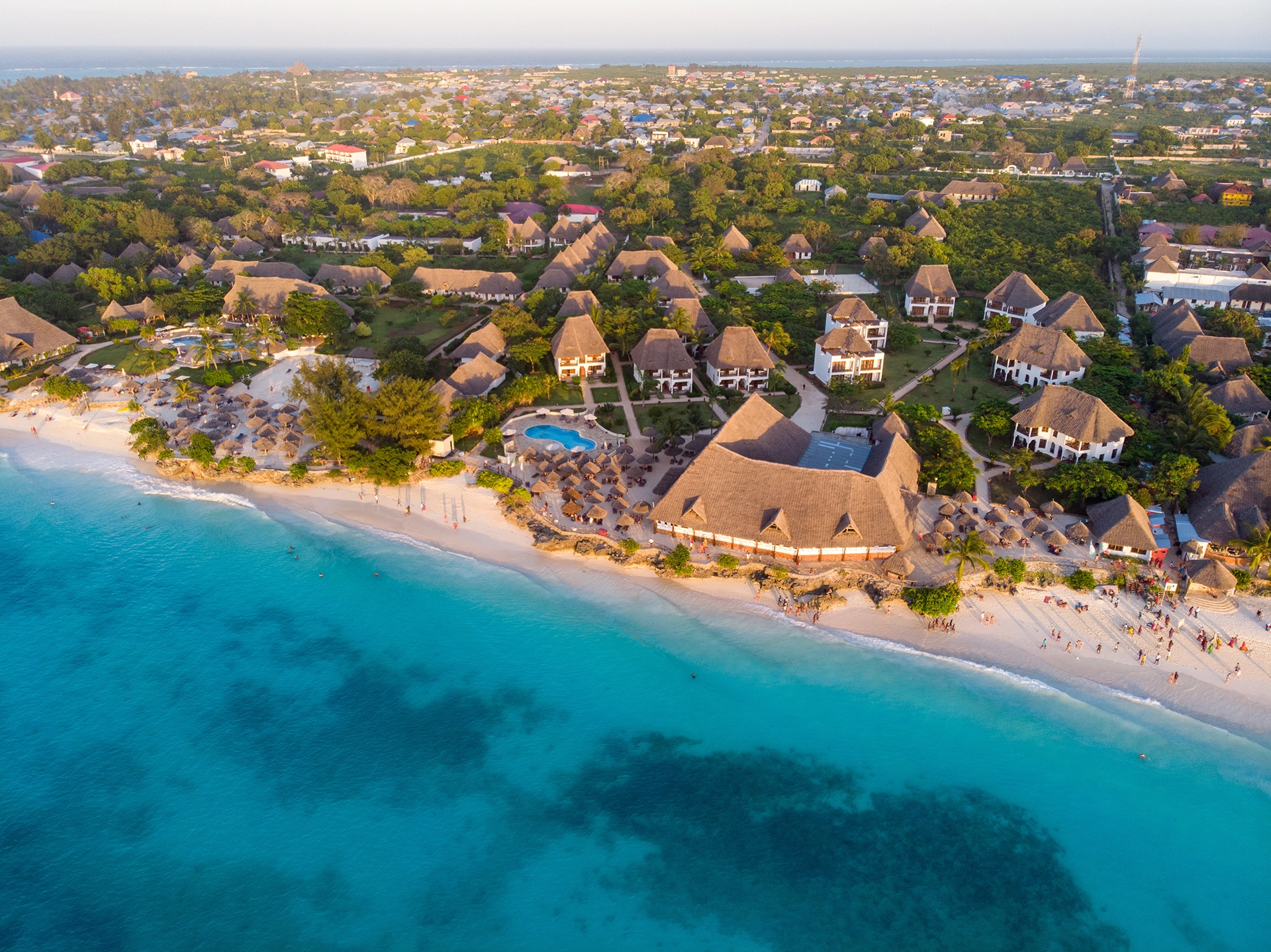
Zanzibar is treated in detail in the dedicated article (Zanzibar: An Emerging Luxury Destination) and the headline figures are recapped here for completeness. OCGS Zanzibar recorded 917,167 international arrivals to the archipelago in 2025, up 24.5 per cent on the 736,755 of 2024 (Tourism Statistical Release for December 2025, reported by The Citizen on 18 January 2026; measured). A second official series, the 2025 International Visitors' Exit Survey, attributes 654,880 arrivals to Zanzibar, up 9 per cent; the two series count differently and agree on direction. In 2024 Europe accounted for approximately 72 per cent of the visitor base and Italy was the single largest source market at 11.8 per cent, equivalent to roughly 87,202 Italian travellers; Italy led again in December 2025, at 14.4 per cent of arrivals. The premium operator footprint at Nungwi, Kendwa and Pingwe-Michamvi has consolidated through the post-pandemic recovery, with Park Hyatt (Stone Town, 2015), Meliá Zanzibar (Kiwengwa), Marriott's Le Méridien, the Anantara Zanzibar Resort and Residences at Nungwi (111 hotel keys plus 70 branded apartments, USD 150M GDV, opening 2027, Infinity Developments) and Six Senses (announced 2024, Pingwe corridor) the most visible operators.
The legal grammar is distinct from the mainland. Foreign tenure on Zanzibar is a lease of public land of up to ninety-nine years, granted in terms of no more than thirty-three years each, under Section 47 of the Land Tenure Act 1992 as amended in 2010 and 2018. Rights of occupancy are granted only to Zanzibaris (Section 24), so there is no freehold for non-citizens. Zanzibar also has its own investment statute, the Zanzibar Investment Act 2023, which repealed the ZIPA Act 2018: its Section 25 and Second Schedule set Strategic Investment Status at USD 50 million on Unguja and USD 5 million on Pemba, with at least thirty per cent of the capital in equity. The detailed underwriting commentary, including climate exposure inputs, sits in the dedicated article.
Tanzania Investment Act 2022
The Tanzania Investment Act of 2022 is the single most institutionally consequential change in the country's investment architecture since the early 1990s. The Act replaced the 1997 Investment Act and sets out a Strategic Investment Status with additional benefits for qualifying projects. The capital thresholds are explicit: a wholly foreign-owned or joint-venture project requires a minimum of USD 50 million, a wholly Tanzanian-owned project a minimum of USD 20 million, and a Special Strategic Investment category applies above USD 300 million. The Act's guarantees do not start at those thresholds. They cover every business enterprise to which the Act applies, from a minimum capital of USD 500,000 for a foreign-owned or joint-venture business and USD 50,000 for a Tanzanian-owned one (Section 2): the transfer of profits, loan service and sale proceeds in freely convertible currency (Section 28), no nationalisation or expropriation except by due process of law with fair, adequate and prompt compensation (Section 29), and arbitration under Tanzanian arbitration law, the rules of the International Centre for Settlement of Investment Disputes (ICSID) or an investment treaty, as the parties agree (Section 33). Strategic status adds further benefits on top (Section 23).
The qualitative criteria are equally explicit. A project also qualifies for SIS if it creates at least 1,000 local jobs with senior-position depth, exports fifty per cent or more of output or provides import-substitution goods, stimulates industrial-park development, transfers technology, or produces goods aligned with national priorities. The Act as a whole is calibrated to attract long-duration capital on the basis of legal protection rather than fiscal arbitrage. The guarantee against nationalisation is explicit, the guarantee against discretionary regulatory disruption is partial, and the dispute resolution venue can be international where the parties agree.
For the tourism investor, the strategic status is materially relevant only at resort-scale. A boutique villa investment of USD 200,000 to USD 2 million does not reach it. Whether the Act's general guarantees cover such an investment depends on whether it is made through a business enterprise with the minimum capital the Act requires, USD 500,000 under foreign ownership (Section 2); below that level, the indirect benefit is the institutional confidence the Act creates for the operator. A resort-scale project at USD 50 million and above can add the benefits of the status to guarantees it already holds, and arbitration by agreement of the parties does not depend on the status (Section 33). The Anantara Zanzibar project, at USD 150 million GDV, falls under Zanzibar's own statute, which sets the same USD 50 million figure for Unguja.
Land tenure for foreigners
The land tenure architecture is the single most important constraint on Tanzania investment underwriting, and it is widely misunderstood. Under the Land Act 1999 and the Village Land Act 1999, all land in mainland Tanzania is held in public ownership, vested in the President as trustee for the people of the United Republic. No foreigner can own land outright. The statute is explicit, the case law is consistent, and the practical effect is structural: foreign capital participates in the land economy through a derivative mechanism, not through freehold.
*The mechanism is the Right of Occupancy. A foreign investor, having registered a Tanzanian limited liability company through BRELA and received a Certificate of Incentives from the Tanzania Investment Centre, obtains land through a granted Right of Occupancy held by TIC, and is in turn issued a derivative Right of Occupancy* by TIC for a term of up to ninety-nine years less ten days. The ten-day shortfall is a statutory construct that preserves the head right at TIC level. Shorter terms of thirty-three and sixty-six years are available; in practice the ninety-nine year ceiling is the working envelope for institutional hospitality and residential investment. The renewal at year ninety-nine is discretionary, not automatic, governed by the law and policy in force at that future date.
Zanzibar operates an analogous but distinct framework. Under Section 47 of the Land Tenure Act 1992, as amended in 2010 and 2018, a lease of public land may not exceed ninety-nine years and is granted in terms of no more than thirty-three years each; before a term is renewed, the Minister responsible for lands assesses the performance of the investment, in consultation with the Minister responsible for investment. The Minister responsible for lands grants the lease. Under Section 27 of the Zanzibar Investment Act 2023, the Zanzibar Investment Promotion Authority (ZIPA) grants leases itself only inside Special Economic Zones and elsewhere facilitates the lease through the Minister. The two frameworks are administered separately, and a foreign investor with positions on both Unguja and the mainland will hold two independent land rights, a Zanzibar lease and a derivative right from TIC. This is procedural detail to plan for at the capital-structure stage.
The implication for capital structuring is straightforward. Institutional investors underwriting on a thirty to fifty year horizon sit inside the ninety-nine year ceiling, but on Zanzibar any hold longer than the first lease term, thirty-three years at most, depends on a renewal that follows a ministerial assessment. Multi-generational transmission plans that assume perpetual title need to price the lease renewal risk explicitly. Allocators that underwrite Tanzania as if it were a freehold market are misreading the regulation, on both islands and the mainland.
The corporate setup
The operational pathway for a foreign investor into Tanzania is sequenced, documented and slower than a Gulf master-developer route. Company registration runs through the Business Registration and Licensing Agency, BRELA, via its online registration system. A Limited Liability Company under the Companies Act requires at least two shareholders and two directors, with no statutory minimum capital floor. BRELA issues a Certificate of Incorporation for a subsidiary or a Certificate of Compliance for a branch of a foreign parent. The Tanzania Revenue Authority then issues a free Taxpayer Identification Number, and the entity applies for sector-specific business licences before commencing operations.
Foreign directors, managers and employees require work and residence permits. The residence permit is typically a precondition for the work permit and, in practice, often required before the business licence can be issued to a foreign-majority entity. A power of attorney mechanism allows a temporary licence where the permits are not yet in place at registration.
The investor-resident framework was upgraded in 2023. The Immigration (Amendment) Regulations 2023 introduced a Class C-11 Investor Residence Permit calibrated for the individual property buyer. The threshold is USD 100,000 of qualifying real estate investment, renewable on a two-year cycle at USD 500 for the principal applicant plus USD 50 per dependent. The application requires a recommendation letter from TIC on the mainland or ZIPA in the case of Zanzibar, plus title deed and police clearance from the country of origin. The C-11 covers the principal applicant, spouse and dependent children. It does not carry a path to Tanzanian citizenship and does not extend automatic European travel access. It provides legal residence inside the tenure envelope.
The SIS route is administratively distinct from C-11. Above the USD 50 million threshold the project is registered with TIC under SIS and the senior team accesses separate permits attached to the strategic project. The two pathways are calibrated for different scales: C-11 for the individual property buyer, SIS for the resort-scale operating investor. They are not mutually exclusive within a single family-office allocation.
| Route | Threshold | Term / duration | Restriction / scope | Use case |
|---|---|---|---|---|
| Derivative Right of Occupancy via TIC | Project capital varies; Certificate of Incentives required | Up to 99 years less 10 days; renewable discretionary | No freehold for non-citizens; mainland only | Standard institutional land access on mainland |
| Lease of public land (Zanzibar) | Project capital varies; ZIPA approval required | Up to 99 years, in terms of up to 33 years; renewal after ministerial assessment | Granted by the Minister responsible for lands; by ZIPA inside Special Economic Zones | Zanzibar resort and residential development |
| Strategic Investment Status (TIA 2022) | USD 50M foreign / JV; USD 20M Tanzanian; USD 300M Special | No separate term in the Act; additional incentives approved case by case (Section 23); the Act's guarantees do not depend on the status | Zanzibar has its own status under the Zanzibar Investment Act 2023 (USD 50M Unguja, USD 5M Pemba) | Resort-scale operating investor |
| BRELA Limited Liability Company | No statutory minimum (effectively USD 50) | Indefinite (subject to filings) | 2 shareholders + 2 directors required | Holding vehicle for land and operations |
| Class C-11 Investor Residence Permit | USD 100,000 qualifying property | 2-year renewable | Residence only; no citizenship pathway | Individual property buyer; principal + family |
The Italian buyer specificity
Italy is the second largest source market for mainland Tanzania at 11.8 per cent of arrivals in 2024, behind the United States at 15.0 per cent and ahead of France at 7.3 per cent. On Zanzibar Italy was the single largest source market on the archipelago in 2024, also at 11.8 per cent of the 736,755 total, and it led again in December 2025 at 14.4 per cent, in a year that closed at 917,167 arrivals (OCGS). The combined volume across the two destinations places Italy as the largest single European source for the country. The pattern is not a 2024 anomaly: Italian charter capacity from Milan Malpensa, Bergamo Orio al Serio and Rome Fiumicino has been continuous through the post-pandemic recovery, and the Italian package-holiday operator base routes a documented annual flow into both the safari and coastal circuits.
The fiscal layer is the Italy-Tanzania double taxation treaty, signed in Dar es Salaam on 7 March 1973 and in force since 6 May 1983 together with the protocol signed in Rome on 31 January 1979 that amends it (Italy's Ministry of Economy and Finance), one of the older instruments in the Tanzanian network alongside the Canada, Denmark, Finland, India, Norway, Sweden, South Africa and Zambia treaties. Withholding tax rates under the Italian treaty network cap interest, dividends, royalties and management-fee withholdings at a maximum of 20 to 25 per cent, with the specific Tanzania rates set in the bilateral text. Allocators should verify the current rate schedule against the live text.
The interaction with the Italian Article 24-bis regime is meaningful. Italian residents on the substitute-tax regime, whose annual charge rose from EUR 200,000 to EUR 300,000 for those who transfer residence from 1 January 2026 under the Budget Law 2026, can structure passive income from Tanzanian property assets within the substitute-tax envelope while the Tanzanian withholding applies at source under the bilateral treaty. The combined effect, for an Italian resident with a Zanzibar villa or a mainland safari estate, is a clean fiscal architecture that does not require a third-country routing.
The diaspora and second-home dimension has no public count. No public source found for this article gives the number of Italians who own property in mainland Tanzania or on Zanzibar, and the article does not estimate it. The operator base on Zanzibar has consolidated around Italian-led capital and project management for over a decade.
Risk vectors honestly disclosed
Honest disclosure of risk is the underwriting input that distinguishes institutional allocation from cycle-driven capital. Tanzania carries documented exposures that have to be named at the parcel and portfolio level.
Currency. The Tanzanian shilling (TZS) depreciated 1.3 per cent against the US dollar in the twelve months to December 2025, after appreciating 3.8 per cent in 2024. The currency is not freely convertible in the G10 sense, and capital repatriation, while guaranteed by Section 28 of the Tanzania Investment Act 2022 to every business enterprise the Act applies to, is administered through formal banking channels. Allocators should underwrite property cash flows in USD where the lease and operating agreements permit.
Political concentration. Freedom House classifies Tanzania as Not Free, with a score of 28 out of 100 in Freedom in the World 2026, against 35 in the 2025 edition, the edition in which the status moved from Partly Free to Not Free. The Mo Ibrahim Foundation's 2024 Ibrahim Index of African Governance ranks Tanzania 15th of 54 African countries with an overall score of 58.2 out of 100, above the African average (49.3) and the Eastern African regional average (46.8), a reading of 2023 data that predates the 2025 election. On 3 November 2025 the Foundation itself wrote that "an election which excludes the opposition parties is neither fair nor legitimate". The general election of 29 October 2025, from which the main opposition candidates had been barred, was met with protests on polling day and in the days that followed, an internet shutdown and a curfew, and President Samia Suluhu Hassan was declared re-elected with 98 per cent of the vote. As of 27 September 2026 the death toll is contested, and it is carried here as a range with its sources. On 31 October 2025 the UN human rights office reported at least 10 deaths. On 11 November 2025 the same office said it had received reports that hundreds had been killed, and that it could not verify exact figures. The most recent official count located for this revision, the report of a government-appointed commission presented in April 2026, records at least 518 deaths, and its chair said the figure may not be final. Opposition and religious groups estimate thousands (DW, 24 April 2026), a claim not independently verified. The principal political risk vector is electoral-cycle volatility, and the 2025 cycle now gives it a dated precedent with operating consequences for any hospitality asset that depends on connectivity and staff movement.
Regulatory cadence. The 2022 Investment Act is a deliberate institutional upgrade, but the broader regulatory environment moves on a slower cadence than the master-developer Gulf jurisdictions. Permitting through TIC and ZIPA, environmental impact assessment through the National Environment Management Council, and registration through the Department of Lands each carry documented administrative steps. Each of these steps runs on its own timeline, and the permit schedule for the specific parcel belongs in the underwriting file before capital is committed.
Infrastructure transition. The Standard Gauge Railway, with freight services from Dar es Salaam to Dodoma launched June 2025 and the Kwala Dry Port commissioned July 2025, is materially improving logistics. A planned 1,028 kilometre extension from Tanga via Moshi and Arusha to Musoma is scheduled for completion in 2028, with implications for the northern safari circuit. The Bagamoyo deep-water port project is again in preparation but still preparatory as of mid-2026. Infrastructure improvement is positive for operating costs, but the timeline is multi-year and should not be priced as imminent.
Sector concentration. Tourism accounts for about 17.2 per cent of GDP (Ministry of Natural Resources and Tourism, 2025/26 budget speech) against extractives (primarily gold) at roughly 8 to 10 per cent. Record gold exports of USD 2.8 billion in the first ten months of 2025 (+38.9 per cent year on year) confirm the foreign-exchange base is now structurally diversified between tourism and minerals. Concentration risk in tourism itself is at the source-market level (United States and Italy combined account for approximately 27 per cent of mainland arrivals) rather than at the country-revenue level.
The constraint is named, the constraint is statutory, and the constraint cannot be wished away. Allocators that underwrite Tanzania as if it were a freehold market are misreading the regulation.
Victaura Research
The conditions are forming, the constraints are statutory, the underwriting inputs are explicit. A frontier institutional market is not a fully institutional one. The distinction is the entire allocation question.
Victaura Research
What this means for the institutional buyer
For a family office, principal advisor or single private buyer considering Tanzania exposure in 2026, the implications are practical and can be stated in five points.
First, the tenure ceiling is the binding underwriting input. All foreign land access on the mainland and Zanzibar is leasehold, capped at ninety-nine years (less ten days on the mainland derivative right), with discretionary renewal. Holding horizons of thirty to fifty years sit inside the ceiling but, on Zanzibar, beyond the first lease term of up to thirty-three years they depend on a renewal. Multi-generational transmission plans need to price renewal risk explicitly.
Second, the protection envelope is the investment statute itself, and the strategic route adds benefits to it. On the mainland the Tanzania Investment Act 2022 gives its guarantees, against nationalisation without fair, adequate and prompt compensation, on transfers in convertible currency and on arbitration by agreement, ICSID rules included, to every business enterprise it applies to, from USD 500,000 of capital under foreign ownership; strategic status, from USD 50 million, adds further benefits. On Zanzibar the status sits in the Zanzibar Investment Act 2023, at USD 50 million on Unguja and USD 5 million on Pemba, and that Act likewise gives its guarantees to every approved investment. The smaller individual buyer does not reach the strategic status but benefits from the institutional confidence the two statutes create for the operator.
Third, the corporate setup is sequenced and slower than a Gulf jurisdiction. BRELA LLC, TIN with the Tanzania Revenue Authority, sector-specific licensing, immigration permits, TIC or ZIPA recommendation, derivative Right of Occupancy registration. The cumulative timeline from first engagement to operating asset is measured in months, not weeks. The chain of title at exit is correspondingly more defensible.
Fourth, the operator chain matters more than the brand flag. Singita, Four Seasons, andBeyond, Asilia and the Zanzibar branded-residence operators are all credible, but the relevant underwriting question is who manages construction, permitting and handover, and under which documented terms. Brand validates the segment; the development manager delivers the building. Confusing the two is the most common error in Tanzania hospitality underwriting.
Fifth, the residence frame is residence, not citizenship. Class C-11 provides legal residence and full property rights within the leasehold envelope at a USD 100,000 threshold. The interaction with the Italian Article 24-bis regime is favourable for Italian-resident buyers structuring a multi-jurisdictional platform, but the C-11 is not a golden visa and does not extend a path to Tanzanian citizenship or global travel scope.
Skin in the game disclosure. Victaura, through its parent Greystone B.V. (Netherlands), develops projects on Lake Como (Italy), in Nungwi, Zanzibar (Tanzania), on Gili Air and in Uluwatu, Bali (Indonesia), and holds an off-plan capital position on Al Marjan Island, Ras Al Khaimah (UAE). Readers should assume commentary may be influenced by, or benefit, these positions. This document is classified as marketing material under MiFID II Article 24(3). It is not investment advice.
From Victaura
- Where the World's Wealth Is Moving (Vol.1 dossier 2026)
- Zanzibar: An Emerging Luxury Destination
- Responsible Development on Coasts and Islands
- Scarcity as Value Protection: Lakefront, Oceanfront and Island Freehold
- Our Approach: Location, Timing, Execution
- Secret Zanzibar Hotel & Villas (Nungwi)
- Invest with Victaura
References
- NBS / MNRT / Bank of Tanzania, International Visitors' Exit Survey 2024
- Tanzania Investment Act 2022 (Strategic Investment Status framework)
- United Republic of Tanzania, Land Act No. 4 of 1999
- Tanzania Investment Centre, Investor and Company Registration Guidance
- Tanzania Immigration Department, Residence Permit Class C (including C-11)
- BRELA, Business Registration and Licensing Agency Online Registration System
- Zanzibar Investment Act 2023 (Act No. 10 of 2023), Sections 25, 27 and 62 and Second Schedule (text published by the Zanzibar House of Representatives)
- UNCTAD World Investment Report 2025 (Tanzania FDI 2024 = USD 1.72 billion)
- Tanzania Investment Centre, 2024 Investment Statistics (842 projects, USD 7.7bn)
- World Bank, Tanzania Economic Update
- Bank of Tanzania, Monetary Policy Committee Statement December 2025
- Italian Ministry of Economy and Finance, Department of Finance, double taxation conventions: Tanzania (signed 7 March 1973; amending protocol signed 31 January 1979; in force since 6 May 1983)
- Mo Ibrahim Foundation, Ibrahim Index of African Governance 2024
- Freedom House, Freedom in the World 2026, Tanzania country report (Not Free, 28/100; 35/100 and Not Free in the 2025 edition)
- Tanzania Standard Gauge Railway and Kwala Dry Port, Ministry of Transport priorities 2025/26
- UN News, Tanzania: Reports of hundreds killed and detained following deadly election violence, 11 November 2025 (OHCHR; exact figures not verifiable)
- Al Jazeera, Opposition says 'hundreds' killed in Tanzania post-election protests, 31 October 2025 (UN human rights office: at least 10 deaths)
- DW, Tanzania's opposition criticizes 'whitewashing' of violence, 24 April 2026 (government-appointed commission: at least 518 deaths, figure may not be final)
- The Citizen, Zanzibar tourism hits nearly one million arrivals in 2025, 18 January 2026 (OCGS: 917,167 in 2025; December 100,729; Italy 14.4%)
- Mo Ibrahim Foundation, Madame President, this is not acceptable, 3 November 2025
- Bank of Tanzania and Ministry of Natural Resources and Tourism, The 2025 International Visitors' Exit Survey Report, July 2026 (Zanzibar: 654,880 arrivals, +9%; Tanzania: 2,294,495, +7.1%; fieldwork August 2025)
- Daily News (Tanzania), Royal Tour, strategic investments propel tourism sector, 12 October 2024 (tourism 17.2 per cent of GDP, over 1.5 million direct and indirect jobs)
- Ministry of Natural Resources and Tourism (Tanzania), budget speech for 2025/2026 (tourism 17.2 per cent of GDP)
- Land Tenure Act 1992 (Act No. 12 of 1992), Sections 24, 46 and 47 (text published by the Zanzibar House of Representatives)
- Land Tenure (Amendment) Act 2010 (Act No. 11 of 2010), Sections 5 and 6: leases of public land, ceiling of 99 years (Zanzibar House of Representatives)
- Written Laws (Miscellaneous Amendment) Act, Act No. 1 of 2018, Section 6: Land Tenure Act 1992, Section 47, terms of up to 33 years within the 99-year ceiling (Zanzibar House of Representatives)
- Tanzania Investment Act 2022 (Cap. 38, English version, Government Notice No. 395B of 13 June 2023), Sections 2, 23, 28, 29 and 33 (copy held by FAOLEX, Food and Agriculture Organization of the United Nations)
The information on this website is provided for informational purposes only and does not constitute an offer, solicitation, or financial advice. Indicated returns are estimates and are not guaranteed; past performance is not indicative of future results. Capital invested is at risk.
Considering an allocation to luxury real estate in the locations we operate? Speak to us about our current and upcoming projects.
Speak to Victaura →Related insights

Destinations
Leasehold in Prime Resorts: Pricing a Term-Bound Right
Foreign buyers in prime resort markets rarely buy freehold. In Zanzibar they buy a leasehold of up to 99 years. In Bali they buy an 80-year right of use. A term-bound right is not a title, and it does not price like one. This is how the allocator underwrites the countdown, and where the marketing line quietly fails.
Destinations
Zanzibar: An Emerging Luxury Destination
Zanzibar is transitioning from a mid-tier coastal destination to a luxury and ultra-luxury market by statute and by demand, but on leasehold tenure with a 99 year ceiling and with disclosed climate exposure. The 2024 and 2025 arrivals data, the framework of the Land Tenure Act 1992 and the Zanzibar Investment Act 2023, and the operator pipeline at Nungwi tell a consistent story: the conditions are forming, the constraints are real, and the underwriting requirements are explicit.

Destinations
Nungwi: Why the North Coast
Nungwi, at the northern tip of Zanzibar's Unguja island, is chosen for land because the sea stays usable there when it retreats from other beaches. This note tests that claim for the principal. It reads the tide, the 30 m buffer rule, the anchor capital already present and the erosion record, and it grades every number it uses.