
Destinations
Building on Pemba: The Logistics Case
Whether a hotel can be built on Pemba depends less on land than on five inputs: the port that receives materials, the cable that carries power, the water source, the labour pool and the permit chain. This article grades the public evidence for each as of 8 October 2026, names what has no published number, and leaves demand to other pieces.
 Illustration
Key takeaways
- - Mkoani Port received its first container ship on 30 September 2024; before then Pemba's two large ports handled passenger vessels only (The Citizen, 30 September 2024, press-reported).
- - The Mkoani yard is reported to hold 580 containers stacked three high, with a planning ceiling of 30,000 containers a year; a ceiling is not throughput (The Citizen, 30 September 2024, press-reported planning figure).
- - A September 2025 report cites 596 imported and 300 exported containers at Mkoani; if the count covers the year since the first ship, the longest span possible, it is under 3 percent of one year's ceiling, and a shorter span means a higher rate (The Citizen, 18 September 2025, press-reported; Victaura's arithmetic).
- - Pemba receives 20 MW against 16.7 MW of demand, about 3.3 MW of headroom shared with every new connection (Minister's statement to the House of Representatives, 23 February 2026, press-reported).
- - A $64 million contract for Pemba electricity infrastructure was stated as signed on 25 March 2026, with no scope or date given (The Citizen, 26 March 2026, press-reported).
- - Shumba Port in North Pemba, at Sh17.3 billion, was 40 percent complete in the September 2025 report, and Wete has no published scope (The Citizen, 18 September 2025, press-reported).
- - The only dated materials price is one resident's rebar account, Sh10,000 to Sh15,000, and no freight tariff was found (The Citizen, 10 August 2026, directional).
- - No observed Pemba building-permit duration was found, and the 2018 permit guidelines state a window of 14 working days (Development Control Unit, 2018); the Zanzibar Investment Act 2023, in force since 1 February 2024, repealed the 2018 investment Act and leaves the certificate procedure to regulations (Zanzibar House of Representatives, Act No. 10 of 2023, Sections 21 and 62).
On this page (11)
Can a hotel be built on Pemba, and what decides it?
A hotel can be built on Pemba, and logistics decides whether it is built on time. Pemba is the northern island of the Zanzibar archipelago, and its build conditions differ from those of Unguja, the main island, in ways a principal can price. Materials arrive by sea. Power arrives through a subsea cable from the mainland. Water comes from boreholes and a limited network. Permits run through Zanzibar institutions. This article covers those inputs and leaves demand to Pemba: The Quieter Island.
A build on Pemba is a supply chain before it is a design. Landed cost is the price of a material delivered to the site gate, including freight, port handling, levies, breakage and waiting time. A budget built on ex-works prices, quoted at the supplier's gate, leaves those island costs out. Schedule risk follows the same logic. A container that misses its slot delays a crew that is already on the payroll.
The evidence base for Pemba is thinner than for Unguja. Most published Zanzibar infrastructure statistics are aggregated or centred on the main island. Where a Pemba figure exists, this article gives its date, its source and its grade. Where none exists, it says so. Two of the four grades in Victaura's research method are used. Measured means a census, an engineering record or a statutory text. Directional means a figure whose size cannot be relied on, and here it covers a single witness, an indirect indicator and a statement known only from the press, which is labelled press-reported.
The 2022 census sets the scale of the local labour and service base. North Pemba counted 272,091 people and South Pemba 271,350, which sums to 543,441 (measured; the sum is Victaura's). A population of that size supports a local labour pool. Whether it supports a deep contractor market is a different question, and the public record does not answer it.
How do building materials reach Pemba?
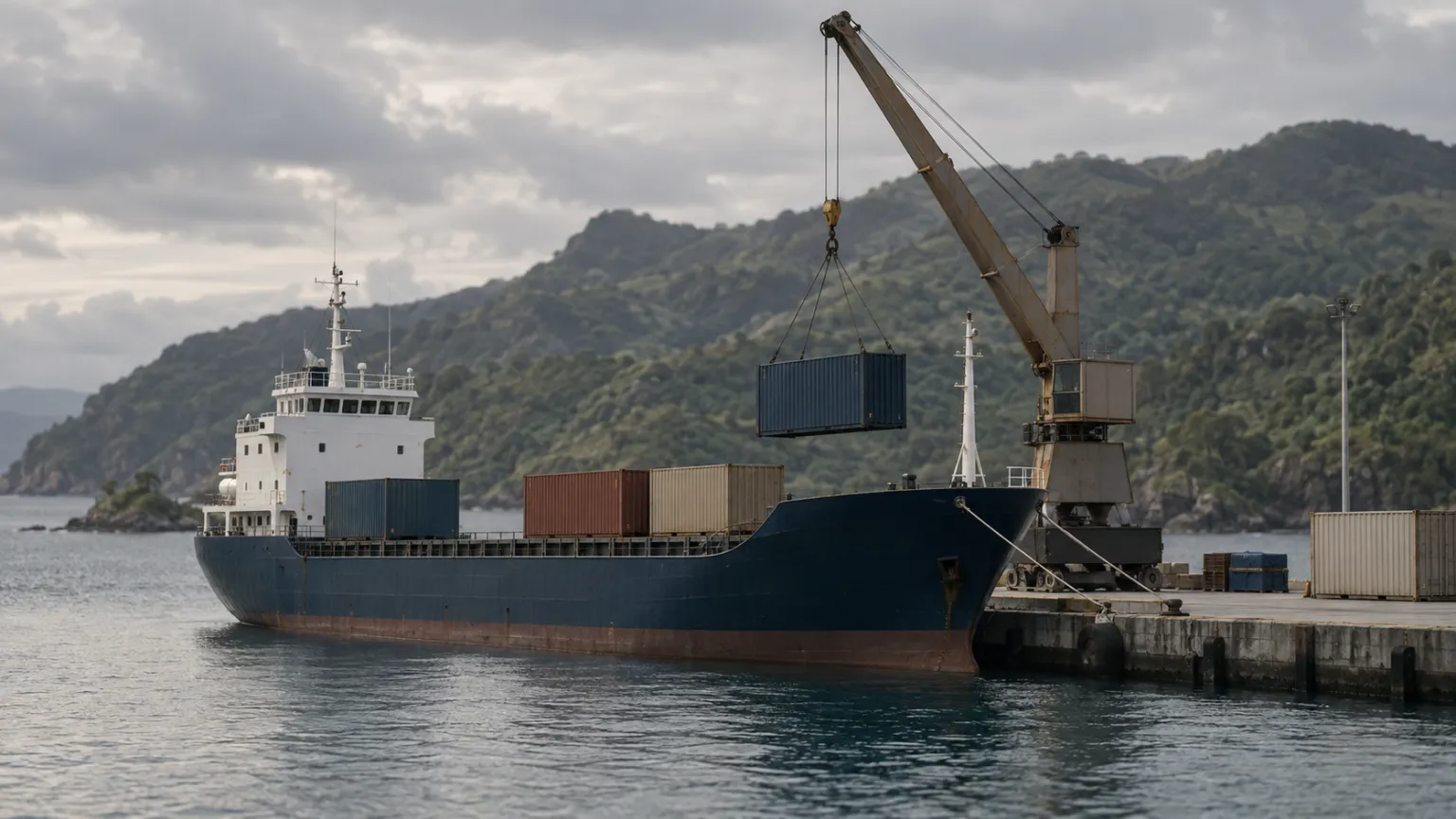
Building materials reach Pemba by sea, and until late 2024 cargo for the island was routed through Unguja. The Citizen reported on 30 September 2024 that the first container ship had docked at Mkoani Port, and that Pemba's two large ports had until then handled only passenger vessels (press-reported). The same article said cloves, seaweed and fish would now ship directly, without passing through Malindi Port in Unguja.
The Mkoani container yard was built for container cargo, and its annual ceiling is a plan. The report describes a 4,200 square metre storage area able to hold 580 containers stacked three high, and a planning ceiling of 30,000 containers a year (press-reported, planning figure). About 45 containers had already arrived with the shipping line CMA CGM. Fumba Port Ltd was tasked with loading and unloading. A ceiling is not throughput, and the two should not be confused.
Early throughput is small against that ceiling. A second Citizen report, dated 18 September 2025, stated that the port had processed 596 imported containers and 300 exports, including seashells and cloves (press-reported). The article says the count runs "since September 2025", the month of its own publication, so the span cannot be stated. Read as a count since the first container ship in September 2024, the longest span it can cover, the total of 896 is under 3 percent of one year's ceiling of 30,000 (Victaura's arithmetic). A shorter span would mean a higher annual rate. A port in its first years is a port still proving its schedule.
Passenger ferries remain the fallback, and they are a poor fit for construction cargo. Booking aggregators list passenger sailings from Mkoani to Unguja and to Tanga, and their schedules conflict from page to page (directional). A marine officer quoted by The Citizen in September 2025 said the new project ended reliance on passenger ships for cargo. No published freight tariff for bulk cargo on these routes was found.
Sea routing also fixes the order in which a build can proceed. Heavy and bulky items arrive in containers, so each one needs a place on site, or at an agreed staging point, by the time it lands. Earthworks, a secure laydown area and an access road wide enough for container haulage come before the first delivery. This sequencing follows from the port facts above and is Victaura's view.
A port ceiling is a plan. Throughput is a record.
Victaura Research
Mkoani, Wete and Shumba, which Pemba port works?
Mkoani is the cargo-capable port on public record, as of 8 October 2026. The most recent operating figures that could be opened date from September 2025. No dated 2026 operating statement for Mkoani was found. The principal who plans a delivery schedule against this port should therefore ask the cargo handler, named in September 2024 as Fumba Port Ltd, for current berth windows, container dwell times and the date of the last vessel call, in writing, before design is frozen.
Wete is announced and not described. The September 2025 report says upgrades at Fumba and Wete are at different stages of execution. It gives no cost, completion percentage or timeline for Wete. Wete lies in the north of Pemba, so for a northern site that gap matters. Until a scope is published, Wete should be treated as a planning intention in the logistics model.
Shumba is the larger project under way in North Pemba. The September 2025 report gives a total of Sh17.3 billion (Tanzanian shillings), split between a Sh5.7 billion berth and an Sh11.6 billion package covering a passenger lounge, fencing and a mosque. It was launched on 9 December 2024, stood at 40 percent complete at the time of reporting, and was expected to finish by December, with no year given. A container terminal is planned (press-reported). No completion confirmation was found as of 8 October 2026.
The two Mkoani cost figures do not match, and that is a method point. The Citizen reported Sh6.4 billion invested in renovating Mkoani in September 2024, plus a separate Sh4.874 billion for handling equipment. In September 2025 it gave Sh6.9 billion for a "Fumba Port in Pemba", under a heading on the Mkoani project. They may describe different scopes, or the same scope at different dates. The principal should not average them. Both are reported, neither is audited, and the operator's scope document is the only way to reconcile them.
What does freight to Pemba cost?
No published freight tariff for construction cargo to Pemba was found. The port coverage states that the project should lower costs for government and traders. None of it gives a rate per container or per tonne. A cost claim without a rate cannot be underwritten. The principal should read every statement that the new port reduces costs as a direction of travel with no number attached.
The one dated price signal is anecdotal and sits inside a national story. On 10 August 2026 The Citizen quoted a Pemba resident saying an 8mm rebar piece had risen from Sh10,000 to Sh15,000, over a period the article does not state, and that timber pieces started at Sh10,000 (directional, single witness). The article attributes national increases to fuel prices lifting production, haulage and distribution costs. It gives no comparison between Pemba and Unguja.
A tax change is named as a driver, and its Zanzibar reach is not stated. The same article reports that the Finance Act 2026 introduced higher taxes and levies on specific goods, including cement products. It does not say how those levies apply in Zanzibar, and it gives no cement price for either island. Until the application is confirmed with a customs or tax adviser, the effect on a Pemba budget cannot be sized.
The principal should underwrite landed cost with quotes, because benchmarks do not exist. The method is simple. Obtain at least three dealer quotes per major package, for cement, steel, aggregate, timber, glazing and building services, each priced delivered to the Pemba site and, separately, delivered to a reference site on Unguja. Date the quotes. Re-quote at fixed intervals. The spread between the two islands is the Pemba premium, and it is observable only this way. This is Victaura's suggested method and carries no source.
Currency and payment terms add a second layer to landed cost. Imported materials are priced abroad and often paid in foreign currency, while local labour and many local services are priced in Tanzanian shillings. A rate quoted today may not hold at the point of delivery. The principal should state in each supply contract who carries exchange-rate risk between order and delivery.
A cost claim without a rate cannot be underwritten.
Victaura Research
Is there enough grid power on Pemba?
On the government's figures Pemba has more supply than demand, through a subsea cable from the mainland opened on 3 June 2010. Electrical Review reported a 75 km, 36 kV cable between Tanga and Pemba, rated 25 MVA (megavolt-amperes), supplied and installed by Nexans (press-reported, trade press quoting the supplier). Funding was a €45 million Norwegian state grant, €8 million from the Zanzibar government and €4 million from the Union government. The asset is now sixteen years old.
The margin rests on a ministerial statement. The Minister for Water, Energy and Minerals told the House of Representatives on 23 February 2026 that Pemba receives 20 megawatts against a demand of 16.7 megawatts (press-reported ministerial statement). The surplus is about 3.3 megawatts, Victaura's subtraction. The same statement placed the deficit on Unguja, at roughly 30 megawatts.
Headroom of 3.3 megawatts is about a fifth of reported demand, and it is shared. The ratio is Victaura's arithmetic. A resort's peak load should be set against that figure, and any other new connection on the island draws on the same margin. The reporting describes one supply line from Tanga. No statement on redundancy or on the present condition of the Pemba cable was found. The ministerial remarks on ageing cables concerned Unguja's lines and should not be transferred to Pemba.
A grid upgrade for Pemba is reported and unscheduled. The managing director of the Zanzibar Electricity Corporation said on 25 March 2026 that a $64 million contract had been signed with a US company to improve Pemba's electricity infrastructure (press-reported). No scope, no energisation date and no capacity figure came with it. The prudent design baseline is a site generator sized for essential loads, with the grid as the primary source. That is Victaura's design view and carries no source.
Outage history for Pemba is the missing datum. No Pemba-specific outage report for 2025 or 2026 was found. A House debate on 12 February 2026 centred on frequent power cuts, and the deputy minister said the government sometimes cuts power in certain areas to stop overloaded wires from collapsing (press-reported, Zanzibar-wide). Whether that practice touches Pemba is not stated. The principal should request the utility's interruption log for the distribution feeder that would serve the site, covering at least twelve months.
Where does water for a Pemba build come from?
Water on Pemba begins as a borehole question. The Pemba Rural Water Supply and Sanitation Project, financed by the African Development Bank, was reported by its contractor to have received a final acceptance certificate on 3 July 2015. It comprised 53 deep wells, three reservoirs, four elevated tanks, a pump station and 134 km of high-density polyethylene (HDPE) pipe (directional, reported by the contractor on a PowerChina page hosted by China Daily). It evidences a groundwater-based network, and little more.
No Pemba-specific service-reliability data was found. The Zanzibar-wide statistics that surface in public documents either pool the two islands or concentrate on the urban area of Unguja. A figure for hours of supply, pressure or outage on Pemba would be the right input for a hotel water design. It is not in the public record that could be read. The absence is itself a finding for the diligence list.
Construction water and operating water are two different demands. Construction needs water for mixing, curing, dust suppression and a worker camp, early and in volume. Operation needs it for rooms, laundry, kitchens, pool top-up and irrigation, continuously. A coastal site on a low island carries a saltwater-intrusion risk in any borehole, so yield and salinity testing is the first site-specific study. This is an engineering view and carries no source.
Abstraction rights and permits for a private borehole were not found in public documents. The Zanzibar Water Authority is the institution to ask. The principal should obtain its written position on abstraction and discharge before committing to a borehole-based design, and should treat a desalination or tanker-supply fallback as a priced line in the budget. A tanker route depends on the same ports and roads described above.
Who builds on Pemba, and what does labour cost?
Pemba has a sizeable rural labour base, and no Zanzibar construction wage rate was found. The 2022 census counted 214,230 rural residents in North Pemba out of 272,091, and 195,584 out of 271,350 in South Pemba (measured, via citypopulation.de). That is 409,814 rural residents out of 543,441, or 75.4 percent, on Victaura's arithmetic. A rural population supplies general labour. It does not by itself supply supervisors, tradespeople or equipment operators.
Specialist trades are likely to travel to the site. Building services, marine works, glazing, pool systems and fit-out may be supplied by firms based on Unguja or the mainland. That expectation is Victaura's reading, and no public source states the split for Pemba. If it holds, the budget carries transport, lodging and downtime for those crews, and the schedule carries their dependence on sailings.
Minimum wage reports carry conflicting dates and bases. The Citizen reported on 24 March 2023 that the private-sector minimum in Zanzibar rose from Sh300,000 to Sh347,000 from April 2023, without stating whether the figures are monthly. On 1 May 2026 the President of Zanzibar announced an increase from Sh300,000 to Sh500,000 a month, effective January 2027, and the report does not say whether it covers the private sector. The two reports share a starting figure and cannot be reconciled from the text. As of 8 October 2026 the applicable floor should be confirmed with the Labour Commission.
A wage floor is one input, and idle time is the larger one on an island. No Zanzibar construction-sector wage rate was found. The March 2023 report lists daily minimums for full-time contract workers, unchanged at Sh30,000 for skilled and Sh25,000 for unskilled, without naming a sector (press-reported). The construction rates that surface in wage databases cover the mainland and do not transfer. What moves labour cost on a remote site is supervision, productivity and the days a crew waits for a late delivery. That is a working view, and it ties labour back to the freight question.
What is the permitting path on Pemba, from ZIPA to lease?
Investment on Zanzibar is channelled through the Zanzibar Investment Promotion Authority, known as ZIPA. ZIPA issues the investment certificate that sits ahead of a lease. The January 2023 press report describes investors as holders of land leases that can be revoked (press-reported). A foreign investor cannot take the right of occupancy, which the Land Tenure Act 1992 grants only to Zanzibaris above the age of eighteen (Section 24(1); measured, statutory text). What a foreign holder takes instead is set out in Zanzibar Title: What a Foreigner Can Own. The certificate comes first, and the lease follows.
The statutory basis changed in 2024. The Zanzibar Investment Act, 2023 (Act No. 10 of 2023) was assented to on 1 February 2024 and came into operation on that day. Its Section 62 repeals the Zanzibar Investment Promotion and Protection Authority Act No. 14 of 2018, its Section 4 establishes ZIPA, and its Section 21 leaves the procedure, conditions and validity of the Certificate of Investment to regulations (measured, text published by the House of Representatives). Counsel must read the Act and the regulations in force on the day of application.
The development clock is a construction constraint. On 2 January 2023 the ZIPA executive director said leases would be revoked from investors who fail to develop within the required period, and that undeveloped land would be reissued to investors able to implement tangible investments (press-reported). The article states no period, and the statutes state two. A lease of public land may be terminated if the holder fails to complete development of the land within thirty months of being granted the lease (Land Tenure Act 1992, Section 48(1)(a), as replaced in 2010), and ZIPA may suspend the Certificate of Investment if the investor fails to begin implementing the project within one year of obtaining all the required legal documents (Zanzibar Investment Act 2023, Section 22(1)(c)) (measured, texts published by the House of Representatives). On Pemba, a late container or a late power connection eats into both clocks, and the principal should have the dates that apply to the specific lease confirmed in writing.
Published permit windows exist, and no observed permit duration for Pemba was found. The Development Control Unit's 2018 building-permit guidelines for investors map investment areas on Pemba as well as on Unguja, and state that ZIPA, through the Development Control Unit, shall consider an application and issue a building permit, or advise the applicant otherwise, within 14 working days of submission. The guidelines predate the 2023 Act and tie the validity of a permit to the repealed 2018 law. A January 2023 law firm brief gives 7 working days for the same step. A policy repository lists a January 2022 version of the guidelines for Unguja, attributed to the Ministry of Industry and Trade, and its page gives no timelines or fees. A stated window is not a record of how long permits take, so the principal should carry permit duration as an open schedule risk.
Sequence matters more than any single approval. On Victaura's reading, the certificate, the lease, the planning clearance and the building permit each depend on the one before, and counsel should confirm that order. A delay at the first moves every later date. The principal's schedule should show these as a chain with dependencies, and each link should carry a written expected duration from the issuing body, since a published window is a target and not a record.
| Input | What the public record shows | Grade | Open gap |
|---|---|---|---|
| Sea access | Mkoani received its first container ship on 30 September 2024; yard holds 580 containers | Directional (press-reported) | No freight tariff; no current berth data |
| Secondary ports | Wete expansion announced; Shumba 40 percent complete in the September 2025 report | Directional (press-reported) | No Wete scope; no Shumba completion confirmation |
| Grid power | 20 MW supply against 16.7 MW demand (23 February 2026); cable opened 3 June 2010 | Directional (press-reported) | No outage log; no redundancy statement |
| Grid upgrade | $64 million contract stated on 25 March 2026 | Directional (press-reported) | No scope or date |
| Water | AfDB-financed rural scheme with 53 deep wells, certificate dated 3 July 2015 | Directional (contractor's own page) | No current reliability data |
| Labour | 543,441 residents, 75.4 percent rural; minimum wage reports conflict | Measured; directional (press-reported) | No Zanzibar construction wage |
| Land and permits | Leases revocable for non-development (2 January 2023); by statute a lease may be terminated if development is not complete within thirty months, and the certificate suspended if work has not begun within one year; the Zanzibar Investment Act 2023, in force since 1 February 2024, repealed the 2018 Act | Directional (press-reported); the Acts are measured (statutory text) | Dates for the specific lease to be confirmed; permit windows of 14 and 7 working days are stated, not observed |
| Materials price | 8mm rebar piece Sh10,000 to Sh15,000 (10 August 2026) | Directional | No cement price; no island comparison |
How should a principal underwrite a Pemba build?
The programme should carry five separate buffers, one per input. Materials lead time, power connection, water source, specialist crews and permit duration each deserve their own contingency line, owned by a named party. A single blended contingency hides which dependency failed. The size of each buffer is a decision for the principal, and the public record offers no benchmark to set it from, which is why the quote method above matters.
Procurement should be packaged around full-container shipments and early orders. Long-lead items such as glazing, building services and fit-out should be ordered and shipped before the site is ready to receive them, with a staging decision taken in advance on where goods wait, at Mkoani or on Unguja. Storage on an island has a cost and a security dimension. This is Victaura's design view and carries no source.
Project facts belong to the project page, and this article adds none. Readers who want what Victaura publishes on Pemba should use the public Pemba project page. Everything above rests on third-party documents listed in the references. Nothing here describes a budget, a schedule or a price for any project, and nothing should be inferred about them.
Diligence on Pemba adds a question to any standard checklist. The twelve questions in The Underwriting File apply to a Pemba build. Logistics adds a thirteenth, which is who is accountable, contractually, for a container that arrives late. The answer determines whether delay is the contractor's cost or the owner's. The construction contract should state the answer expressly.
On an island, a late container is a cost before it is a delay.
Victaura Research
Where the Pemba logistics case is weak, honestly disclosed
The largest gap is price. No freight tariff, no landed-cost comparison between Pemba and Unguja, and no Zanzibar construction wage were found. The only price datum is one resident's account of rebar. Any budget built on this article's evidence would be built on absence, and should be treated as such.
Most Pemba figures are press reports of official statements. The container-yard capacity, the Shumba progress, the $64 million contract and the 20 MW supply figure are what officials said, as carried by one newspaper. None is an audited throughput, a metered load or a signed scope. Where two reports disagree, as with the Mkoani cost, this article names the conflict and does not resolve it.
Several primary pages could not be opened. The Zanzibar Ports Corporation website returned a certificate error, the ZIPA site did the same, and an airport directory returned an access denial. The article therefore makes no claim about berth depth, runway length or scheduled air service, and ZIPA's own pages are not used as a source; the statutory points rest on the texts of the Zanzibar Investment Act 2023 and of the Land Tenure (Amendment) Act 2010 published by the House of Representatives, and on the Land Tenure Act 1992 in the copy hosted by FAOLEX. Air access to Pemba is outside this article's evidence.
Dates matter, and several of these facts will move. Every status here is written as of 8 October 2026, or as of the date of its source. The wage change reported for January 2027, the $64 million grid contract, the Wete scope and the Shumba completion could each change the picture within months. The principal should re-verify each against the issuing body before relying on it.
The logistics case supports a view on buildability and no more. It does not say Pemba is cheap to build, quick to build or free of risk. It says which inputs decide the outcome, which have evidence, and which do not.
What the Pemba logistics case concludes
Pemba's buildability rests on five inputs, and only two have Pemba-specific evidence of capacity, both from press reports. Sea access has a documented step change since September 2024, with no operating figures found after September 2025. Grid power has a reported surplus of about 3.3 megawatts as of February 2026, through one cable from Tanga, with no statement on redundancy and no outage log found. Labour has a census headcount, which is not a count of trades, and no Zanzibar construction wage rate was found. Water reliability has no readable Pemba-specific evidence, and permit duration has a stated window but no record. A budget sized on the first two alone leaves the other three unsized, and no freight rate for sea access was found.
The sequence of verification follows from those gaps. First, the operator's current berth and dwell data at Mkoani. Second, the written lease clock and permit timeline from ZIPA. Third, dealer quotes delivered to the site and to a reference site on Unguja. Fourth, a borehole test and the water authority's position. Fifth, the Zanzibar Electricity Corporation's interruption log for the feeder that would serve the site, covering at least twelve months. The order is Victaura's suggestion and carries no source.
Skin in the game disclosure. Victaura, through its parent Greystone B.V. (Netherlands), develops projects on Lake Como (Italy), in Nungwi, Zanzibar (Tanzania), on Gili Air and in Uluwatu, Bali (Indonesia), and holds an off-plan capital position on Al Marjan Island, Ras Al Khaimah (UAE). Readers should assume commentary may be influenced by, or benefit, these positions. This document is classified as marketing material under MiFID II Article 24(3). It is not investment advice.
References
- The Citizen, First container ship docks at Mkoani Pemba Port, ushers in a new dawn 2024
- The Citizen, Ports projects position Zanzibar as EAC's major trade gateway 2025
- The Citizen, Zanzibar power outages driven by ageing cables, rising demand, says Govt 2026
- The Citizen, Zanzibar reassures investors as energy projects expand 2026
- allAfrica, Tanzania: Frequent Power Outages Spark House Debate On the First Day 2026
- Electrical Review, Nexans completes subsea cable link in Zanzibar 2010
- The Citizen, Surging material costs paralyze Tanzania's construction sector 2026
- The Citizen, Mwinyi: Zanzibar's new minimum wage will take effect in January 2027 2026
- The Citizen, Zanzibar announces minimum wage for the private sector 2023
- The Citizen, Zanzibar to revoke leases of undeveloped land 2023
- National Bureau of Statistics (Tanzania), 2022 Census, Kaskazini Pemba, via citypopulation.de
- National Bureau of Statistics (Tanzania), 2022 Census, Kusini Pemba, via citypopulation.de
- PowerChina, Pemba Rural Water Supply and Sanitation Project acceptance 2015
- Ministry of Industry and Trade (Zanzibar), Building Permit for Investors Guidelines and Procedures Unguja 2022, via Policy Vault
- ZIPA, Investment Certificate service page (could not be opened during verification)
- Direct Ferries, Mkoani ferry listing (schedules conflict between pages)
- Zanzibar Investment Act 2023 (Act No. 10 of 2023), Sections 1, 4, 21, 22 and 62 (text published by the Zanzibar House of Representatives)
- Land Tenure (Amendment) Act 2010 (Act No. 11 of 2010), Section 7: Land Tenure Act 1992, Section 48, termination of a lease of public land (text published by the Zanzibar House of Representatives)
- Development Control Unit (Zanzibar), Building Permit for Investors: Drawing Guidelines and Procedures, 2018 (14 working days; investment areas on Unguja and Pemba)
- Ardean Law Chambers, Land for Investment and Doing Business in Zanzibar, January 2023 (building permit within 7 working days)
- Land Tenure Act 1992 (Act No. 12 of 1992), Section 24, right to a grant of land (copy hosted by FAOLEX)
The information on this website is provided for informational purposes only and does not constitute an offer, solicitation, or financial advice. Indicated returns are estimates and are not guaranteed; past performance is not indicative of future results. Capital invested is at risk.
Considering an allocation to luxury real estate in the locations we operate? Speak to us about our current and upcoming projects.
Speak to Victaura →Related insights
Destinations
Pemba: The Quieter Island
Fifty kilometres north of an island the market has already priced, Pemba receives a fraction of Zanzibar's arrivals, carries a statutory investment threshold one tenth of Unguja's, and is building an international airport. The constraints are frontier-grade: leasehold tenure, thin airlift, minimal advisory infrastructure. The case for looking now echoes Unguja a decade ago, and carries the same underwriting requirements, honestly disclosed.
Destinations
Zanzibar Title: What a Foreigner Can Own
Zanzibar offers a foreign principal no freehold. The primary land right, the Right of Occupancy, is reserved to Zanzibaris, and the foreign holder takes a government lease or a unit title instead. A lease of public land is capped by statute at 99 years and granted in terms of up to 33. This note maps who issues each title, what a bare plot lacks against an approved project, what the February 2026 ZIPA notice added, and what stays unverified.
Destinations
Zanzibar: An Emerging Luxury Destination
Zanzibar is transitioning from a mid-tier coastal destination to a luxury and ultra-luxury market by statute and by demand, but on leasehold tenure with a 99 year ceiling and with disclosed climate exposure. The 2024 and 2025 arrivals data, the framework of the Land Tenure Act 1992 and the Zanzibar Investment Act 2023, and the operator pipeline at Nungwi tell a consistent story: the conditions are forming, the constraints are real, and the underwriting requirements are explicit.