
ESG & Stewardship
Lake Como Water Quality: What the Tests Show
Can the principal swim in Lake Como? At classified bathing points not under a temporary ban, yes, and the grade differs shore by shore. The lake is not one number. Three families of tests exist (bathing classification, independent single samples, and ecological status), they answer different questions, and the stream mouths that feed the shore are where they diverge.
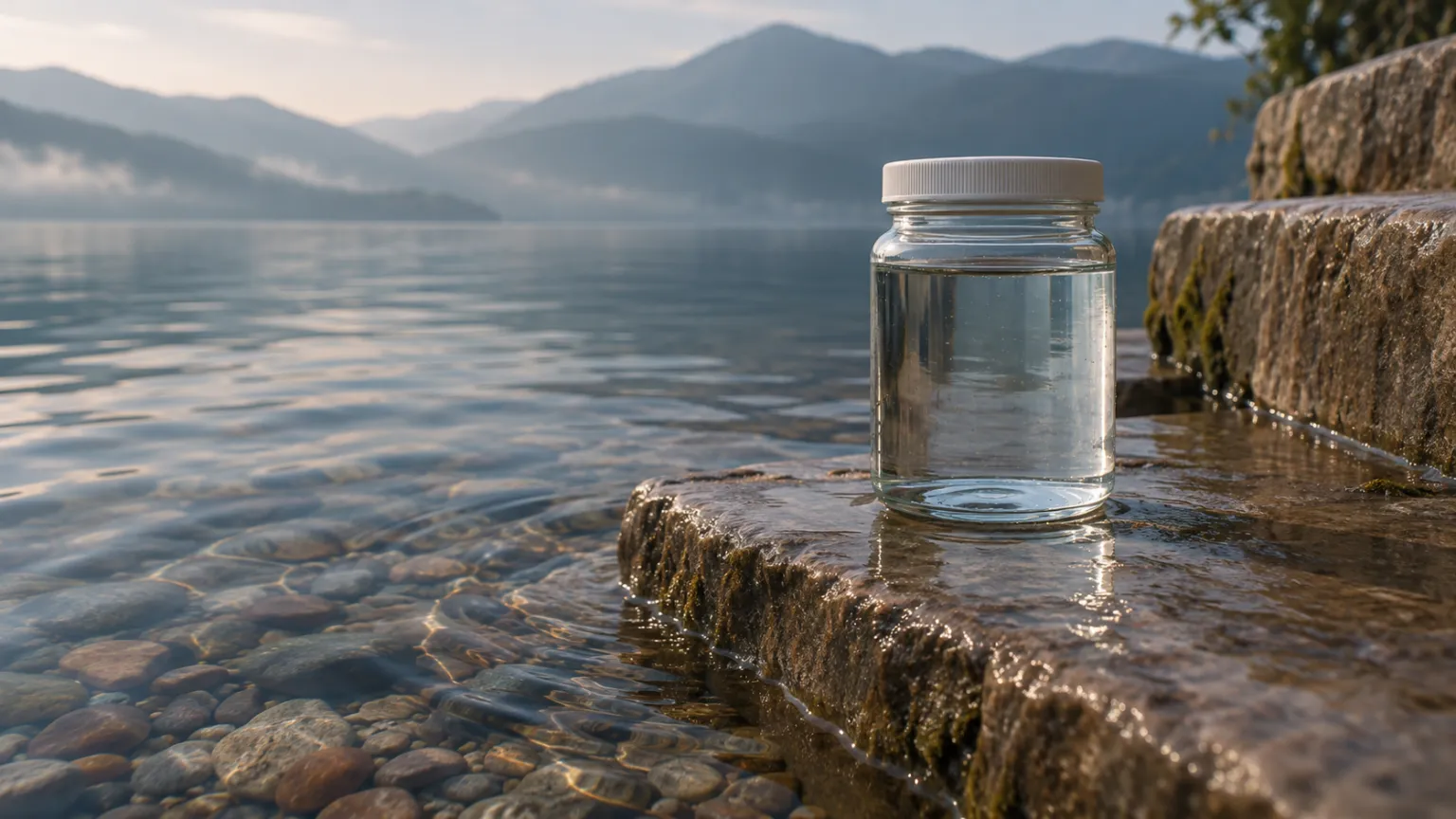 Illustration
Key takeaways
- - Lake Como is graded per bathing point, not as one lake; April 2024 press reports showed grades from excellent to sufficient (directional, press-reported, Espansione TV, 27 May 2024).
- - Inland excellent thresholds are 200 enterococci and 500 E. coli cfu per 100 ml at the 95th percentile, assessed over four seasons (Directive 2006/7/EC, Annex I and Article 4).
- - Single-sample limits that trigger a temporary ban are 500 enterococci and 1,000 E. coli per 100 ml (Regione Lombardia, citing the 30 March 2010 decree).
- - Goletta dei Laghi found 3 of 9 Lario points heavily polluted and 1 polluted on 16–26 June 2026 (measured, single samples, Legambiente Lombardia).
- - Goletta points are mostly stream mouths, including the Cosia at Como, so the result is a map of inflows and not a bathing grade (Legambiente; Espansione TV, 21 August 2024).
- - The last verified Lario ecological rating is sufficient, from 2018, with a good-status target for 2027 (directional, SNPA / ARPA Lombardia, 23 May 2018).
- - In 2024, 7 of 29 Lombard lake stations were in good trophic status and 22 in sufficient; the figure is regional, not Lario (measured, ARPA Lombardia, 22 December 2025).
- - Italy had 4,972 of 5,535 bathing waters excellent, about 89.8 per cent by count, in the 2025 data; it is a national figure, not a lake figure (measured, EEA and ISPRA).
Can the principal swim in Lake Como, and where?
Yes, at classified points not under a temporary ban, and the answer changes shore by shore. In Lake Como (Lario), Italian bathing-water law applies to defined bathing areas, and the health authority ATS Insubria samples them each season. Press coverage of the April 2024 samples reported Villa Olmo in Como, three areas in Menaggio and two in Bellagio as excellent and Villa Erba at Cernobbio as good, with two Colico points at sufficient (directional, press-reported, Espansione TV, 27 May 2024). The lake as a whole carries no single grade.
*A bathing water is a defined stretch of surface water where the authority expects many people to swim and has not banned bathing permanently. That is the scope of Legislative Decree 116/2008, the Italian transposition of Directive 2006/7/EC. Each bathing water is classified excellent, good, sufficient or poor from two faecal-indicator bacteria, Escherichia coli* and intestinal enterococci. Clarity, colour and smell are not part of the grade. A clear lake can fail. A green one can pass.
The question for the allocator is narrower than whether the lake is clean. It is which point the asset sits beside, what that point was classified, and what feeds the water in front of the property. A house three hundred metres from a stream mouth and a house on an open headland share a postcode and not a risk.
The tests answer different questions and must not be added together. A shore can be excellent for bathing while the lake remains below good ecological status. Both statements can be true on the same day. This article reads each test family, states what it can show, and says where the evidence is thin.
What does the Lake Como bathing-water classification actually measure?
The classification is a statistical statement about bacteria over four seasons, not a snapshot. Under Directive 2006/7/EC, Article 4(2), the assessment uses the current bathing season and the three preceding ones. Annex II defines the last assessment period as the last four seasons. One bad week does not cancel a good record, and one good week does not repair a bad one.
The thresholds for inland waters are fixed in Annex I. For excellent, the 95th percentile must stay at or below 200 cfu per 100 ml for intestinal enterococci and 500 for E. coli. For good, 400 and 1,000 at the 95th percentile. For sufficient, 330 and 900 at the 90th percentile. A lake is an inland water, so the stricter marine values do not apply. The same values appear on the Regione Lombardia page, though it labels every class as 95th percentile.
A single sample above the limit triggers a temporary ban, not a reclassification. Regione Lombardia gives the single-sample limits under the ministerial decree of 30 March 2010 as 500 for enterococci and 1,000 for E. coli per 100 ml, and exceeding them closes the area until a new sample passes. The season runs from May to September, with at least monthly sampling, per the same regional page.
Short-term pollution is treated separately, and the Directive says so. Article 2(8) defines it as having clearly identifiable causes and not normally affecting water for more than about 72 hours. Article 3(6) lets samples taken during such an event be disregarded, and Article 5(4) lets a water be temporarily classified poor and still comply, but only with a bathing ban or advice against bathing and action on the causes. The principal should read the classification as the long record, and the ban notices as the short one.
Which Lake Como shores were rated excellent, and which were not?
The April 2024 reporting shows a spread from excellent to sufficient on the same lake. According to Espansione TV, citing the Ministry of Health bathing portal and ATS Insubria sampling, Villa Olmo, Riva del Tenciù at Laglio, Argegno and all three Menaggio areas were excellent. The two Bellagio areas, Punta Spartivento and Rivetto, were also rated at the top class. The Colico lido was good, while Inganna and Laghetto Piona at Colico were sufficient (directional, press-reported).
Villa Olmo is the instructive case, because its grade moved. The same article notes it was sufficient a few years earlier and excellent in 2024. Since the classification looks back four seasons, an upgrade means the weaker seasons have rolled out of the window. It does not prove that a cause was removed. A downgrade can follow the same way.
Laglio shows how a local event can interrupt a point's record. The same article recalls that in 2019 Riva del Tenciù had a red flag and a bathing ban because of works affecting water quality. That is a documented example of a point that later returned to excellent. It is also a reminder that construction near a shoreline is a live water-quality variable.
The primary source is the Ministry of Health bathing portal, and the principal should read it directly. The portal lists every point, its class and its sampling results for the season. This article relies on press reproduction of the 2024 grades and has not reproduced the current-season classification for each point. Grades are reissued after each season, so any figure here is a dated reading, not a standing one.
A lake can be excellent at one jetty and sufficient at the next. The unit of analysis is the point, never the lake.
Victaura Research
What do independent tests such as Goletta dei Laghi add?
Goletta dei Laghi is a single-sample survey by Legambiente, and it is built to find problems, not to certify swimming. Its technicians sample mostly at stream mouths and outfalls, where contamination concentrates. A sample is called polluted when it exceeds the legal limits and heavily polluted when it exceeds them by more than double, on the same two parameters, under Legislative Decree 116/2008 and the 2010 decree (as reported by Il Giorno, 27 June 2025).
The 2026 Lario round sampled nine points between 16 and 26 June 2026. Five were within limits, one was polluted and three were heavily polluted, according to Legambiente's own regional page. The heavily polluted points were the mouth of the Cosia stream at the Giardini a Lago in Como, the Caldone mouth at Lecco and the Gallavesa mouth at Vercurago. Bellano's Valle dei Mulini mouth was polluted (measured, single samples, Legambiente Lombardia, June 2026).
The 2025 round was harsher in count and similar in pattern. Il Giorno reported 11 Lario points, with five heavily polluted, including the Cosia, Inganna, Meria and Caldone mouths (directional, press-reported, 27 June 2025). Sampling ran from 10 to 19 June 2025. The point sets differ between years, so the improvement Legambiente describes for 2026 is a comparison of different samples, not a time series of one set.
The Goletta result and the bathing classification can both be right. A stream mouth is rarely a bathing area, and a one-day sample after rain differs from a four-season percentile. In August 2024 Legambiente Como argued that the shore in front of the Giardini a Lago could become bathable, and named the Cosia as the main obstacle (Espansione TV, 21 August 2024). The principal should treat Goletta as an early-warning map of where pollution enters, not as a grade.
Is the ecological status of Lake Como good under the Water Framework Directive?
The ecological status is a different test from the bathing grade, and the last Lario reading I could verify is old. Directive 2000/60/EC, the Water Framework Directive, asks member states to bring surface waters to good status. In 2018 ARPA Lombardia rated the Lario ecological status sufficient, below good, with the target set for 2027 under the regional water protection programme (SNPA, 23 May 2018). That reading is more than eight years old and is directional for today.
The weak point named in that source is eutrophication, and the evidence is biological. The same article records cyanobacteria surface blooms since 2000, with higher frequency in recent years. It also notes that in 2017 intense phytoplankton photosynthesis precipitated calcite and turned the water green-blue. Climate change is cited as a contributor to higher phosphorus in the deep layers. None of this is a bacterial finding, and none of it changes a bathing class.
ARPA Lombardia publishes a trophic index that can be checked. The Livello Trofico Laghi per lo Stato Ecologico (LTLeco) combines spring total phosphorus, mean transparency and hypolimnetic oxygen. In reference year 2024 it was applied at 29 lake stations in Lombardy, with 7 in good status and 22 in sufficient status (measured, ARPA Lombardia, published 22 December 2025). The page does not break the result down by lake, so it cannot be read as a Lario figure.
Chemical status is the line most readers miss. Legambiente's 2026 regional page reports that ARPA Lombardia classifies the Lario chemical status as not good, because of exceedances of cadmium, nickel and PFAS. I could not open the ARPA classification itself, so this is directional, with Legambiente as the channel. It says nothing about bathing, and it is not a health finding.
Where do sewage and discharges enter Lake Como?
The recurring finding is that contamination arrives through streams that collect untreated discharges on the way to the lake. Legambiente Como described the Cosia as the main obstacle for the Giardini a Lago shore, carrying contaminated water of sewer origin, and asked for poorly treated or untreated sewer discharges to be eliminated (Espansione TV, 21 August 2024). The same source reports an improvement in what it calls the first basin (primo bacino), without defining the area. It is an advocacy claim, and it is consistent with the Goletta pattern.
Institutions have started to coordinate on the pipes. On 2 October 2024 the Provinces of Como and Lecco, the Autorità di Bacino del Lario e dei Laghi Minori, Como Acqua, Lario Reti Holding and the Guardia di Finanza naval unit in Como signed a memorandum on protecting the lake. It provides for joint checks of critical sewer situations and for the Provinces to share data on pipes running into the lake, including whether each has a valid authorisation (Espansione TV, 2 October 2024).
The memorandum names no figures, deadlines or budgets. That matters for an underwriter. A protocol is an intent to cooperate, and it does not establish a capital programme or a date by which any stream mouth will pass. The principal should wait for evidence in the sampling record, not in the signing announcement.
Unsewered or poorly collected sources are the hardest to see from a map. Legambiente Como's August 2024 statement points to poorly treated or untreated sewer discharges, without naming plants or networks. I could not verify current plant capacities or connection rates from an official source for this piece, so no treatment-plant figure appears here. That gap is stated, not filled.
A signed memorandum is an intention. A passing sample, four seasons running, is evidence.
Victaura Research
Do drought, heat and lake level change the Lake Como readings?
Lower levels and higher temperatures plausibly concentrate contaminants, but the causal link is not proven in the sources read here. Legambiente's 2026 page reports the lake down more than 22 cm since the end of June 2026 and at a 41 per cent filling level, a storage indicator of the Osservatorio utilizzi idrici, on 5 July 2026, and a 2025 surface temperature 0.64 °C above the 1995–2020 average, citing Copernicus. These are context figures, directional for the water-quality question.
Rain is the other variable, and it moves in the opposite direction. Storm runoff can overload sewers and flush stream mouths within hours. That is exactly the short-term pollution the Directive describes, with a duration of roughly 72 hours. A Goletta sample taken in the days after heavy rain will read worse than the seasonal norm, and one taken in a dry spell will read better.
Sampling date is therefore part of the data. The 2025 and 2026 Goletta rounds were both taken in June, which is early in the season. The bathing classification averages four seasons and is designed to damp this noise. For a lakefront property, the useful habit is to ask when each reading was taken and what the weather had been doing.
Warmer water is also an ecological variable, separate from bacteria. The 2018 ARPA-linked reading ties climate change to higher phosphorus in the deep layers, and records recurring cyanobacteria blooms. A shore can keep an excellent bacterial grade while its seasonal algae behaviour changes. The two records need to be tracked separately.
| Test | Run by | What it measures | Latest reading found | Grade and source |
|---|---|---|---|---|
| Bathing-water classification | ATS Insubria, Ministry of Health portal | E. coli and enterococci, percentile over four seasons | Excellent to sufficient by point (April 2024 samples) | Directional, press-reported, Espansione TV, 27 May 2024 |
| Single-sample survey | Legambiente, Goletta dei Laghi | Same two bacteria, one sample per point, mostly stream mouths | 3 of 9 heavily polluted, 1 polluted, 5 within limits (June 2026) | Measured, single samples, Legambiente Lombardia 2026 |
| Ecological status (WFD) | ARPA Lombardia | Phytoplankton, trophic index, supporting elements | Sufficient in 2018; no current Lario figure verified | Directional, SNPA / ARPA Lombardia, 23 May 2018 |
| Chemical status (WFD) | ARPA Lombardia | Cadmium, nickel, PFAS and other priority substances | Not good, as reported by Legambiente (2026) | Directional, Legambiente as channel, 2026 |
What does Lake Como water quality mean for a house with direct lake access?
For a property whose value rests on lake access, the bathing grade of the adjacent point is a fact of value. It can be read, dated and monitored. A house whose frontage looks onto an excellent point carries one kind of use risk. A house beside a stream mouth that Goletta repeatedly flags carries another. The principal should write this into underwriting as a named line, not as a footnote.
Access rights and water quality are separate diligence items. The legal question of how a plot reaches the water is covered in Direct Water Access on Lake Como. Water quality sits beside it. A private jetty on a poor point is a lawful asset with a weaker use case. Neither fact repairs the other.
Compare lakes with care. Press coverage often turns a Goletta count into a verdict on a lake. A comparison between lakes needs the same instrument on the same points, and that dataset was not assembled here. The market comparison is treated separately in Lake Como or Garda: Two Lakes, Two Markets.
National context is favourable, and it is not local evidence. ISPRA reports, from the European Environment Agency 2025 data, 5,535 Italian bathing waters, of which 4,972 were excellent, about 89.8 per cent, 340 good, 104 sufficient and 72 poor. ISPRA, summarising the EEA report, notes that across Europe coastal waters generally score above rivers and lakes, so a national average is not a lake figure (measured, EEA and ISPRA, 2025 data).
How should the allocator read the Lake Como tests before acting?
Start with the classification of the nearest bathing point, and record the season it refers to. Open the Ministry of Health Portale Acque (portaleacque.salute.gov.it), find the point, note the class and the most recent samples. Record the date. Repeat after each season, since the four-season window rolls and the class can move.
Then map what drains to the shoreline. Identify stream mouths, outfalls and storm overflows within reach of the frontage, and check whether any has appeared in Goletta rounds. The Cosia in Como, the Caldone in Lecco and the Gallavesa at Vercurago are named in the 2026 round. Distance from a mouth and the direction of lake currents are site facts that no regional table supplies.
Add the hazard layer that the water test does not cover. A shore with clean water can still sit under a slope. Lake Como Landslides: Reading the Hazard Maps covers that separate question, and the two should be read together before any frontage is underwritten.
Last, price the uncertainty as a range, not as a point. A grade can change after four seasons, a ban can follow a single sample, and an ecological reading can lag by years. The defensible position is that quality is monitored, not guaranteed, and that the monitoring data are public and free to read.
Swimmable is a regulated, dated, per-point statement. Clean is a word, and the principal should not underwrite a word.
Victaura Research
Weaknesses, honestly disclosed
The bathing grades here come from press reproduction, not from the portal itself. The Espansione TV article of 27 May 2024 reproduces the Ministry of Health portal data from April 2024 samples. It names a subset of points and gives no numerical results for the bacteria. The classification for the current season was not retrieved for this piece.
The Lario ecological status is eight years old, and the chemical status rests on a secondary channel. The sufficient rating dates from 2018. The not-good chemical status is reported by Legambiente, not read from an ARPA classification document. The LTLeco figure is regional. A current Lario ecological classification from the river basin plan was not located.
Goletta data are not comparable year on year. The 2025 round had 11 points and the 2026 round had 9, with different locations. Il Giorno's 2025 coverage also gave inconsistent point lists between two of its own articles, so per-point 2025 detail is not reproduced. Single samples near stream mouths overstate what a swimmer meets in open water.
Treatment-plant capacity and connection rates are absent. No official figure for plant performance or sewer coverage was verified, so none appears. The 2024 memorandum is cited as an event, not as a result. Water-quality conditions can change within a season, and nothing here is a forecast.
Skin in the game disclosure. Victaura, through its parent Greystone B.V. (Netherlands), develops projects on Lake Como (Italy), in Nungwi, Zanzibar (Tanzania), on Gili Air and in Uluwatu, Bali (Indonesia), and holds an off-plan capital position on Al Marjan Island, Ras Al Khaimah (UAE). Readers should assume commentary may be influenced by, or benefit, these positions. This document is classified as marketing material under MiFID II Article 24(3). It is not investment advice.
References
- European Parliament and Council, Directive 2006/7/EC concerning the management of bathing water quality
- European Parliament and Council, Directive 2000/60/EC (Water Framework Directive)
- Repubblica Italiana, Decreto Legislativo 30 maggio 2008, n. 116, GU n. 155 del 4 luglio 2008
- Regione Lombardia, Qualità delle acque di balneazione
- Espansione TV, Balneabilità, i rilievi di ATS per il 2024, 27 May 2024
- Legambiente, Goletta dei Laghi in Lombardia, 8 July 2026
- Il Giorno, Salute laghi lombardi, Goletta 2025, promossi e bocciati, 27 June 2025
- SNPA / ARPA Lombardia, Como città d'acqua, il punto sulla situazione del Lario, 23 May 2018
- ARPA Lombardia, Livello Trofico Laghi per lo Stato Ecologico, anno 2024
- ISPRA, The quality of European bathing waters remains stable (EEA 2025 data)
- European Environment Agency, European bathing water quality in 2025, inland bathing water quality
- Espansione TV, Turisti a mollo tra i batteri a Como, Legambiente, 21 August 2024
- Espansione TV, Como, firmato il protocollo d'intesa per migliorare la qualità delle acque del lago, 2 October 2024
The images in this article are computer-generated illustrations, not photographs.
The information on this website is provided for informational purposes only and does not constitute an offer, solicitation, or financial advice. Indicated returns are estimates and are not guaranteed; past performance is not indicative of future results. Capital invested is at risk.
Considering an allocation to luxury real estate in the locations we operate? Speak to us about our current and upcoming projects.
Speak to Victaura →Related insights
ESG & Stewardship
Lake Como Landslides: Reading the Hazard Maps
Lake Como has steep slopes, a census of past landslides and three layers of rules that decide what may be built on them. ISPRA's IFFI inventory maps 10,439 landslide records in Como province, the Po basin plan classes active slides as Fa, and a Class 4 feasibility class excludes new building. This note shows how a principal reads those maps for a single parcel.
Value-Add Methodology
Lake Como Villas: The Conformity Test
On Lake Como the villa a principal buys is almost always an existing building, so its legitimate state decides what can be restored and whether the deed passes. This article sets out the order of tests, from titles and condoni to the survey, the cadastral plan, the Salva Casa tolerances and the binding landscape opinion, and ends with the clause for the preliminary contract.
ESG & Stewardship
Lake Como Flood Risk: Designing for the Hazard
Lake Como floods its own shoreline, and the record is public. The lake reached 138.5 cm at the Malgrate gauge on 31 October 2023 against a 120 cm flood threshold at Como. This note argues that for a lakefront principal, the finished floor level, the drainage and the materials are the first underwriting step. Insurance is the second, and it prices what the design has already fixed.